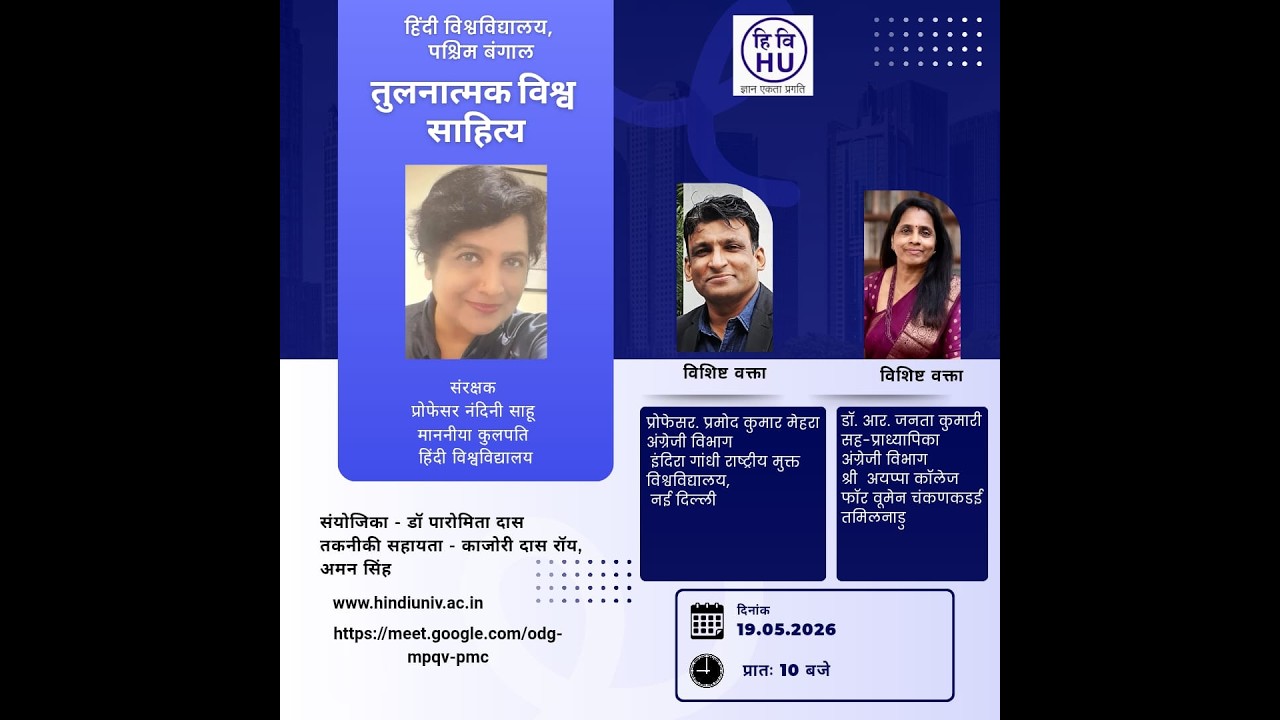
LECTURE-41: HINDI UNIVERSITY COMPARATIVE WORLD LITERATURES SERIES.
Keywords
Summary
206 words
Critical Evaluation
Value of the Information & Strength of the Argument
The lecture provides a broad overview of key concepts in world literature, such as Goethe’s Weltliteratur, Tagore’s Vishwa Sahitya, and contemporary theories like distant reading. The speakers argue for the importance of world literature in fostering global citizenship and ethical imagination, drawing on thinkers like Martha Nussbaum. However, the argumentation is largely descriptive and lacks critical engagement with counterarguments. The speakers do not provide concrete examples or textual analysis to support their claims, and the discussion remains at a general level. The value of the information lies in its accessibility and the synthesis of various perspectives, but it does not offer new insights or rigorous scholarly analysis.
Scientific Rigor, Source Quality, Title Accuracy
The lecture references several key figures and concepts in comparative literature, including Goethe, Tagore, David Damrosch, Franco Moretti, and Martha Nussbaum. However, these references are made in passing without detailed citations or critical evaluation. The title accurately reflects the content, which is a lecture in a series on comparative world literatures. The lecture is not based on original research but rather on the speakers’ expertise and personal reflections. The technical issues and informal delivery detract from the overall rigor. No comments were provided for analysis.
207 words
Title / Content Match
The title accurately reflects the content, which is a lecture in a series on comparative world literatures.
Quality & Reliability
6/10
The lecture is an academic presentation by established scholars, but it is largely a discussion of concepts and personal reflections rather than a rigorous, evidence-based analysis. The arguments are not systematically supported by citations or data, and the delivery is informal with some technical interruptions.
Key Moments
Markers derived by PSI from the transcript: the creator did not define chapters.
- Introduction by Prof. Nandini Sahu, Vice-Chancellor, Hindi University, welcoming speakers and outlining the lecture series.
- Prof. Sahu introduces Prof. Parmod Kumar Mehra and Dr. R. Janatha Kumari, highlighting their contributions.
- Prof. Mehra begins his talk on world literature and global citizenship, referencing Tagore's poem 'Where the Mind is Without Fear'.
- Prof. Mehra discusses Goethe's concept of Weltliteratur and its historical context.
- Prof. Mehra talks about Tagore's vision of Vishwa Sahitya and its relevance today.
- Prof. Mehra introduces contemporary scholars like David Damrosch and Franco Moretti, discussing distant reading.
- Prof. Mehra addresses critiques of world literature, including concerns about Eurocentrism and intellectual imperialism.
- Prof. Mehra connects world literature to ethical imagination and global citizenship, citing Martha Nussbaum.
- Technical interruption as Prof. Mehra's connection drops; the lecture pauses.
- Prof. Mehra resumes briefly, but the lecture is cut short due to connectivity issues.
Cited Sources
- Goethe's concept of Weltliteratur — Referenced in the lecture as a foundational idea for world literature.
- Tagore's Vishwa Sahitya — Discussed as an Indian perspective on world literature.
- David Damrosch's works on world literature — Mentioned as a contemporary scholar in the field.
- Franco Moretti's 'Distant Reading' — Referenced as a methodological approach in comparative literature.
- Martha Nussbaum's 'Cultivating Humanity' — Cited in relation to the ethical value of literature.
Concurring Sources
- David Damrosch, 'What Is World Literature?' — Damrosch's definition of world literature as a mode of circulation and reading aligns with the lecture's emphasis.
Dissenting Sources
- Critiques of world literature as Eurocentric — The lecture acknowledges critiques but does not deeply engage with them, such as the argument that world literature can perpetuate intellectual imperialism.
Contribution & Novelties
The lecture offers a broad, accessible introduction to the field of comparative world literature, emphasizing its relevance to contemporary global challenges. It synthesizes key thinkers and concepts, providing a starting point for further exploration. The discussion on global citizenship and ethical imagination is particularly timely. However, the lecture does not present original research or novel arguments, and its contribution is primarily pedagogical.
Pour aller plus loin :
- Weltliteratur (Wikipedia) — Overview of Goethe’s concept.
- Vishwa Sahitya (Wikipedia) — Tagore’s essay on world literature.
- Distant Reading (Wikipedia) — Franco Moretti’s method.
- Martha Nussbaum’s Cultivating Humanity (Wikipedia) — Her argument for liberal education.
101 words
Radar Profile
The radar profile shows moderate scores across all dimensions, indicating a balanced but not exceptional lecture. The highest score is in 'quantite_information' (6), reflecting the breadth of topics covered, while 'niveau_technique' (5) suggests an intermediate level of technical depth. The overall profile suggests a useful introductory resource for students, but not a groundbreaking scholarly contribution.