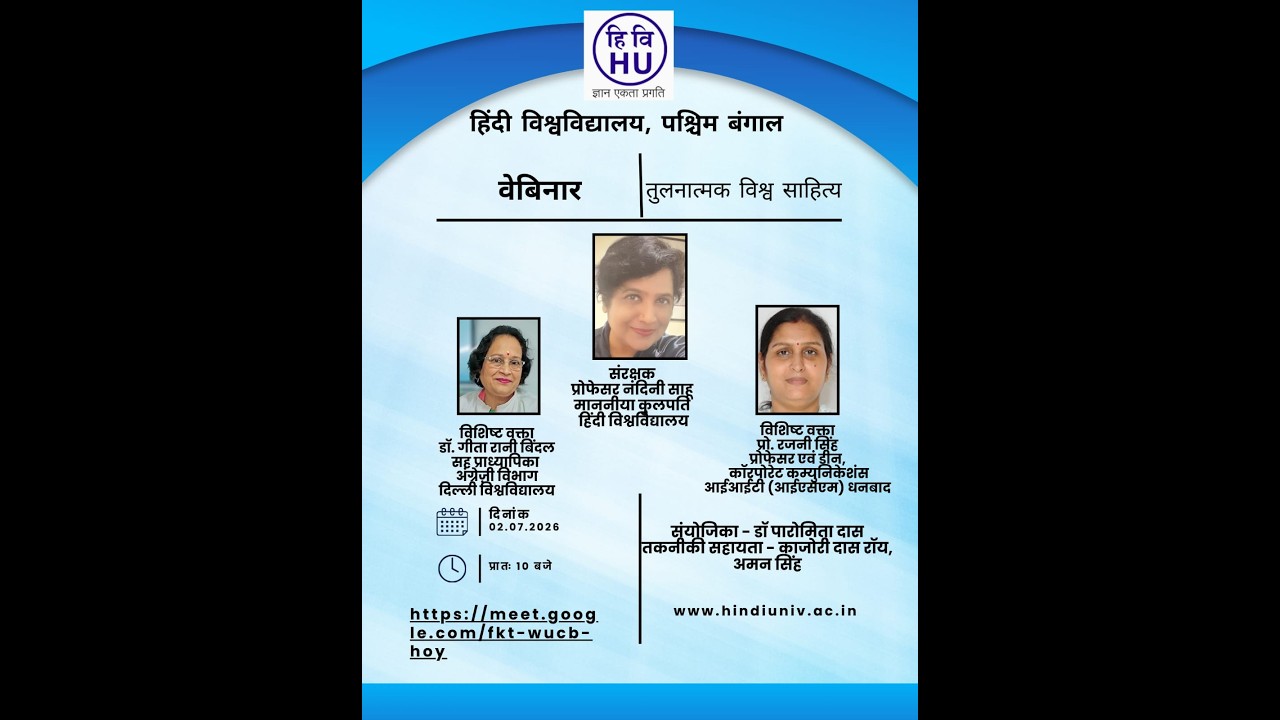
LECTURE: 47- COMPARATIVE WORLD LITERATURES SERIES.
Keywords
Summary
158 words
Critical Evaluation
Value of the Information & Strength of the Argument
The lecture provides valuable insights into Dalit feminist epistemology, moving beyond mere literary analysis to argue for the political and epistemic significance of life writing. The argument is well-structured, systematically building from theoretical frameworks to textual evidence. Professor Singh effectively demonstrates how Pawar’s memoir challenges dominant narratives and constructs an alternative archive. The use of intersectionality and subaltern studies is apt and enriches the analysis. The argumentation is solid, though it relies heavily on established theories without introducing novel perspectives. The lecture’s value lies in its synthesis and application of these theories to a specific text, making it a useful resource for scholars and students.
Scientific Rigor, Source Quality, Title Accuracy
The lecture demonstrates academic rigor through its engagement with canonical theorists (Spivak, Crenshaw, Friedman) and the primary text. However, specific citations are not systematically provided during the talk, and the sources are not listed in the description. The title is broad but accurately reflects the series; the content is more specific, focusing on Dalit feminist life writing. The lecture is part of a university series, lending it institutional credibility, but the lack of formal citations and the informal webinar format slightly diminish its scholarly rigor.
205 words
Title / Content Match
The title is generic but accurately reflects the series format; the content focuses on Dalit feminist life writing, which fits within comparative world literatures.
Quality & Reliability
7/10
The lecture is an academic presentation by established scholars, grounded in recognized theoretical frameworks (Spivak, Crenshaw, Friedman) and primary texts. However, it is a recorded webinar with limited production values, and the claims are not systematically referenced with citations during the talk.
Key Moments
Markers derived by PSI from the transcript: the creator did not define chapters.
- Introduction by Prof. Nandini Sahu, welcoming speakers and outlining the lecture series.
- Prof. Sahu poses questions about Dalit autobiography, selfhood, and counter-archive.
- Prof. Rajni Singh begins her talk, introducing the topic of Dalit feminist life writing.
- Discussion of Spivak's 'Can the Subaltern Speak?' and its relevance to Dalit feminist writing.
- Analysis of the metaphor of weaving (aayan) and its epistemological significance.
- Application of intersectionality (Crenshaw) to understand multiple oppressions faced by Dalit women.
- Examination of everyday resistance: education, conversion to Buddhism, and collective organizing.
- Quotes from Pawar's memoir illustrating caste-based humiliation and ghettoization.
- Conclusion: Dalit feminist life writing as counter-archive and political testimony.
Cited Sources
- The Weave of My Life — Primary text discussed in the lecture.
- Can the Subaltern Speak? — Referenced in the context of subaltern studies and representation.
- Demarginalizing the Intersection of Race and Sex — Referenced for the concept of intersectionality.
Concurring Sources
- The Weave of My Life — Primary text; the lecture's analysis aligns with scholarly interpretations.
Contribution & Novelties
The lecture offers a focused analysis of Urmila Pawar’s memoir as a counter-archive, synthesizing subaltern studies, intersectionality, and feminist epistemology. It contributes to the discourse on Dalit feminist writing by emphasizing the political and epistemic dimensions of life writing. The lecture’s originality lies in its application of these frameworks to a specific text, highlighting the metaphor of weaving as a form of knowledge production.
Pour aller plus loin :
- Dalit feminism — Overview of Dalit feminist movements and theories.
- Intersectionality — Foundational concept by Kimberlé Crenshaw.
- Subaltern (postcolonialism) — Context for Spivak’s work.
93 words
Radar Profile
The radar profile shows high scores in quality of information and reliability, with moderate scores in quantity and technical level. This indicates a well-argued, academically sound lecture that may be more accessible to a specialized audience.