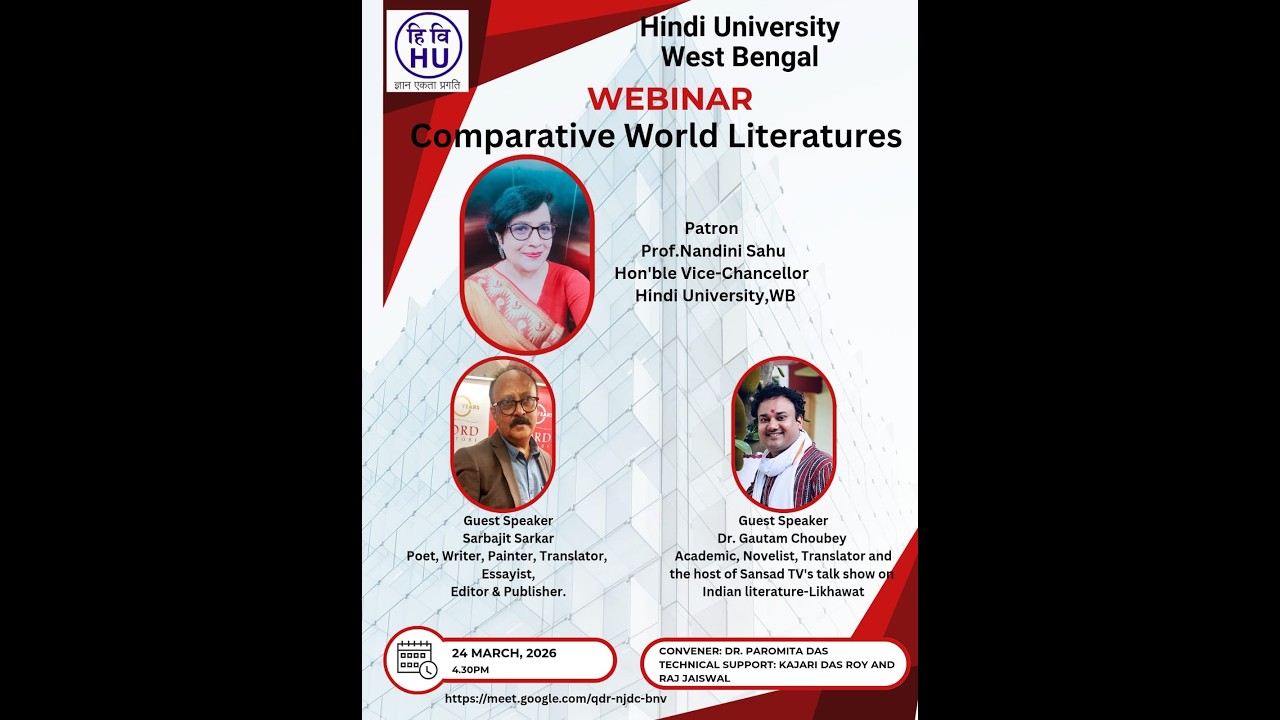
LECTURE 35 : Comparative World Literatures
Keywords
Summary
171 words
Critical Evaluation
Value of the Information & Strength of the Argument
The value of the information lies in the personal and reflective perspectives of the speakers, which complement more formal academic treatments. Sarkar’s argumentation is based on anecdotal evidence and philosophical reflections rather than systematic analysis, but it effectively conveys the importance of comparative literature in fostering empathy and cultural understanding. He uses concrete examples, such as his childhood reading of ‘Kir Putul’ and ‘Oliver Twist’, to illustrate how literature from different cultures can resonate with universal human emotions. His discussion of Glissant’s work on creolization provides a theoretical underpinning, though it is not deeply explored. Choubey’s lecture, though not fully transcribed, is praised for its comparative framework and ethical focus, suggesting a more rigorous academic approach. Overall, the argumentation is persuasive but lacks empirical depth.
Scientific Rigor, Source Quality, Title Accuracy
The lecture demonstrates a reasonable level of scientific rigor, with speakers drawing on their expertise and mentioning relevant scholars like Edouard Glissant. However, specific sources are not systematically cited, and the discussion is more conversational than academic. The title accurately reflects the content, and the webinar’s structure is clear. The vice chancellor’s introduction provides context and validates the speakers’ credentials. No comments are provided for analysis.
206 words
Title / Content Match
The title accurately reflects the content, which is a lecture on comparative world literature.
Quality & Reliability
6/10
The lecture is a webinar recording with two speakers discussing comparative literature from personal and academic perspectives. It lacks rigorous citations and empirical evidence, but the speakers are established academics and writers, and the content is coherent and insightful.
Key Moments
Markers derived by PSI from the transcript: the creator did not define chapters.
- Introduction by host, welcoming attendees and introducing the webinar on comparative world literature.
- Vice Chancellor Prof. Nandini Sahu's video message, praising the speakers and highlighting key points from their lectures.
- Introduction of first speaker Sarbajit Sarkar, detailing his background as a poet, writer, and publisher.
- Sarkar begins his lecture, sharing childhood reading experiences and the impact of 'Kir Putul' and 'Oliver Twist'.
- Sarkar discusses the role of literature in fostering empathy and resistance, and introduces the concept of comparative world literature.
- Sarkar explains the fibril metaphor and references Edouard Glissant's work on creolization and cultural exchange.
- Sarkar talks about South Asian literature, its linguistic diversity, and the importance of reading beyond national and linguistic frames.
- Sarkar concludes his lecture, emphasizing the unifying power of literature and the need for intercultural dialogue.
- Host thanks Sarkar and introduces the second speaker, Dr. Gautam Choubey.
- Choubey's lecture begins (not fully transcribed), focusing on comparative frameworks and ethical realism.
Cited Sources
- Edouard Glissant's works on creolization and relation — Mentioned by Sarkar as a theoretical influence on understanding cultural exchange and creolization.
- Kir Putul by Abanindranath Tagore — Referenced by Sarkar as a Bengali children's book that influenced his literary sensibilities.
- Oliver Twist by Charles Dickens — Referenced by Sarkar as an English novel that resonated with him alongside the Bengali book.
Concurring Sources
- World Literature: A Reader — General academic texts on world literature often align with the lecture's emphasis on transcending national boundaries.
- The Princeton Sourcebook in Comparative Literature — Standard reference for comparative literature methodologies.
Dissenting Sources
- Eurocentric critiques of comparative literature — Some scholars argue that comparative literature has historically been Eurocentric, which the lecture acknowledges and challenges.
Contribution & Novelties
The lecture offers a personal and creative perspective on comparative literature, emphasizing the role of imagination and empathy in connecting diverse literary traditions. Sarkar’s use of the fibril metaphor and his engagement with Glissant’s ideas provide a fresh angle, though not entirely novel. The discussion of South Asian literature as a site of productive tension between diversity and unity is valuable. The lecture contributes to ongoing debates about decolonizing comparative literature and centering marginalized voices.
Pour aller plus loin :
- World literature — Overview of the concept and its evolution.
- Comparative literature — Academic discipline overview.
- Édouard Glissant — Key thinker on creolization and relation.
- Creolization — Cultural process discussed in the lecture.
- South Asian literature — Context for the discussion on regional literature.
124 words
Radar Profile
The radar profile shows moderate scores across all dimensions, indicating a balanced but not exceptional lecture. The highest score is in information quality, reflecting the speakers' expertise, while technical level is lower due to the non-specialist audience. The overall profile suggests a lecture that is informative and accessible but not groundbreaking.