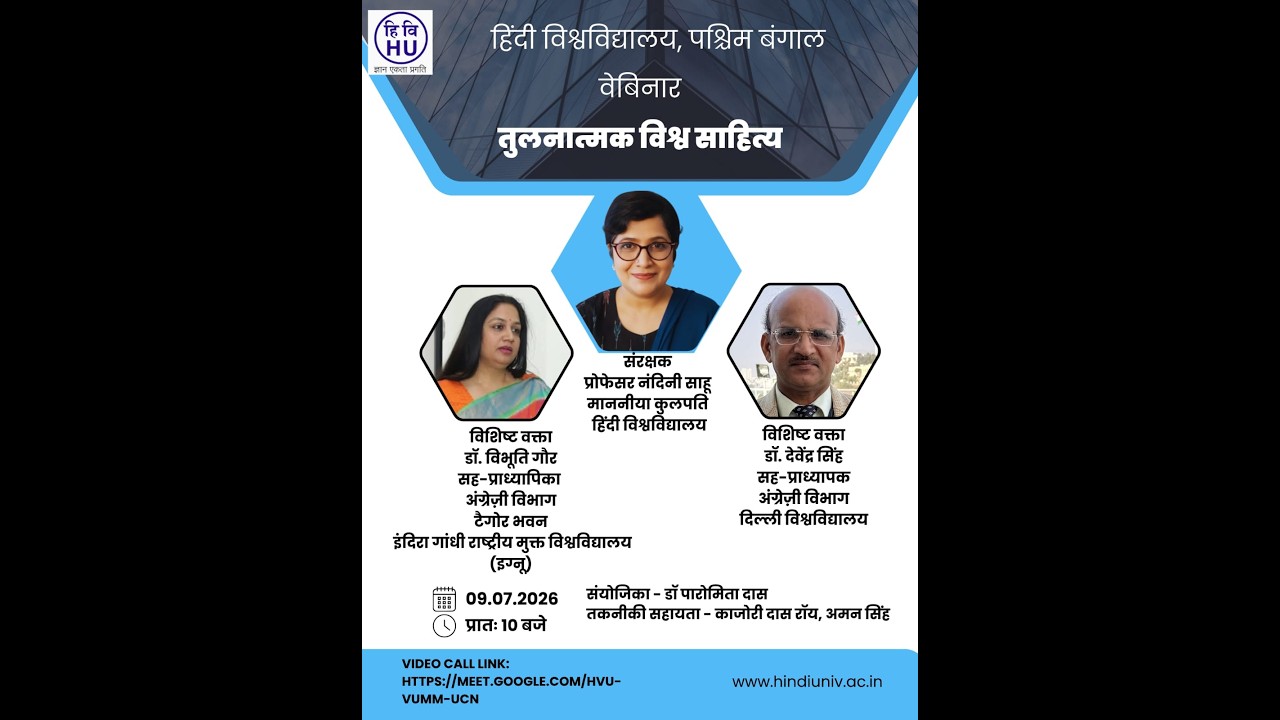
LECTURE:49- COMPARATIVE WORLD LITERATURES SERIES.
Keywords
Summary
131 words
Critical Evaluation
Value of the Information & Strength of the Argument
The lecture provides a broad overview of Indian aesthetics, highlighting key concepts such as rasa, dhvani, and sphota, and attempts to position them within a global context. The argumentation is largely assertive and relies on traditional interpretations rather than critical analysis. The speaker makes sweeping claims about the superiority and influence of Indian aesthetics, often without providing concrete evidence or citations. For instance, he asserts that Indian grammar influenced Western structuralism and that Chomsky’s ideas were anticipated by ancient Indian thinkers, but these connections are not rigorously substantiated. The value lies in the synthesis of classical Indian aesthetic theories and their potential relevance to contemporary literary studies, but the lack of critical engagement and the presence of unverified historical assertions weaken the overall argument.
Scientific Rigor, Source Quality, Title Accuracy
The lecture does not cite specific sources or provide references. It mentions classical texts like the Natyashastra and works by Anandavardhana and Bhartrihari, but without precise citations. The speaker also references Western theorists like Chomsky and Derrida, but again without specific works. The title ‘Comparative World Literatures Series’ is broad, and the content focuses specifically on Indian aesthetics, which may not fully align with the expected comparative scope. The lecture is more of an exposition of Indian aesthetic theories than a rigorous comparative analysis. The lack of citations and the presence of unverified historical claims reduce the scientific rigor. The title is somewhat misleading as it suggests a broader comparative approach, but the lecture is primarily centered on Indian aesthetics.
259 words
Title / Content Match
The title is generic and does not specify the content, which focuses on Indian aesthetics and its place in world literature. It is somewhat misleading as it suggests a broader comparative scope.
Quality & Reliability
6/10
The lecture is an academic presentation by scholars in Indian aesthetics, but it contains unverified historical claims and lacks rigorous sourcing. The content is largely opinion and interpretation, with some references to classical texts and theorists, but no systematic citation of academic sources.
Key Moments
Markers derived by PSI from the transcript: the creator did not define chapters.
- Introduction by the convener, welcoming speakers and setting the context for the lecture series.
- Dr. Devendra Singh begins his lecture on Indian aesthetics, emphasizing its scientific and philosophical foundations.
- Discussion on the concept of shunya (zero) and its connection to structure and meaning in Indian aesthetics.
- Explanation of Bhartrihari's sphota theory and its relation to sound and meaning, with comparisons to Chomsky.
- Introduction of Anandavardhana's dhvani theory and the three types of meaning: abhidha, lakshana, and vyanjana.
- Detailed discussion of the rasa theory, its nine sentiments, and the order from shringara to shanta.
- Comparison of Indian aesthetics with Western theories, including structuralism and deconstruction.
- Concluding remarks on the relevance of Indian aesthetics to contemporary research and the need to revitalize Indian knowledge systems.
Cited Sources
- Natyashastra — Referenced as the foundational text for rasa theory.
- Dhvanyaloka — Mentioned as the work by Anandavardhana on dhvani theory.
- Vakyapadiya — Referenced as Bhartrihari's work on sphota and grammar.
Concurring Sources
- Natyashastra — Classical text on dramaturgy and aesthetics, foundational to rasa theory.
- Dhvanyaloka — Anandavardhana's work on dhvani, a key text in Indian aesthetics.
Dissenting Sources
- Western structuralism — The claim that Indian grammar anticipated structuralism is not widely accepted in academic discourse.
Contribution & Novelties
The lecture offers a synthesis of classical Indian aesthetic theories and attempts to position them within a global comparative framework. It emphasizes the scientific and philosophical underpinnings of Indian aesthetics, which is often overlooked in mainstream literary studies. The speaker’s emphasis on the historical transmission of Indian ideas to the West, while controversial, opens avenues for further research.
Pour aller plus loin :
- Rasa theory — Overview of the concept of rasa in Indian aesthetics.
- Dhvani theory — Explanation of Anandavardhana’s theory of suggestion.
- Sphota — Concept of the eternal sound unit in Indian linguistics.
- Comparative literature — Academic field that studies literature across cultures.
105 words
Radar Profile
The radar profile shows moderate scores across all dimensions, with a slight emphasis on quantity of information and technical level. This suggests a lecture that provides substantial content but lacks rigorous sourcing and critical analysis.