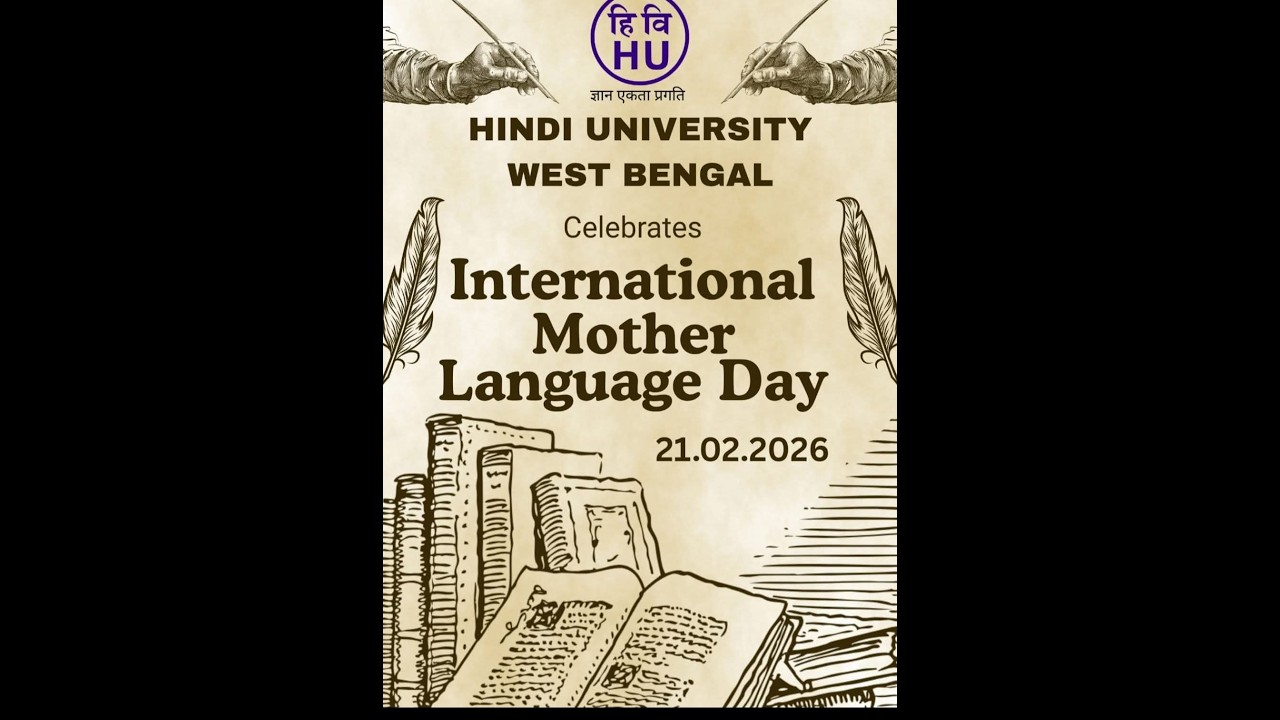
Lecture on International Mother Language Day.
Keywords
Summary
155 words
Critical Evaluation
Value of the Information & Strength of the Argument
The video provides valuable insights into the institutional perspective on mother language education in India, highlighting the role of NEP 2020 and UNESCO. The argumentation is based on cultural and educational principles, emphasizing the cognitive and emotional benefits of mother tongue instruction. However, it lacks empirical evidence and relies on anecdotal references and personal opinions. The speakers argue for additive multilingualism and the rejection of a false binary between local and global languages, which is a sound pedagogical stance. The inclusion of student performances and personal anecdotes adds authenticity but does not strengthen the scientific rigor.
Scientific Rigor, Source Quality, Title Accuracy
The video does not cite specific academic sources, but references UNESCO and NEP 2020, which are credible institutional sources. The title accurately reflects the content, which is a lecture and celebration. The description provides minimal information, only naming the patron. The video is a recording of an institutional event, so the scientific rigor is limited. No comments were provided for analysis.
172 words
Title / Content Match
The title accurately reflects the content, which is a lecture and celebration of International Mother Language Day.
Quality & Reliability
6/10
The video is an institutional lecture and cultural program, not a scientific study. It presents personal opinions and institutional commitments, with references to UNESCO and NEP 2020, but lacks verifiable data or citations.
Key Moments
Markers derived by PSI from the transcript: the creator did not define chapters.
- Introduction and welcome by Vice-Chancellor Prof. Nandini Sahu.
- Recitation of a poem by Gangadhar Meher in Odia.
- Discussion on NEP 2020 and mother tongue as medium of instruction.
- Student performances: poetry and songs in various languages.
- Speech on the history of International Mother Language Day.
- Discussion on language preservation and endangered languages.
- Invitation to contribute to the university journal.
- Vote of thanks and concluding remarks.
Cited Sources
- UNESCO International Mother Language Day — Referenced as the origin of the day and promoter of linguistic diversity.
- National Education Policy 2020 — Referenced for its recommendation on mother tongue as medium of instruction.
Concurring Sources
- UNESCO International Mother Language Day — Supports the importance of mother languages and linguistic diversity.
Contribution & Novelties
The video offers an institutional perspective on mother language education in India, emphasizing the implementation challenges of NEP 2020. It showcases a multilingual celebration, highlighting the diversity of Indian languages. The call for research on endangered languages and the promotion of translation studies are notable contributions.
Pour aller plus loin :
- UNESCO Atlas of the World’s Languages in Danger — Useful for understanding language endangerment.
- Mother Tongue-Based Multilingual Education — Provides background on the pedagogical approach.
- Linguistic Human Rights — Relevant to the discussion on language rights and preservation.
89 words
Radar Profile
The radar profile shows moderate scores across all dimensions, with the highest in quality of information and the lowest in technical level. This reflects the video's focus on cultural and educational aspects rather than technical or scientific depth.