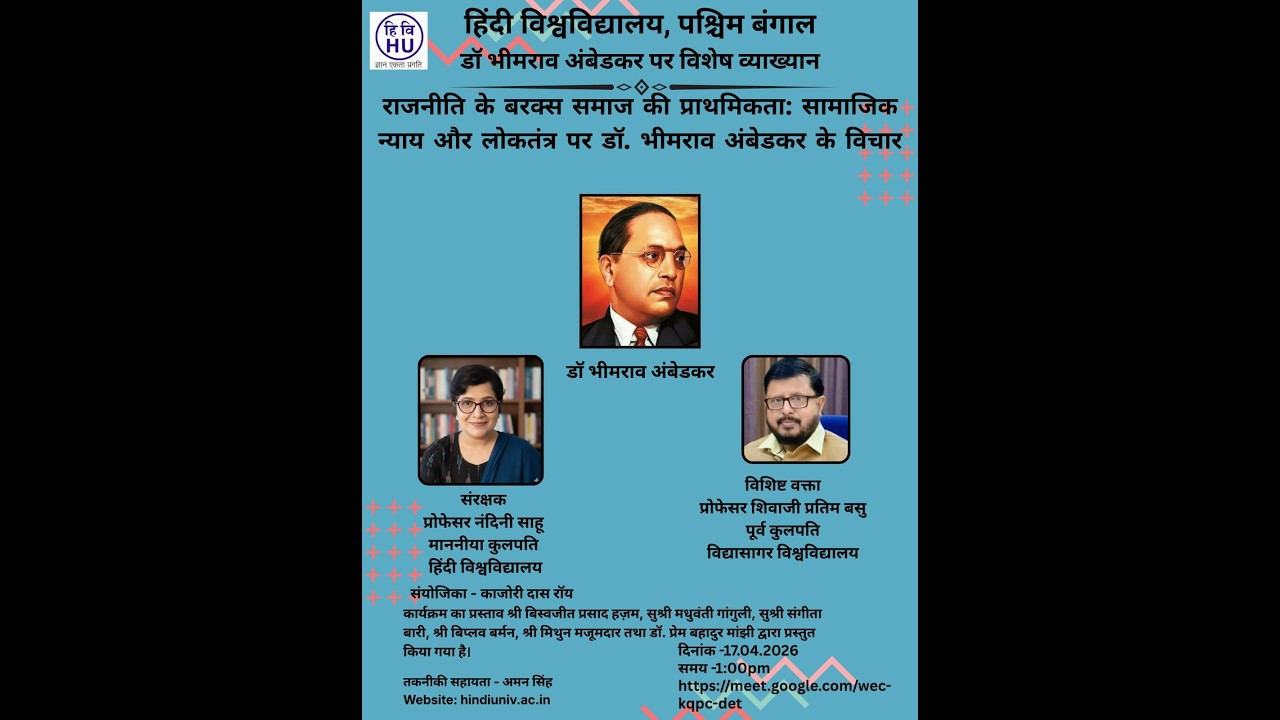
LECTURE ON DR. B.R.AMBEDKAR
Keywords
Summary
138 words
Critical Evaluation
Value of the Information & Strength of the Argument
The lecture provides a valuable overview of Ambedkar’s core ideas, particularly his emphasis on social democracy as a prerequisite for political democracy. The speaker’s argument is coherent and well-structured, drawing on historical events and Ambedkar’s writings. However, the argumentation is largely descriptive rather than analytical, and the speaker does not engage deeply with counterarguments or contemporary debates. The value lies in its synthesis of Ambedkar’s life and thought, making it accessible to a general audience, but it lacks the depth of a scholarly analysis.
Scientific Rigor, Source Quality, Title Accuracy
The lecture demonstrates a good level of scientific rigor in terms of factual accuracy, but it does not cite specific sources or provide references. The speaker’s authority as a political scientist adds credibility, but the lack of citations limits the verifiability of the information. The title is broad and could be more specific, but it accurately reflects the content. No comments were provided, so no analysis of public reception is possible.
170 words
Title / Content Match
The title is generic and broad, but the lecture content focuses on Ambedkar's social and political thought, which aligns with the title.
Quality & Reliability
7/10
The lecture is delivered by a former vice-chancellor and distinguished professor of political science, with a long academic career. It provides a structured overview of Ambedkar's life and ideas, but relies on general historical knowledge without citing specific sources or providing detailed evidence. The speaker's expertise lends credibility, but the lack of citations and the informal delivery limit the scientific rigor.
Key Moments
Markers derived by PSI from the transcript: the creator did not define chapters.
- Introduction and welcome address by the convenor and Vice-Chancellor.
- Speaker begins lecture, outlining Ambedkar's prioritization of social transformation over political power.
- Discussion of Ambedkar's early life, including his education and experiences of discrimination.
- Ambedkar's time at Columbia University and the London School of Economics, and his influences.
- Ambedkar's activism against untouchability, including the burning of Manusmriti and the Poona Pact.
- Ambedkar's role in drafting the Indian Constitution and his advocacy for reservations.
- Conclusion summarizing Ambedkar's vision of a society based on human dignity and merit.
Contribution & Novelties
The lecture provides a comprehensive overview of Ambedkar’s life and ideas, emphasizing his concept of social democracy. It is valuable for those seeking an introduction to Ambedkar’s thought, but it does not present new research or original insights. The speaker’s perspective as a political scientist adds a nuanced understanding of Ambedkar’s relevance to contemporary democracy.
Pour aller plus loin :
- B. R. Ambedkar - Wikipedia — Provides a detailed biography and context.
- Annihilation of Caste - Wikipedia — Ambedkar’s seminal work critiquing the caste system.
- Poona Pact - Wikipedia — Historical agreement between Ambedkar and Gandhi.
- Social democracy - Wikipedia — Concept central to Ambedkar’s vision.
106 words
Radar Profile
The radar profile shows balanced scores across all dimensions, with slightly higher scores in information quantity and quality, reflecting the lecture's comprehensive yet accessible nature. The technical level is moderate, indicating that the content is suitable for a general audience but lacks advanced analytical depth.