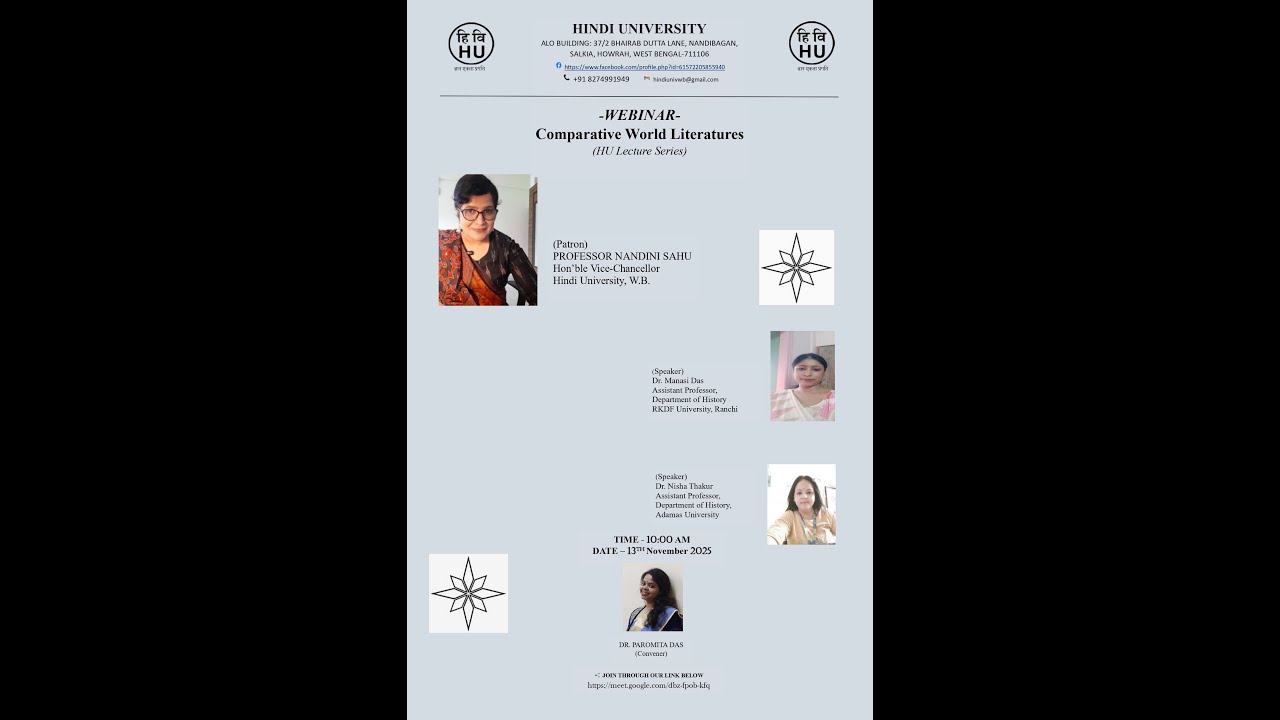
LECTURE 32: Hindi University, West Bengal Special Lecture Series
Keywords
Summary
146 words
Critical Evaluation
Value of the Information & Strength of the Argument
The lecture provides valuable insights into a lesser-known figure and region, arguing for the inclusion of philosophical texts in comparative literature. The argumentation is coherent and well-supported with specific examples from Udayana’s works and historical context. The speaker effectively demonstrates how Udayana’s debates with Buddhism were not just confrontations but productive exchanges that shaped both traditions. The comparative framework with European and Islamic scholasticism is illuminating, though it could be more systematically developed. The lecture’s value lies in its interdisciplinary approach and its challenge to Eurocentric narratives of rationality.
Scientific Rigor, Source Quality, Title Accuracy
The lecture demonstrates scholarly rigor in its use of historical and philosophical sources, though it does not provide explicit citations or a bibliography. The speaker references primary texts and historical figures accurately, and the argument is grounded in established scholarship. The title is too generic and does not convey the specific focus on Udayana and Mithila, which may mislead potential viewers. The content is well-structured and the speaker’s expertise is evident, but the lack of formal citations reduces its utility for academic verification.
187 words
Title / Content Match
The title is generic and does not reflect the specific content, which focuses on Udayana's philosophical debates with Buddhism in Mithila.
Quality & Reliability
7/10
The lecture is scholarly, well-structured, and grounded in historical and philosophical sources, but lacks explicit citations and peer-reviewed references, and the presentation is informal.
Key Moments
Markers derived by PSI from the transcript: the creator did not define chapters.
- Introduction and welcome by the host, introduction of speakers.
- Video message from Prof. Nandini Sahu, emphasizing the role of history in comparative literature.
- Dr. Nisha Thakur begins her lecture on Udayana's debate with Buddhism.
- Discussion of Mithila as a center of learning and its intellectual continuity.
- Analysis of Udayana's arguments on the self and consciousness.
- Examination of Udayana's theology and causation, and parallels with Aquinas.
- Discussion of the shared epistemological vocabulary between Buddhist and Brahminical thinkers.
- Conclusion: Udayana's relevance to comparative world literature and the global history of ideas.
Cited Sources
- Udayana's works (e.g., Nyayakusumanjali, Atmatattvaviveka) — Mentioned as primary sources for the lecture.
- Hindi University Journal of Interdisciplinary Studies (HUJIS) — Mentioned in the introductory video message as a forthcoming journal.
Concurring Sources
- Udayana (Stanford Encyclopedia of Philosophy) — Provides scholarly overview of Udayana's philosophy.
- Mithila (Britannica) — Historical and geographical context of the region.
Dissenting Sources
- Some scholars argue that Udayana's debates were primarily sectarian and not as dialogic as presented. — Alternative interpretations exist in academic discourse, but no specific source is cited in the lecture.
Contribution & Novelties
The lecture offers a fresh perspective on Udayana’s philosophical debates as literary texts, arguing for their inclusion in comparative world literature. It highlights the intellectual culture of Mithila, which is often overlooked in mainstream historical narratives. The comparative approach with European and Islamic scholasticism provides a new framework for understanding these texts.
Pour aller plus loin :
- Udayana — Overview of the philosopher and his works.
- Nyaya — The school of logic to which Udayana belonged.
- Mithila (region) — Historical and cultural context of the region.
- Navya-Nyaya — The later development of Nyaya logic in Mithila.
96 words
Radar Profile
The radar profile shows high scores in information quantity and quality, reflecting the lecture's depth and scholarly content. The technical level is moderate, indicating accessibility to a general academic audience. Overall reliability is good, though the lack of formal citations slightly reduces the score.
💬 No comments were provided for analysis.