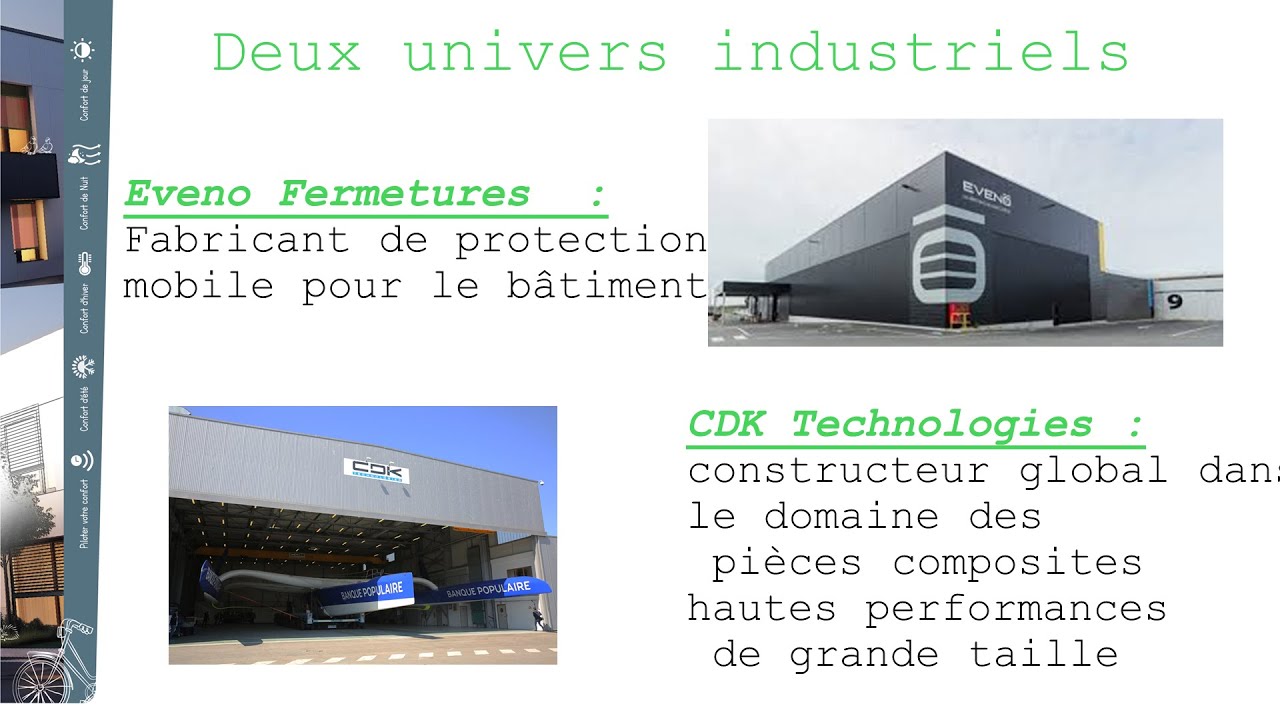
Préimprégnés périmés pour le bâtiment : Eveno Fermetures
Keywords
Summary
166 words
Critical Evaluation
Value of the Information & Strength of the Argument
The presentation provides valuable insights into an innovative recycling approach for carbon fiber prepregs in the construction sector. The argumentation is based on empirical testing, with clear descriptions of trial-and-error processes and quantitative results (e.g., load-deflection curves). The speaker acknowledges limitations and challenges, such as shrinkage and delamination, and proposes iterative solutions. The value lies in demonstrating a practical pathway for industrial symbiosis and circular economy, though the results are preliminary and not yet certified.
Scientific Rigor, Source Quality, Title Accuracy
The presentation is rigorous in its methodology, showing systematic testing and data collection. However, no external sources are cited, and the results are not peer-reviewed. The title accurately reflects the content. The speaker is an industry expert, lending credibility, but the lack of formal references limits the scientific robustness.
139 words
Title / Content Match
The title accurately reflects the content, which focuses on using expired prepregs in building applications.
Quality & Reliability
7/10
The presentation is based on an industrial R&D project with concrete experimental data and a clear methodology, but it lacks formal citations and peer review. The speaker is an industry expert, and the results are presented as preliminary.
Key Moments
Markers derived by PSI from the transcript: the creator did not define chapters.
- Introduction and presentation of the two companies: Eveno Fermetures and CDK Technologies.
- Context: environmental regulations and goals for reducing impact.
- Project objective: reuse prepreg scraps in building products.
- Initial trials: draping small pieces and curing with heat gun.
- Switching to plates and using ovens for curing.
- Testing different layers and orientations; issues with shrinkage.
- Development of exoskeleton structure and injection process.
- Results: improved stiffness and reduced deformation.
- Future steps: industrial process, CSTB certification, and deployment.
- Q&A: sourcing of scraps and scalability.
Contribution & Novelties
The presentation offers a novel approach to recycling expired carbon fiber prepregs in the construction industry, demonstrating a successful collaboration between a composite manufacturer and a building products company. The innovation lies in the development of an exoskeleton structure that reinforces polyurethane foam, potentially reducing material usage and environmental impact. This case study provides practical insights into industrial symbiosis and circular economy principles.
Pour aller plus loin :
- Circular economy in composite materials — Overview of circular economy principles.
- Carbon fiber reinforced polymer — Background on carbon fiber composites.
- Polyurethane foam — Properties and applications of polyurethane foam.
98 words
Radar Profile
The radar profile shows balanced scores across all dimensions, with slightly higher scores in information quantity and quality, reflecting a well-structured presentation with practical data. The technical level is moderate, suitable for a general engineering audience.