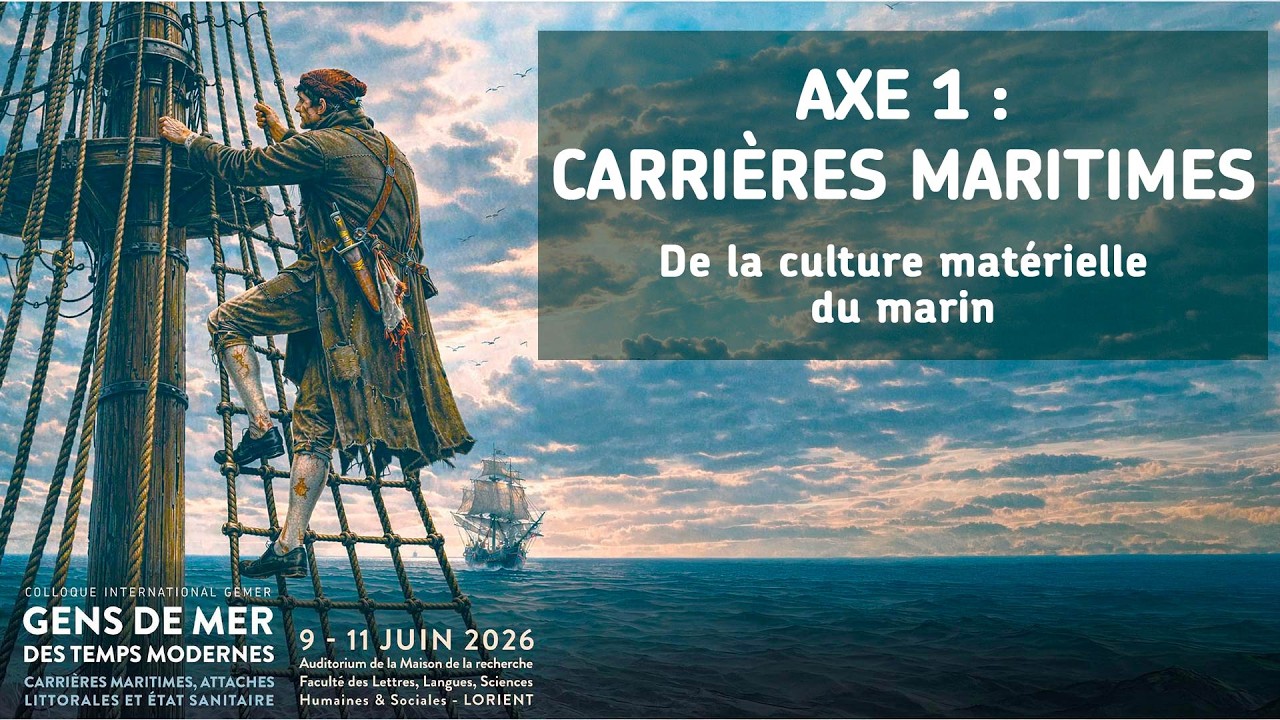
GEMER : De la culture matérielle du marin
Keywords
Summary
126 words
Critical Evaluation
Value of the Information & Strength of the Argument
The presentation offers valuable insights into the material culture of sailors, using a combination of archival and archaeological sources. Bidon’s quantitative analysis of inventories provides a solid foundation for understanding clothing and textile consumption, while Leguen’s qualitative approach adds depth by contextualizing objects within the social and economic realities of sailors’ lives. The argumentation is well-structured, with clear methodological explanations and critical reflections on source limitations. The authors effectively demonstrate how material culture can reveal social hierarchies, global trade influences, and the daily struggles of maritime workers.
Scientific Rigor, Source Quality, Title Accuracy
The sources are diverse and well-suited to the research questions: probate inventories, judicial archives, and underwater archaeological finds. The authors show critical awareness of the biases and limitations of each source type, such as the selective nature of inventories and the legal context of judicial records. The title accurately reflects the content, and the presentation maintains a high level of scholarly rigor. The lack of explicit citations in the video is compensated by the detailed description of archival collections and archaeological sites.
184 words
Title / Content Match
The title accurately reflects the content, which focuses on the material culture of sailors in 18th-century France.
Quality & Reliability
7/10
The presentation is based on archival research and archaeological evidence, with a clear methodology and critical source analysis. However, it is a conference talk without peer review, and some statistical claims are based on limited samples.
Key Moments
Markers derived by PSI from the transcript: the creator did not define chapters.
- Introduction and overview of the presentation.
- Caroline Bidon introduces her study of 707 probate inventories from La Rochelle (1739-1759).
- Discussion of the royal regulation of 1739 and the context of the slave trade.
- Methodology for classifying objects into 13 themes and initial findings on clothing.
- Analysis of textiles, especially the explosion of cotton fabrics like siamoises and basins.
- Observations on color trends, particularly the prevalence of blue due to indigo trade.
- Denis Leguen introduces his thesis on material culture in Brittany using judicial archives and underwater archaeology.
- Discussion of the Dauphine shipwreck and the importance of archaeological finds.
- Analysis of sailors' indebtedness and the role of innkeepers in outfitting them.
- Conclusion: material culture as a reflection of social hierarchies and global exchanges.
Cited Sources
- Archives départementales de la Charente-Maritime — Probate inventories and judicial records consulted by Caroline Bidon.
- Fonds d'amirauté de Saint-Malo et de Nantes — Judicial archives used by Denis Leguen.
- Épave de la Dauphine — Underwater archaeological site studied by Denis Leguen.
Concurring Sources
- The Material Culture of Sailors in the Age of Sail — General scholarly literature on sailors' material culture.
Dissenting Sources
- None — No discordant sources were mentioned in the video.
Contribution & Novelties
The presentation contributes original insights by combining archival and archaeological evidence to reconstruct the material culture of sailors, highlighting the social dynamics and economic constraints. It challenges simplistic narratives of sailors’ poverty by showing the complexity of their possessions and the influence of global trade.
Pour aller plus loin :
- Material culture studies — Overview of the interdisciplinary field.
- Probate inventory — Historical source type used in the research.
- Underwater archaeology — Methods and significance in maritime history.
78 words
Radar Profile
The radar profile shows high scores in information quantity and quality, with moderate technical level and reliability. This indicates a well-researched presentation with strong empirical grounding, though not highly technical in methodology.
💬 No comments were provided for analysis.