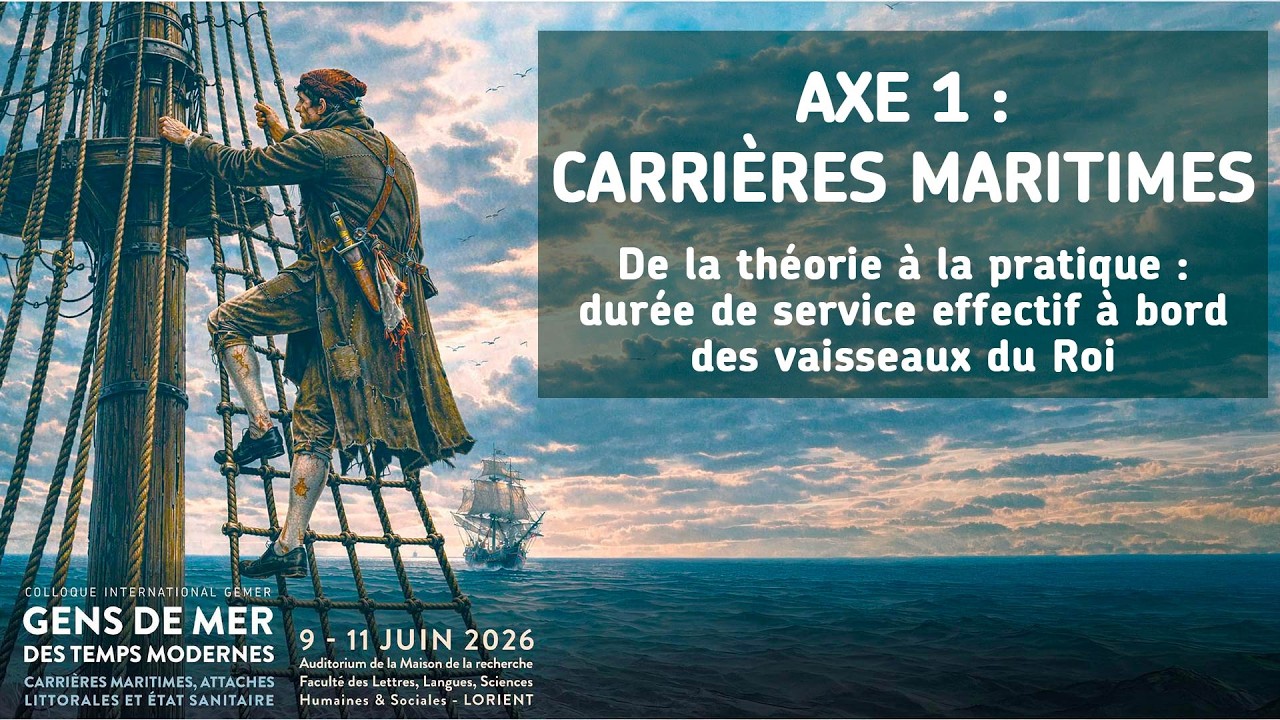
Durée de service effectif à bord des vaisseaux du Roi
Keywords
Summary
192 words
Critical Evaluation
Value of the Information & Strength of the Argument
The value of the information lies in its use of primary sources (naval roles, muster rolls, and pension records) to provide quantitative evidence on a topic often treated qualitatively. The argumentation is solid in that it systematically compares theoretical quotas with actual service data, revealing a significant discrepancy. However, the sample is limited to specific communities (Cancale, Marennes, Martigues) and periods, and the speakers acknowledge the impossibility of full statistical rigor due to high mortality. The reasoning is clear and well-structured, but some claims are based on small numbers and may not be generalizable.
Scientific Rigor, Source Quality, Title Accuracy
The presentation demonstrates rigorous use of archival sources, including roles from the Archives Nationales and the Service Historique de la Défense. The speakers cross-reference multiple types of records to reconstruct careers and mortality. The title accurately reflects the content. The sources are not explicitly cited in the video, but the description mentions the speakers and the context. The analysis is careful, though the informal tone and occasional digressions reduce the perceived rigor. The title is appropriate and does not overpromise.
189 words
Title / Content Match
The title accurately reflects the content, which focuses on the actual duration of service on royal vessels compared to theoretical expectations.
Quality & Reliability
7/10
The presentation is based on original archival research and statistical analysis of a specific corpus (481 men from Cancale), but it is a conference talk with informal tone and some methodological limitations (small sample, survivorship bias). The speakers are historians, but the claims are not peer-reviewed.
Key Moments
Markers derived by PSI from the transcript: the creator did not define chapters.
- Introduction: the theoretical expectation of one year in four service in Brittany.
- Presentation of the corpus of 481 men from Cancale and the finding that 80% served less than the theoretical quota.
- Mortality statistics: half of the men died during the War of Spanish Succession, with 60% dying at sea.
- Analysis of long careers: even among survivors, average service on royal vessels was only 19%.
- Transition to the second part: study of the period 1764-1775 using naval roles from Brest, Rochefort, and Toulon.
- Service duration by port: 4 months at Brest, 6 at Toulon, 9 at Rochefort.
- During the American War, average service was 18 months, below the theoretical 33%, with half serving only once.
Cited Sources
- Sébastien Martin, Rochefort, arsenal des colonies (2015) — Referenced in the presentation to explain the role of Rochefort in supporting colonies.
Concurring Sources
- Sébastien Martin, Rochefort, arsenal des colonies (2015) — Supports the claim about Rochefort's role in colonial supply.
Contribution & Novelties
This presentation provides new quantitative evidence on the actual service duration of French sailors in the 18th century, challenging the theoretical quotas. It highlights the crucial role of mortality and other factors in reducing effective service. The comparison between different ports and periods adds nuance to our understanding of naval mobilization.
Pour aller plus loin :
- French Navy in the 18th century — Overview of the French Navy’s history.
- Inscription maritime — The system of maritime conscription in France.
- War of the Spanish Succession — Context for the mortality statistics.
90 words
Radar Profile
The radar profile shows high scores in information quantity and quality, but lower in technical level and reliability, reflecting the informal presentation style and the limitations of the sample.
💬 Sur les 0 commentaires analysés, aucune tendance n'a pu être dégagée.