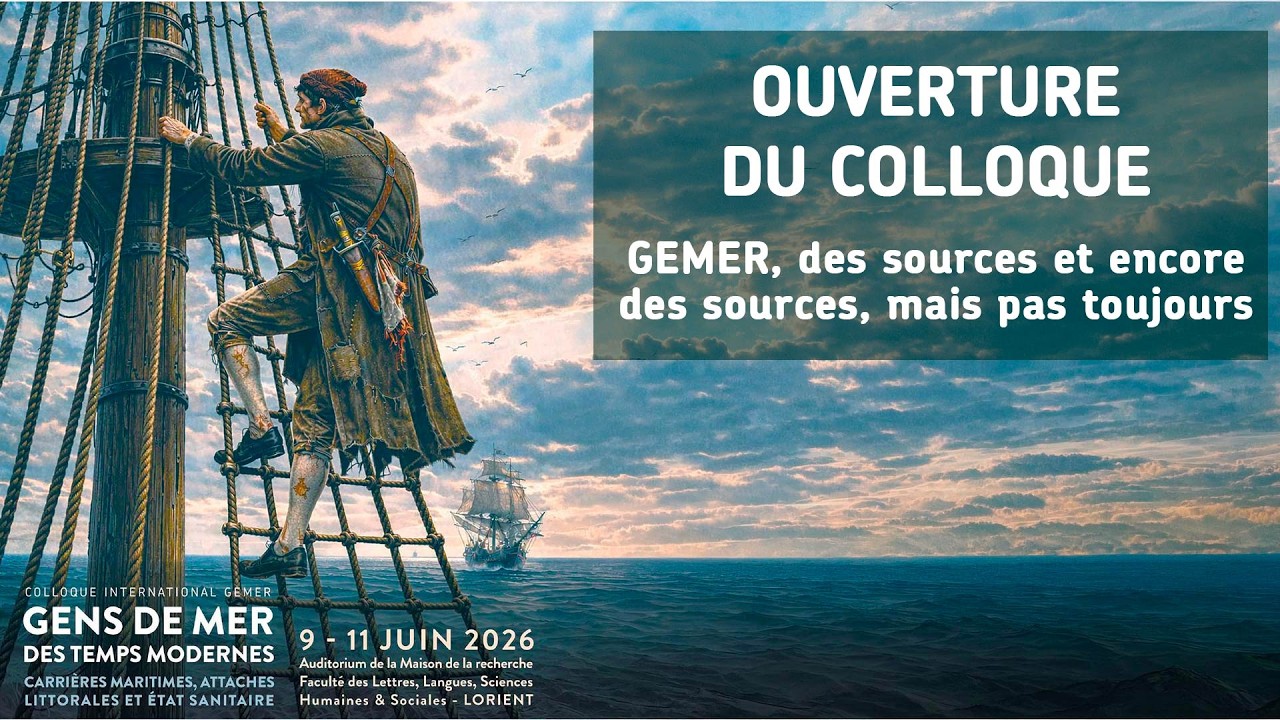
Colloque Gens de Mer des Temps Modernes
Keywords
Summary
167 words
Critical Evaluation
Value of the Information & Strength of the Argument
The value of the information lies in the detailed description of the sources and methodology used in the GEMER project. Hrodej explains the nature of matriculation registers and crew lists, their strengths and limitations, and how they are used to reconstruct the lives of sailors. The argumentation is based on his experience as a historian and the collective work of the project team. He provides concrete examples, such as the size of the registers and the challenges of accessing archives. However, the presentation is not a formal academic argument; it is an introductory talk that sets the stage for the colloquium. The reasoning is sound but not deeply analytical, as it focuses on practical aspects rather than theoretical frameworks.
Scientific Rigor, Source Quality, Title Accuracy
The scientific rigor is evident in the careful description of archival sources and the acknowledgment of their limitations. Hrodej emphasizes that historians are dependent on the sources and cannot invent information. He mentions specific archives, such as the Service Historique de la Marine in Brest and the Archives Nationales, and discusses the challenges of accessing them. The quality of sources is high, as they are primary documents. The title accurately reflects the content, as it is the opening of a colloquium on maritime people. The presentation does not include formal citations, but it references the work of colleagues and local researchers. Overall, the rigor is appropriate for a conference presentation, though it lacks the formal structure of a peer-reviewed paper.
254 words
Title / Content Match
The title accurately reflects the content: the opening of a colloquium on modern maritime people.
Quality & Reliability
7/10
The presentation is given by a historian (Philippe Hrodej) who is a recognized specialist in maritime history, and it is based on primary sources (crew lists, matriculation registers). However, it is a conference opening speech, not a peer-reviewed publication, and it contains personal anecdotes and informal remarks.
Key Moments
Markers derived by PSI from the transcript: the creator did not define chapters.
- Introduction to the GEMER project and its objectives.
- Discussion of the project's origins and the role of local researchers.
- Explanation of the three territories studied: Cancale, Seudre, and Étang de Berre.
- Description of the common period 1764-1775 and its significance.
- Introduction to the primary sources: matriculation registers.
- Explanation of crew lists and their importance.
- Challenges of accessing archives in Paris and the need for local research.
- Mention of the future database and the collective book.
Cited Sources
- Service Historique de la Marine, Brest — Mentioned as the location of matriculation registers and crew lists.
- Archives Nationales, Paris — Mentioned as the location of crew lists for naval vessels (series Marine C6).
- Archives départementales de Rennes — Mentioned as a source for duplicate crew lists.
Concurring Sources
- Service Historique de la Marine, Brest — The archives mentioned are consistent with the sources described.
- Archives Nationales, Paris — The archives mentioned are consistent with the sources described.
Contribution & Novelties
The GEMER project provides a novel approach to maritime history by focusing on small contingents of sailors from specific hinterlands, rather than large ports, and by creating a comprehensive database that combines matriculation registers and crew lists. This allows for a detailed analysis of the careers and social networks of sailors across three distinct maritime facades. The project also highlights the importance of local archival work and the challenges of accessing national archives.
Pour aller plus loin :
- Système des classes — Wikipedia article on the French naval conscription system that generated the matriculation registers.
- Rôle d’équipage — Wikipedia article on crew lists, a key source for maritime history.
- ANR (Agence Nationale de la Recherche) — The French national research agency that funded the GEMER project.
126 words
Radar Profile
The radar profile shows a balanced distribution across the four dimensions, with slightly higher scores in quality and reliability, reflecting the speaker's expertise and the use of primary sources. The lower score in technical level indicates that the presentation is accessible to a general audience.