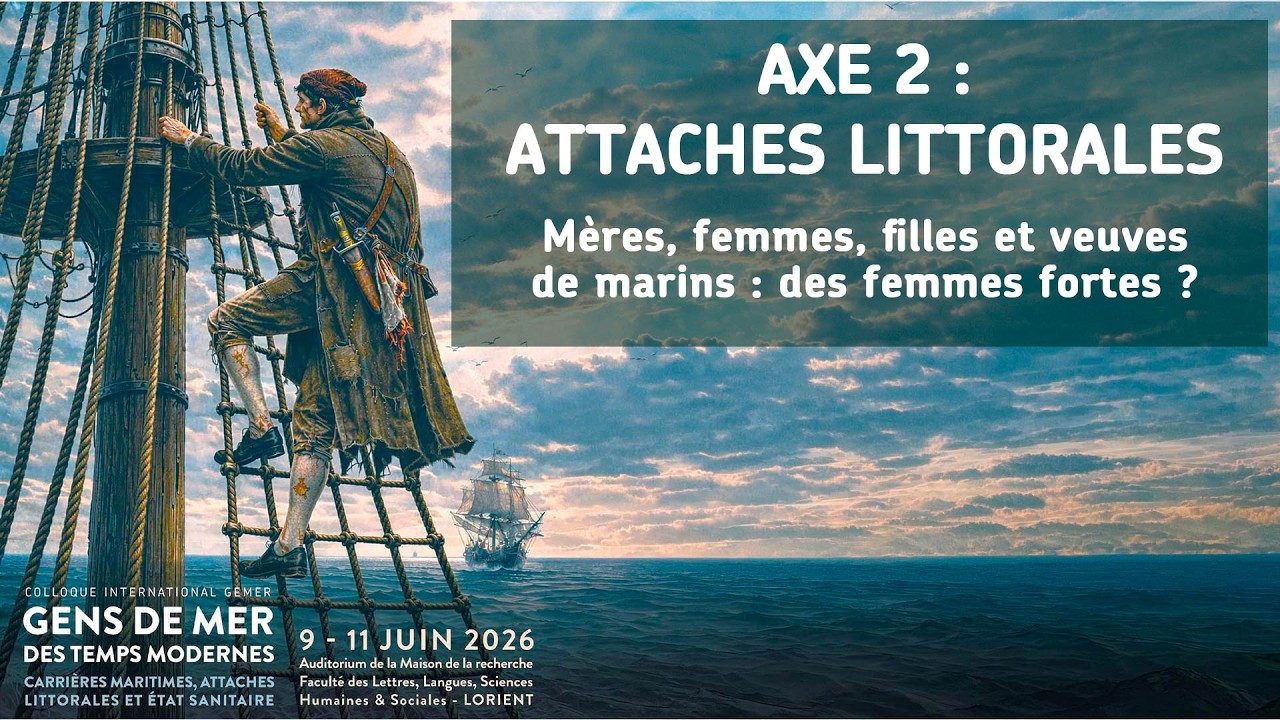
Table ronde. Mères, femmes, filles et veuves de marins : des femmes fortes ?
Keywords
Summary
187 words
Critical Evaluation
Value of the Information & Strength of the Argument
The value of the information is high, as it draws on primary archival sources, including notarial records, testaments, and court proceedings, to provide concrete examples of women’s activities. The argumentation is solid, with speakers carefully qualifying their claims and acknowledging the limitations of the sources. They avoid overgeneralizing, noting that women’s agency was often constrained and circumstantial. The discussion is well-structured, moving from the general context of absences to specific case studies, and then to the legal and testamentary aspects. The speakers engage with existing historiography, such as referencing Emmanuel Charpentier’s concept of ‘substitution’, and they critically assess the gap between legal norms and social practice.
Scientific Rigor, Source Quality, Title Accuracy
The scientific rigor is commendable: the speakers cite specific archival documents, databases (GMER), and secondary literature. They are transparent about the limitations of their data, such as the incompleteness of records and the challenges of tracking individual sailors. The quality of sources is high, as they rely on primary sources from the 18th century. The title accurately reflects the content, focusing on the strength and agency of women in maritime contexts. The discussion is well-aligned with the title, as it explores various dimensions of women’s experiences. No comments were provided for analysis.
213 words
Title / Content Match
The title accurately reflects the content, which focuses on the roles and agency of women (mothers, wives, daughters, widows) of sailors in historical maritime societies.
Quality & Reliability
8/10
The video presents a scholarly roundtable discussion based on archival research, with specific examples and references to primary sources. The speakers are academics and researchers, and the content is well-structured and evidence-based. However, the video is a recording of a live event, and some parts are less polished, with occasional unclear audio and informal transitions.
Key Moments
Markers derived by PSI from the transcript: the creator did not define chapters.
- Introduction to the roundtable and presentation of the first speaker's topic on temporary absence and women's agency.
- Discussion of data on average absence durations for sailors from the GMER database, highlighting the significant time away.
- Case study of Madeleine Bernard, a cabaret owner, illustrating women's economic and social networks.
- Analysis of legal constraints and the use of procurations, with examples of women acting as legal representatives.
- Discussion of the concept of 'substitution' and the role of mothers like Jeanne Girot in managing sons' affairs.
- Transition to the second part on widows and how sailors anticipated death through testaments.
- Examination of testaments that appointed wives as guardians and heirs, often with conditions of remaining widows.
- Conclusion summarizing the findings on women's agency and the importance of their roles in maritime societies.
Cited Sources
- Base de données GMER — Mentioned as the database used for quantitative analysis of sailors' absences.
- Archives notariales de Saint-Coulomb — Primary source for examples of women's legal and economic activities.
- Travaux d'Emmanuel Charpentier — Referenced for the concept of 'personnalité juridique de substitution'.
Concurring Sources
- Women and the Sea: A History of Women in Maritime Communities — General scholarly literature on women in maritime communities, supporting the findings.
Contribution & Novelties
The video provides a nuanced analysis of women’s agency in maritime societies, moving beyond the stereotype of passive waiting wives. It highlights the legal and economic mechanisms that allowed women to act, and the importance of informal networks and trust. The use of specific case studies from notarial records enriches the understanding of everyday life.
Pour aller plus loin :
- Women in Maritime History — Provides an overview of women’s roles in maritime contexts.
- Legal capacity of married women — Explains the legal concept of coverture, relevant to the discussion of women’s legal limitations.
- Notarial records as historical sources — Discusses the nature and use of notarial records in historical research.
111 words
Radar Profile
The radar profile shows high scores in information quantity, quality, and reliability, with a slightly lower technical level, reflecting the accessible yet scholarly nature of the discussion. The balance suggests a well-rounded presentation.