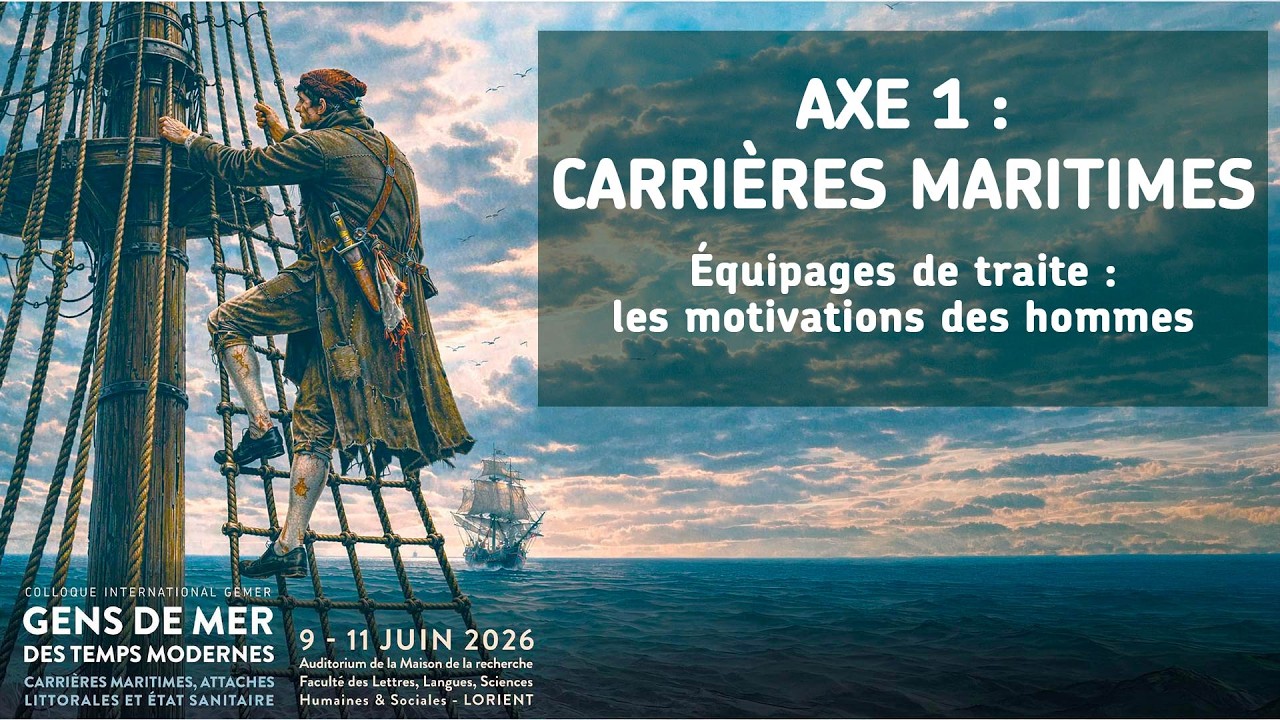
Équipage de traite : les motivations des hommes.
Keywords
Summary
167 words
Critical Evaluation
Value of the Information & Strength of the Argument
The presentation provides valuable insights into the composition and motivations of slave trade crews, based on a substantial database. The argumentation is structured around three clear research questions, and the findings are presented with specific examples and percentages. However, the talk is more descriptive than analytical, and the speaker often digresses into personal anecdotes and methodological reflections. The evidence is convincing but not systematically presented, and the speaker acknowledges limitations, such as incomplete sources for some ports.
Scientific Rigor, Source Quality, Title Accuracy
The speaker demonstrates scientific rigor by grounding his work in archival sources, such as crew registers and matriculation records, and by referencing his own publications and collaborative projects. However, he does not provide specific citations or URLs during the talk, relying on general references to his work and that of other historians. The title accurately reflects the content, focusing on the motivations and profiles of crew members. The talk is well-structured but lacks a formal bibliography, which limits its utility for verification.
174 words
Title / Content Match
The title accurately reflects the content, focusing on the motivations and profiles of slave trade crew members.
Quality & Reliability
7/10
The speaker is a historian with extensive experience in prosopography and database construction, and the talk is based on a specific database of 6700 crew members. However, the presentation is largely anecdotal and lacks detailed methodological transparency or direct citations to sources.
Key Moments
Markers derived by PSI from the transcript: the creator did not define chapters.
- Introduction and presentation of the speaker's background with databases.
- Description of the 'Normandie esclavage' database and its scope.
- Discussion of the three research problems: bottom-up history, regional scale, and demographic challenge.
- Presentation of results on the low proportion of local sailors and recruitment from other ports.
- Analysis of the evolution of recruitment pools over time, with emphasis on Honfleur and Rouen.
- Discussion of the use of the database for qualitative studies, including the 'Alligator' case.
- Conclusion and final remarks on the importance of combining quantitative and qualitative approaches.
Cited Sources
- Normandie esclavage (programme régional) — Mentioned as the framework for the database construction.
- Base Simarconet — Mentioned as a database of maritime registrations for the Cotentin region.
- Les ports normands dans la traite atlantique (ouvrage dirigé par Eric Saunier) — Referenced as a publication presenting results of the research.
Concurring Sources
- Slave Voyages Database — Provides comparable data on slave trade voyages, supporting the regional patterns discussed.
Dissenting Sources
- Critiques of quantitative approaches in history — Some historians argue that quantitative databases may overlook individual experiences, a point the speaker acknowledges but does not fully address.
Contribution & Novelties
The talk contributes to the historiography of the slave trade by focusing on the often-overlooked crew members, using a comprehensive database to analyze their origins and motivations. It highlights the regional dynamics of recruitment and the importance of connecting quantitative data with qualitative case studies.
Pour aller plus loin :
- Transatlantic Slave Trade Database — A comprehensive database for studying slave voyages, useful for comparative analysis.
- Prosopography — A methodological approach used in the talk to study historical populations.
- Maritime History — Provides context for the study of seafaring communities and their roles.
93 words
Radar Profile
The radar profile shows a balanced distribution across all dimensions, with slightly higher scores in information quantity and quality, reflecting the speaker's expertise and the depth of the database. The lower score in technical level suggests the talk is accessible to a general audience, while the overall reliability is solid due to the archival basis.
💬 No comments were provided for analysis.