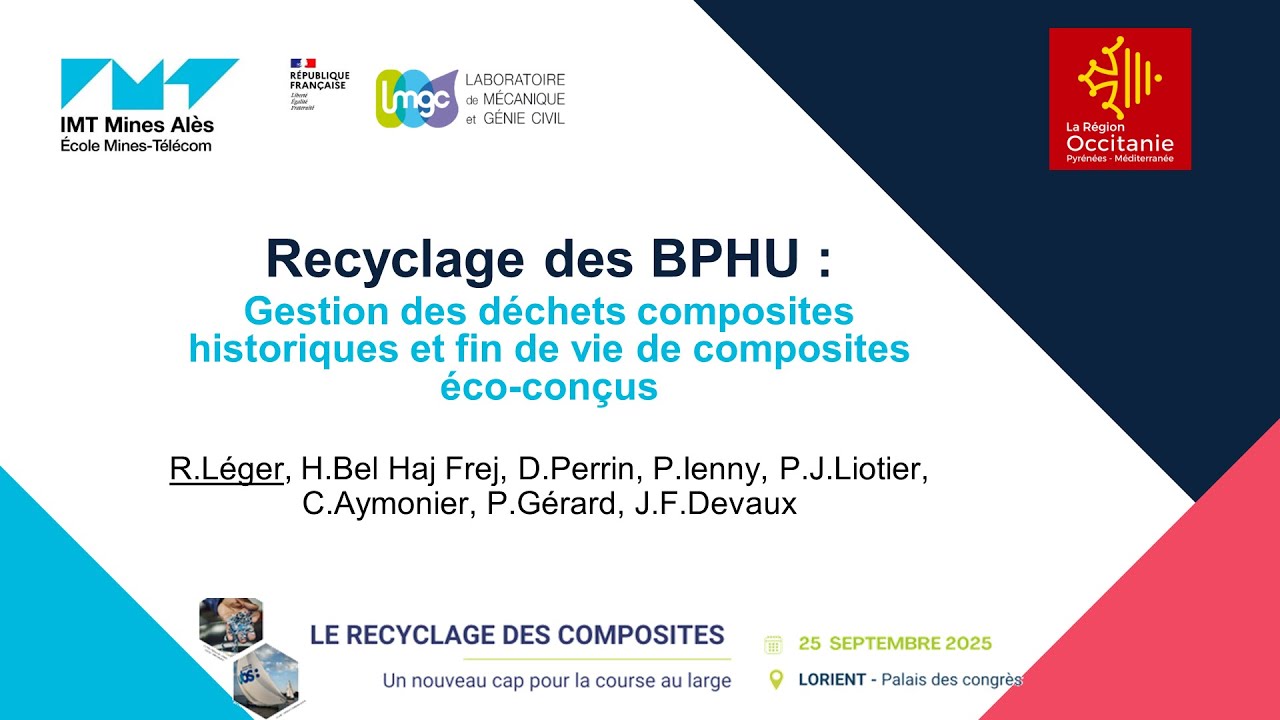
Le recyclage dans le nautisme : Utopie ou réalité ?
Keywords
Summary
167 words
Critical Evaluation
Value of the Information & Strength of the Argument
The talk provides valuable insights into the practical challenges and potential solutions for recycling composites from the nautical industry. The argumentation is based on experimental results from two funded projects, giving concrete data on fiber property retention, mechanical performance of recycled composites, and incorporation in cementitious materials. The speaker acknowledges limitations, such as the need for optimization and cost analysis, which strengthens the credibility. However, some results are presented without deep statistical analysis, and the talk is more of an overview than a detailed scientific presentation.
Scientific Rigor, Source Quality, Title Accuracy
The scientific rigor is moderate: the speaker is a researcher, and the projects are real, but the talk is not peer-reviewed. Sources are not explicitly cited in the video, but the description mentions collaborations with IMT Mines Alès, Arkema, and others. The title accurately reflects the content, which discusses both the utopian ideal of full recyclability and the realistic challenges. The talk does not provide detailed references, but the projects are likely documented in scientific literature.
177 words
Title / Content Match
The title accurately reflects the content, which discusses the feasibility and challenges of recycling in the nautical sector, presenting both utopian and realistic perspectives.
Quality & Reliability
7/10
The speaker is a researcher at IMT Mines Alès, presenting results from two research projects (Tannabaut and DuRacon) on composite recycling. The content is based on experimental data and collaborations with industry (Arkema, CECLO) and institutions (ICMCB, Cerema). However, the presentation is a conference talk, not a peer-reviewed publication, and some results are preliminary or not fully detailed.
Key Moments
Markers derived by PSI from the transcript: the creator did not define chapters.
- Introduction: presentation of the topic and the two projects (Tannabaut and DuRacon).
- Context: end-of-life boats, challenges of collection and dismantling, current lack of material valorization.
- Project Tannabaut: three recycling routes (mechanical, thermal, chemical) for historical composites.
- Vapor-thermolysis with Alpha Recyclage Composites: process description and fiber recovery results.
- Solvolysis in supercritical water with ICMCB: effect of treatment efficiency on fiber properties.
- Mechanical recycling: incorporation of fine composite powder in cementitious matrices, effects on workability and mechanical properties.
- Results: increased toughness, decreased strength, fiber stability after months.
- Project DuRacon: development of recyclable composite with Arkema and CECLO, using Elium resin and carbon fibers.
- Closed-loop recycling: thermolysis process, recovery of fibers and resin, mechanical performance of recycled composite.
- Conclusions and perspectives: cost and environmental assessments, ongoing projects like Simplast and Rosicom.
Cited Sources
- IMT Mines Alès — Speaker's institution, mentioned in the description.
- Arkema — Partner in the DuRacon project, mentioned in the talk.
- CECLO — Company producing high-end bikes, partner in the DuRacon project.
Concurring Sources
- APER (Association for the Recycling of Pleasure Boats) — Mentioned as the organization approving collection centers for end-of-life boats.
Contribution & Novelties
The talk presents original research on recycling composites from the nautical sector, specifically addressing the challenges of end-of-life boats. It provides experimental data on three recycling routes, highlighting the trade-offs between fiber recovery and property retention. The DuRacon project demonstrates a closed-loop recycling approach for thermoplastic composites, achieving high mechanical performance. This contributes to the field of composite recycling and circular economy.
Pour aller plus loin :
- Composite recycling — Overview of composite recycling methods.
- Glass fiber — Properties and applications of glass fibers.
- Thermoplastic composites — Information on thermoplastic matrix composites.
- Life-cycle assessment — Methodology for environmental impact assessment.
100 words
Radar Profile
The radar profile shows balanced scores across all dimensions, with slightly higher scores in information quantity and technical level, indicating a well-rounded presentation with substantial technical content.
💬 No comments were provided for analysis.