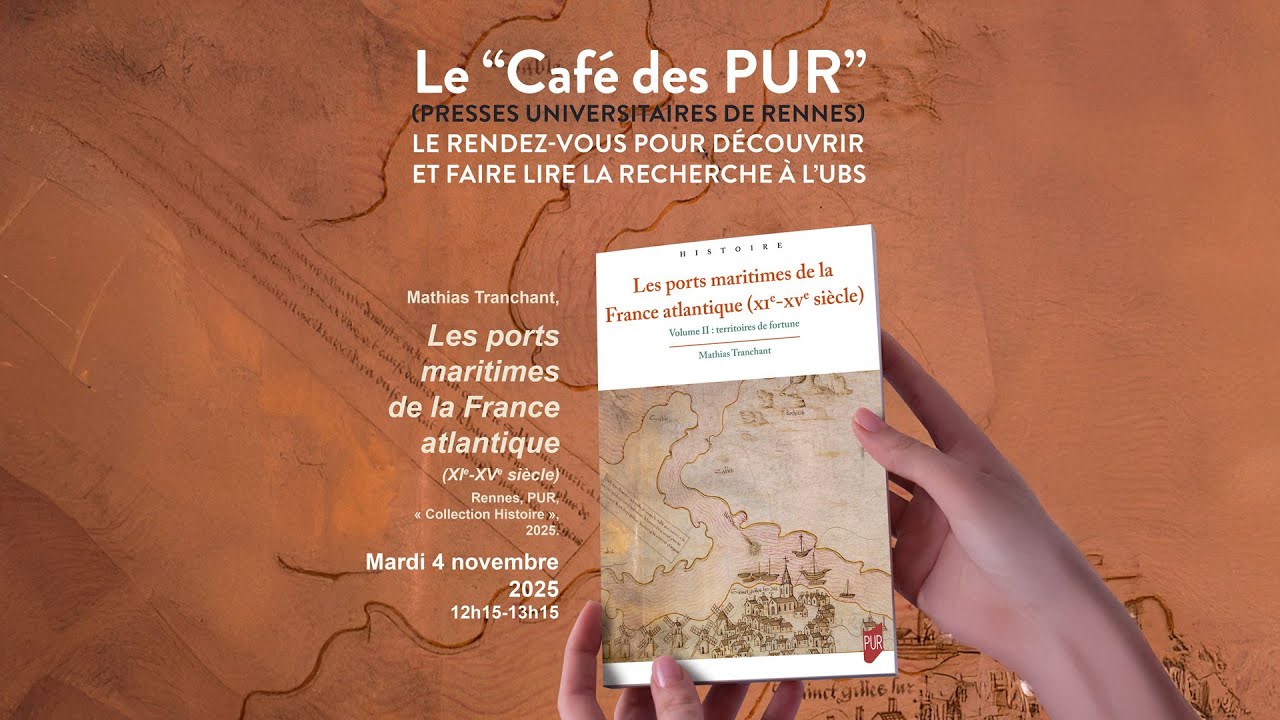
Café des PUR - Rencontre avec Mathias Tranchant : Les ports maritimes de la France atlantique
Keywords
Summary
174 words
Critical Evaluation
Value of the Information & Strength of the Argument
The video provides valuable insights into the methodology and findings of a major historical study. Tranchant’s argumentation is solid, grounded in extensive archival research and a systematic database. He clearly explains the rationale behind his choices, such as the division into two volumes and the use of diverse sources. The discussion is well-structured and informative, offering a nuanced understanding of medieval ports as dynamic territories shaped by environmental, economic, and political factors. The value lies in the expert perspective on a specialized topic, which is presented in an accessible yet rigorous manner.
Scientific Rigor, Source Quality, Title Accuracy
The scientific rigor is high, as the author is a recognized expert and the work is based on a comprehensive analysis of primary sources, including judicial and administrative records. The sources are not explicitly listed in the video, but the author mentions specific archival series and the ESTRAN database, indicating a solid foundation. The title accurately reflects the content, focusing on the ports of Atlantic France. The discussion does not include a formal review of sources, but the author’s credibility and the depth of the research are evident. The video is an interview, so it does not provide a detailed bibliography, but the references to the book and the research process are sufficient for a general audience.
224 words
Title / Content Match
The title accurately reflects the content: a discussion with Mathias Tranchant about his book on Atlantic French ports in the Middle Ages.
Quality & Reliability
8/10
The video features a recognized historian presenting his peer-reviewed research, based on extensive archival work and a systematic database. The discussion is grounded in published scholarship, though it is an interview format rather than a formal presentation of new data.
Key Moments
Markers derived by PSI from the transcript: the creator did not define chapters.
- Introduction of Mathias Tranchant and his academic background.
- Explanation of why the study is divided into two volumes.
- Discussion on the meaning of 'territoire de fortune'.
- Choice of publisher (Presses Universitaires de Rennes) and funding.
- Overview of sources used, including archival series and the ESTRAN database.
- Analysis of a historical map of Saint-Gilles-Croix-de-Vie.
- Definition of 'port' in medieval context and related terms.
- Geographical distribution of ports and factors influencing their location.
- Economic activities in ports: fishing, salt production, commerce.
- Main exports and imports, including grain, salt, and wine.
Cited Sources
- Les ports maritimes de la France atlantique (XIe-XVe siècle), volume 2 — The book discussed in the interview, published by Presses Universitaires de Rennes.
Concurring Sources
- Les ports maritimes de la France atlantique (XIe-XVe siècle), volume 1 — The first volume of the study, providing the geohistorical framework.
Contribution & Novelties
The video offers an original perspective on medieval maritime history, emphasizing the ports as dynamic territories shaped by environmental, economic, and political factors. The author’s systematic approach, using a comprehensive database, provides a new understanding of the diversity and evolution of ports. The discussion highlights the importance of considering ports as integral parts of maritime societies.
Pour aller plus loin :
- Histoire maritime — Overview of maritime history.
- Moyen Âge — General context of the medieval period.
- Port — Definition and types of ports.
- Presses Universitaires de Rennes — Publisher of the book.
93 words
Radar Profile
The radar profile shows high scores in information quantity, quality, and reliability, with a slightly lower technical level, reflecting the accessible yet expert nature of the discussion.
💬 Sur les 0 commentaires analysés, aucune tendance n'est observable.