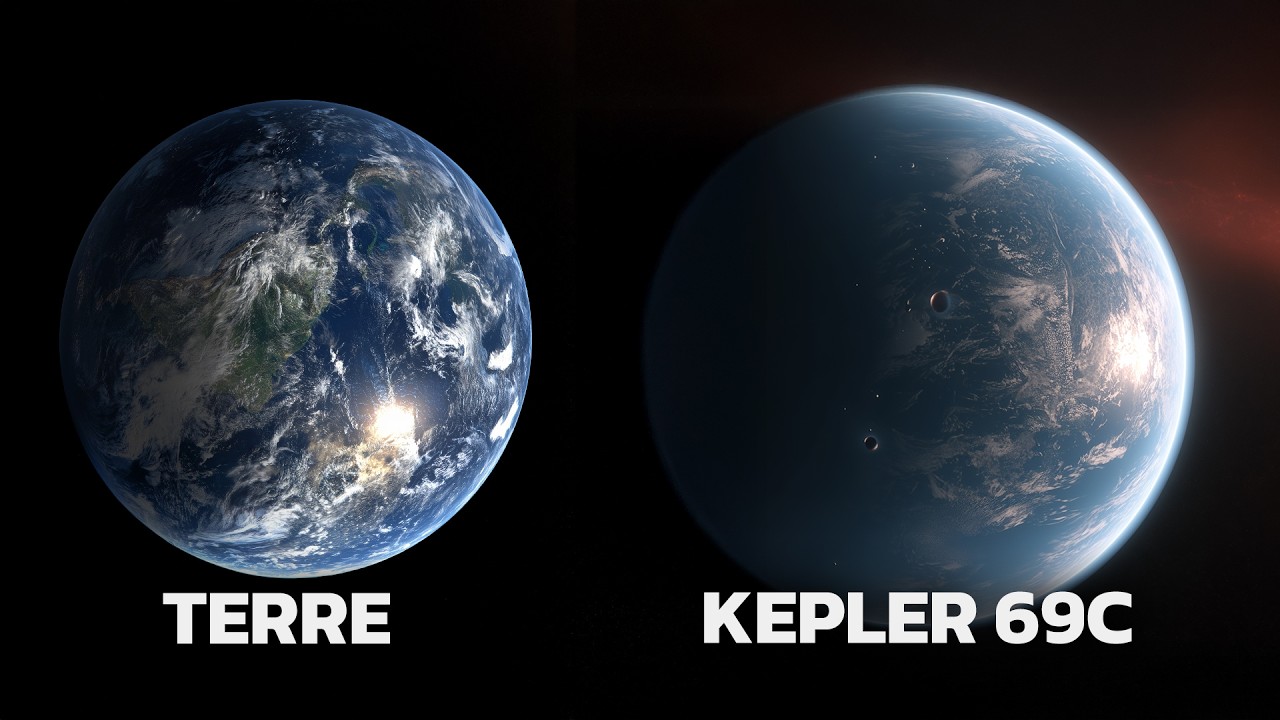
Cette planète est plus habitable que la Terre ?
Keywords
Summary
174 words
Critical Evaluation
The video is a comprehensive and engaging overview of exoplanet research, successfully blending historical context, scientific explanations, and speculative discussions about habitability. Its strength lies in its ability to make complex astronomical concepts accessible to a general audience without oversimplifying to the point of inaccuracy. The inclusion of interviews with scientists, such as Michel Mayor, adds credibility and a personal touch. The production quality is high, with stunning visuals and clear narration.
However, the video has some weaknesses. As a compilation, it lacks a cohesive narrative structure, jumping between topics and sometimes repeating information. The title suggests a focused exploration of superhabitable planets, but the video covers a much broader range of exoplanet topics, which may disappoint viewers expecting a more targeted discussion. While the scientific content is generally accurate, some claims are presented without sufficient nuance, and the speculative nature of habitability assessments is not always clearly communicated. For instance, the discussion of K2-18 b mentions potential biosignatures but also acknowledges doubts, which is good, but other candidates are presented with less critical scrutiny.
The sources cited are primarily the video’s own production, with no external references provided in the description. This limits the viewer’s ability to verify claims independently. The video does not engage with any dissenting scientific viewpoints, which could give a one-sided impression. Additionally, the inclusion of a sponsorship segment (not named) is present but does not detract from the content.
Overall, the video is a valuable educational resource that stimulates curiosity about exoplanets and the search for life. Its main contributions are its historical narrative and its ability to convey the excitement of discovery. However, for a more rigorous scientific analysis, viewers would need to consult primary literature and other sources.
286 words
Title / Content Match
The title is somewhat misleading as the video is a compilation covering many aspects of exoplanets, not solely focused on superhabitable planets. However, the core question is addressed throughout.
Quality & Reliability
7/10
The video provides a broad overview of exoplanet research, featuring interviews with scientists and visits to observatories. It covers historical discoveries and current candidates for superhabitable planets. While generally accurate, it simplifies complex topics and occasionally uses speculative language. The production includes scientific review, but lacks detailed citations for many claims.
Chapters
- Introduction
- Qu'est-ce qu'une exoplanète ?
- La détection de la première exoplanète
- Le télescope T193
- La face cachée de la lune
- Alma
- Le Very Large Telescope
- Beta Pictoris b
- Comment détecter les exoplanètes ?
- La relativité restreinte
- Le ciel
- La méthode de transit
- La méthode par vitesse radiale
- LHS 1140 b
- Proxima Centauri b
- Les variations de lumière des étoiles
- Au-delà de notre évolution
- Les conditions de l'apparition de la vie
- La détection par microlentille gravitationnelle
- Les planètes candidates à la superhabilité
- Les défauts de la Terre
- La vitesse relativiste
- Les dangers d'une nouvelle planète sur le corps humain
- La détection de vie sur les planètes superhabitables
- Les méthodes de propulsion
- Les moyens de parcourir l'espace
- Notre Terre
- Les différents types de mondes
- La formation des mondes
- La détection de 14 Herculis c
- Quelques mondes différents
- Le système 14 herculis
- L'exoplanète 14 Herculis c
- K2-18 b
- Le paradoxe de Fermi
- Les molécules sur K2-18 b
- Les biosignatures atmosphériques
- La vie extraterrestre sur K2-18 b
- Les doutes sur K2-18 b
- L'univers
- L'Extremely Large Telescope (ELT)
- Qu'est-ce que la vie ?
- La vie est-elle possible ailleurs ?
- Comment va fonctionner l'ELT ?
- Les différents instruments de l'ELT
- L'étude atmosphérique
- L'équation de Drake
- Les disques protoplanétaires
Cited Sources
- Zebroloss Facebook — Official Facebook channel of Zebroloss, providing updates and additional content.
- Zebroloss Spotify Podcast — Podcast version of the video, available on Spotify.
- Zebroloss Instagram — Official Instagram channel of Zebroloss, mirroring Facebook content.
- Zebroloss Membership — Join the channel for exclusive benefits.
- Support Zebroloss on Leetchi — One-time donation platform to support the channel.
Concurring Sources
- NASA Exoplanet Archive — A comprehensive database of confirmed exoplanets, supporting the numbers mentioned in the video.
- ESO - Extremely Large Telescope — Official site of the ELT, which the video discusses as a future tool for studying exoplanet atmospheres.
Dissenting Sources
- Scientific critique of superhabitable planet claims — Some scientists argue that the concept of superhabitable planets is speculative and that Earth may be at the upper limit of habitability. The video does not present these counterarguments.
Contribution & Novelties
The video provides a comprehensive and engaging synthesis of current knowledge on exoplanets and habitability, with a focus on superhabitable candidates. It stands out for its historical narrative, from Giordano Bruno to the first detection, and its on-site visits to observatories, which add a unique perspective. The discussion of specific planets like Kepler-442b and Teegarden b, along with the challenges of interstellar travel, offers a thought-provoking look at the future of space exploration.
Pour aller plus loin :
- Exoplanet Exploration — NASA’s official exoplanet discovery and exploration portal, providing up-to-date data and educational resources.
- Kepler-442b — Wikipedia article on this superhabitable candidate, detailing its characteristics and habitability assessments.
- Teegarden’s Star b — Wikipedia article on this potentially habitable exoplanet, including its discovery and properties.
- Drake equation — Wikipedia article explaining the probabilistic argument used to estimate the number of active, communicative extraterrestrial civilizations.
- Fermi paradox — Wikipedia article discussing the apparent contradiction between the high probability of extraterrestrial civilizations and the lack of evidence for them.
166 words
Radar Profile
The radar profile shows a balanced performance across all dimensions, with slightly higher scores in quantity of information and reliability, reflecting the video's comprehensive coverage and generally accurate content. The lower score in technical level indicates that the content is accessible to a general audience, which aligns with its educational purpose.
💬 Très positif. Sur les 30 commentaires analysés, les spectateurs expriment un fort enthousiasme pour la vidéo, la qualifiant de 'passionnante', 'excellente' et 'captivante', avec plusieurs mentions de visionnages répétés et de soutien à la chaîne.