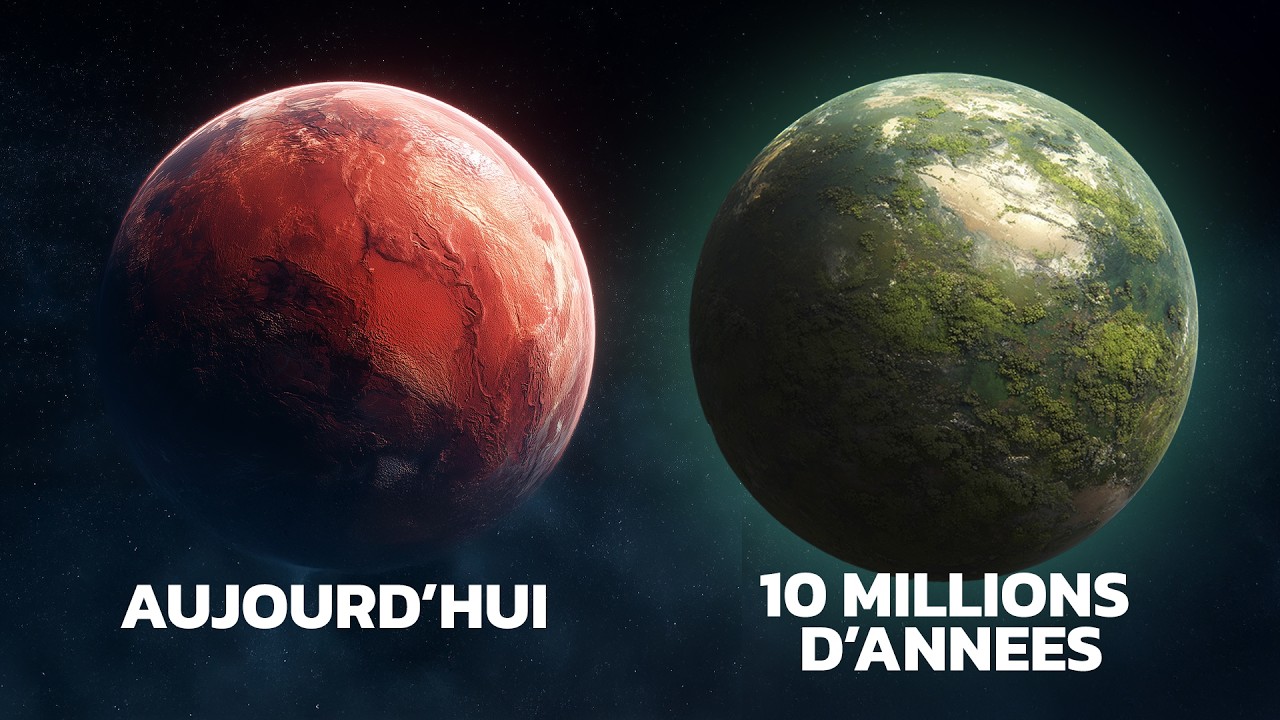
Peut-on vraiment terraformer une planète ?
Keywords
Summary
171 words
Critical Evaluation
The video provides a well-structured and scientifically sound introduction to the concept of terraforming, grounded in established planetary science. The presenter, Zebroloss, effectively communicates complex ideas such as the greenhouse effect, the carbon cycle, and the role of magnetic fields in a way that is accessible without oversimplifying. The argumentation is logical: it starts by deconstructing the notion of terraforming, then builds a case for why Earth is habitable, and finally applies that understanding to the challenges of modifying other planets. The scientific content is accurate, with no major errors or misleading claims. The video benefits from a credited scientific writing team, which lends credibility. However, it lacks direct citations to specific studies or sources, which would enhance its rigor. The discussion is primarily qualitative, with few quantitative details, but this is appropriate for a general audience. The adéquation between the title and content is strong, as the video directly addresses the question of whether terraforming is truly possible. The production quality is high, with clear visuals and a calm, engaging narration. Overall, the video is a valuable educational resource that stimulates curiosity and provides a solid foundation for further exploration. The main limitation is the absence of explicit references, but the content aligns with current scientific consensus. The video also touches on the ethical and practical implications, though briefly. It successfully conveys that terraforming is not a simple technological fix but a profound manipulation of planetary systems, which is a crucial perspective. The inclusion of a brief segment about UFOs and the presenter’s response to a comment adds a personal touch but is tangential to the main topic. The video’s strength lies in its ability to make complex science understandable and to inspire viewers to think critically about humanity’s future in space.
293 words
Title / Content Match
The title accurately reflects the content, which explores the feasibility of terraforming planets by examining the complex systems that make Earth habitable.
Quality & Reliability
8/10
The video presents a scientifically accurate overview of planetary habitability and terraforming, grounded in established concepts such as the habitable zone, greenhouse effect, magnetic field, and carbon cycle. The scientific team is credited, and the content aligns with current astrophysical knowledge. However, it lacks direct citations to specific studies or sources, and the presentation is popularized rather than deeply technical.
Key Moments
Markers derived by PSI from the transcript: the creator did not define chapters.
- Introduction: definition of terraforming and its ambitious nature.
- Carl Sagan's role in popularizing the concept in the 1960s.
- Explanation of the habitable zone and its limitations.
- Discussion of the greenhouse effect and its importance for Earth's temperature.
- Role of the magnetic field in protecting the atmosphere from solar wind.
- The carbon cycle as a regulatory mechanism for climate stability.
- Oceans as thermal buffers and their role in stabilizing temperature.
- Challenges of creating and retaining an atmosphere: gravity and escape velocity.
- The threat of solar wind and the need for a magnetic field.
- Conclusion: terraforming requires understanding and replicating a complex planetary system.
Cited Sources
- Sirius app (promotional link) — Mentioned in the video description as a companion app for the channel.
- Spotify podcast link — Link to the podcast version of the video.
- Channel membership link — Link to join the channel for exclusive benefits.
- Facebook channel — Link to the channel's Facebook page.
- Instagram channel — Link to the channel's Instagram page.
Concurring Sources
- NASA Exoplanet Exploration — NASA's official exoplanet website, which provides information on habitable zones and planetary habitability, aligning with the video's content.
- Encyclopaedia Britannica: Terraforming — Encyclopaedia Britannica entry on terraforming, which supports the video's definition and historical context.
Dissenting Sources
- Scientific American: The Challenges of Terraforming Mars — This article discusses additional challenges not covered in the video, such as the lack of a global magnetic field on Mars and the difficulty of maintaining an atmosphere, which aligns with the video's points but provides more pessimistic outlook.
Contribution & Novelties
The video provides a comprehensive and accessible synthesis of the scientific challenges of terraforming, emphasizing the systemic nature of planetary habitability. It goes beyond simple technological optimism by highlighting the intricate feedback loops and physical constraints. The original contribution lies in its clear explanation of why Earth’s habitability is not a simple recipe but a dynamic equilibrium, and how this understanding complicates any terraforming endeavor.
Pour aller plus loin :
- Habitable zone — Wikipedia article on the concept of the habitable zone, directly relevant to the video’s discussion.
- Greenhouse effect — Wikipedia article explaining the greenhouse effect, a key topic in the video.
- Carbon cycle — Wikipedia article on the carbon cycle, which the video discusses as a regulatory mechanism.
- Terraforming of Mars — Wikipedia article specifically about terraforming Mars, providing further details on proposed methods.
- Magnetosphere — Wikipedia article on magnetospheres, relevant to the video’s discussion of magnetic field protection.
151 words
Radar Profile
The radar profile shows high scores in quantity and quality of information, with a moderate technical level. The reliability score is also high, indicating a trustworthy presentation. The overall balance suggests a well-rounded educational video that is both informative and credible.
💬 Très positif. Sur les 30 commentaires analysés, la grande majorité exprime une admiration pour la qualité de la vidéo et la clarté des explications, avec de nombreuses demandes pour des vidéos sur les OVNI et autres sujets connexes.