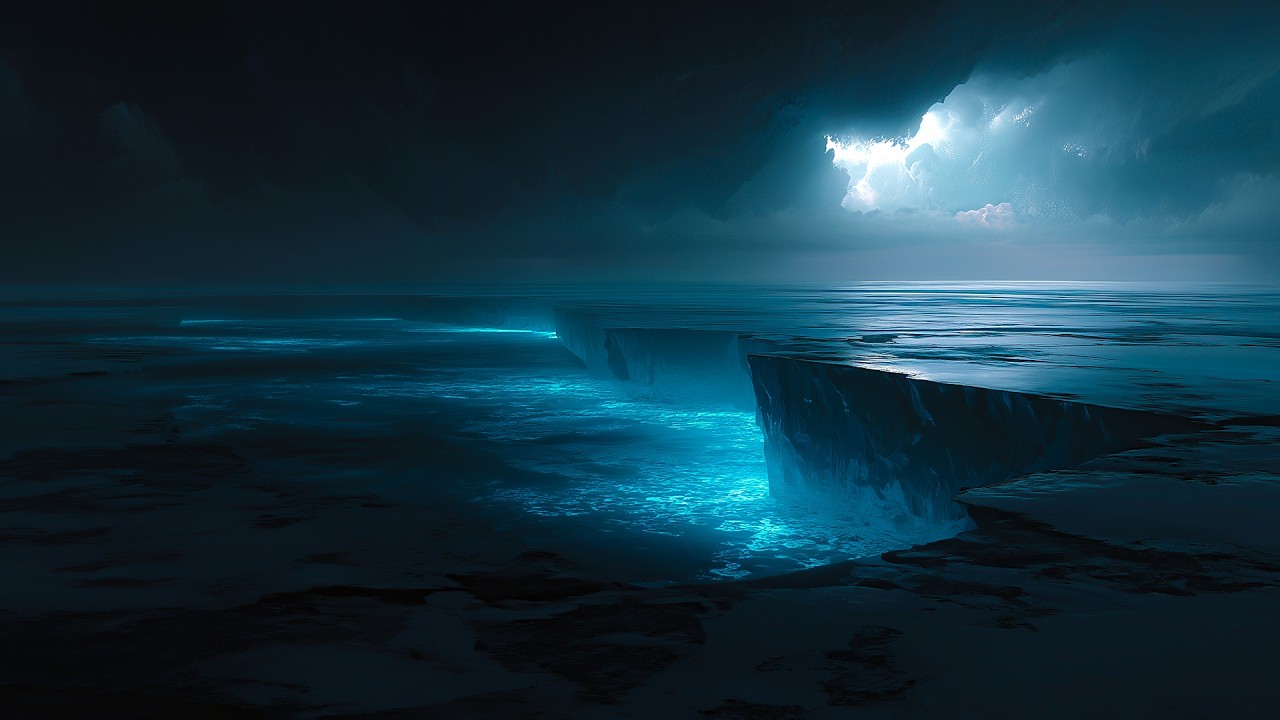
Les océans les plus étranges de l'Univers...
Keywords
Summary
145 words
Critical Evaluation
The video provides a comprehensive and engaging overview of ocean worlds in the solar system and beyond. It successfully bridges the gap between terrestrial oceanography and planetary science, making complex concepts accessible. The historical and philosophical framing of what constitutes an ocean adds depth, though it may be somewhat tangential for viewers seeking purely scientific content. The scientific information is accurate and up-to-date, referencing real missions and phenomena. However, the video lacks explicit citations to primary sources, relying instead on general scientific consensus. The promotional segments for the creator’s app and channel, while brief, detract from the scientific focus. The discussion of exoplanets is speculative but clearly labeled as such. Overall, the video is a valuable resource for science communication, though it could benefit from more rigorous sourcing. The title accurately reflects the content, and the video does not overpromise. The public comments, if any, would likely reflect appreciation for the clear explanations and visualizations.
155 words
Title / Content Match
The title accurately reflects the content, which explores various ocean worlds in the solar system and beyond, highlighting their strangeness and potential for life.
Quality & Reliability
7/10
The video is a well-structured science communication piece, featuring a team of scientific writers and a science journalist. It covers established concepts in planetary science and astrobiology, referencing real missions like Europa Clipper and JUICE. However, it lacks explicit citations to primary sources, and the promotional segments and app promotion reduce the overall scientific rigor.
Key Moments
Markers derived by PSI from the transcript: the creator did not define chapters.
- Introduction: parallels between oceans and space
- Sponsorship and app promotion
- Historical definition of oceans on Earth
- Criteria for defining an ocean
- Introduction to ocean worlds in the solar system
- Europa and its subsurface ocean
- Enceladus and its geysers
- Titan's methane seas
- Exoplanets and water worlds
- Detection methods for hidden oceans
- Upcoming missions: Europa Clipper and JUICE
- Potential for life in alien oceans
- Conclusion: exploring the universe's oceans
Cited Sources
- Europa Clipper mission (NASA) — Mentioned as a mission to explore Europa's subsurface ocean.
- JUICE mission (ESA) — Mentioned as a mission to study Jupiter's icy moons.
Concurring Sources
- NASA Ocean Worlds — Supports the existence of subsurface oceans on icy moons.
- Europa Clipper mission — Confirms the planned exploration of Europa's ocean.
Dissenting Sources
- No direct discordant sources found — The video aligns with current scientific consensus; no major contradictions identified.
External References
Contribution & Novelties
The video synthesizes current knowledge about ocean worlds, emphasizing the philosophical and historical dimensions of defining oceans. It provides a clear framework for understanding what constitutes an ocean and applies it to extraterrestrial environments. The discussion of detection methods and upcoming missions is current and informative.
Pour aller plus loin :
- Ocean worlds (NASA) — Overview of ocean worlds and their significance.
- Europa Clipper mission — Official mission page with detailed information.
- Enceladus (NASA) — Detailed facts about Enceladus and its plumes.
- Titan (NASA) — Overview of Titan’s methane lakes and seas.
- Exoplanet exploration (NASA) — Information on exoplanets, including potential water worlds.
103 words
Radar Profile
The radar profile shows high scores in quantity and quality of information, reflecting the video's comprehensive coverage and accurate scientific content. The technical level is moderate, indicating accessibility for a general audience. Overall reliability is good, though the lack of explicit citations slightly lowers the score.
💬 No comments were provided for analysis.