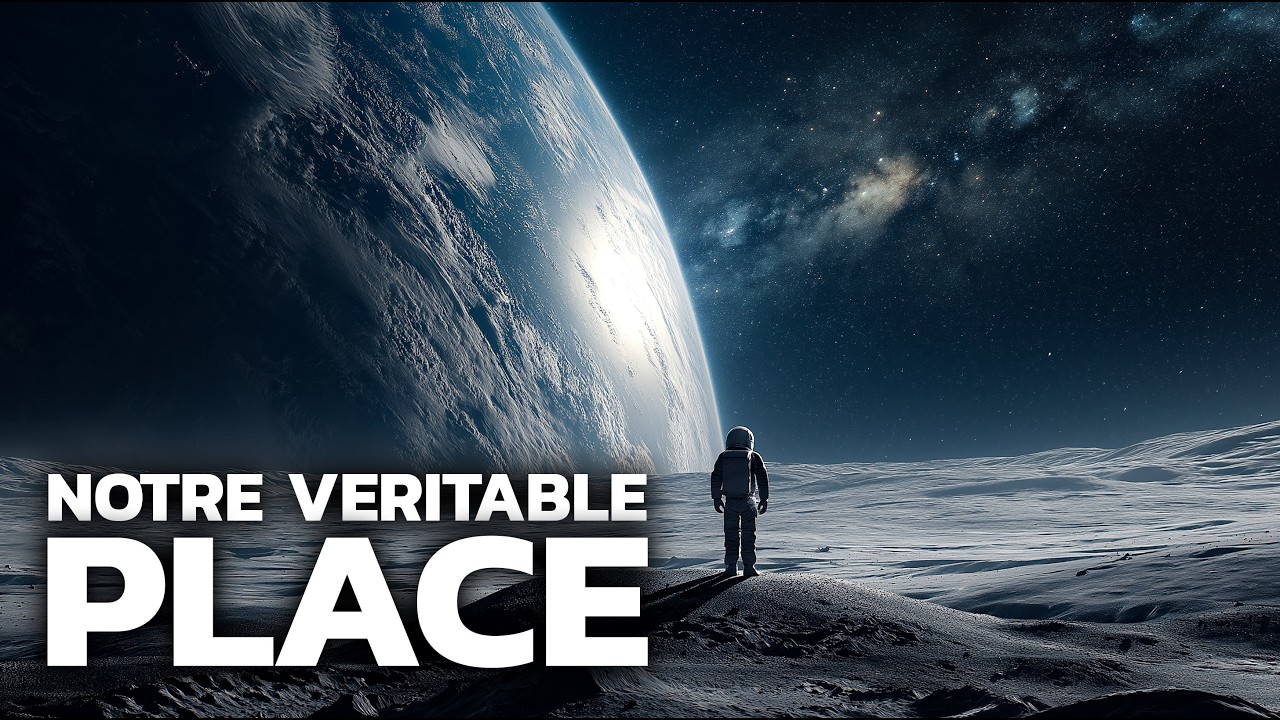
Nous sommes dans l’endroit le plus terrifiant de l’Univers…
Keywords
Summary
142 words
Critical Evaluation
The video excels in its pedagogical approach, breaking down complex cosmic scales into digestible steps. The progression from local to cosmic is logical and effective, allowing viewers to grasp the enormity of the universe. The scientific content is accurate, referencing well-established concepts and missions. However, the video is primarily a popularization, lacking in-depth technical explanations or citations to specific research papers. The argumentation is solid, but it relies on a narrative style rather than rigorous scientific discourse. The inclusion of the app promotion and the plea for female viewers, while engaging, slightly detracts from the scientific focus. The title’s sensationalism is not fully justified by the content, which is more awe-inspiring than terrifying. Overall, the video is a high-quality educational piece that effectively communicates the scale of the universe, but it does not offer novel scientific insights. The sources mentioned (Gaia, SDSS, CMB) are credible, but no direct links are provided in the description, limiting verifiability. The public comments are overwhelmingly positive, with many expressing appreciation for the content and the creator’s teaching style, though some note the underrepresentation of women.
181 words
Title / Content Match
The title is somewhat sensationalist ('most terrifying place') but the content focuses on our cosmic address and the vastness of the universe, which aligns with the theme of awe and scale.
Quality & Reliability
8/10
The video presents a well-structured overview of cosmic scales and structures, referencing established scientific missions (Gaia, SDSS, CMB) and theories (Newton, Einstein). The information is accurate and up-to-date, though presented in a popularized manner without deep technical detail. The creator's credibility is supported by a consistent track record of astronomy content.
Key Moments
Markers derived by PSI from the transcript: the creator did not define chapters.
- Introduction: The question of our cosmic address and the need to expand our perspective.
- Starting from Earth: geodesy, the geoid, and precise positioning systems like GPS.
- Earth's motion: rotation, orbit around the Sun, Kepler's laws, and Newton's gravity.
- Einstein's general relativity and the curvature of spacetime.
- The solar system and the Sun's gravitational dominance.
- The Milky Way: structure, size, and our position within it.
- The Local Group and neighboring galaxies.
- Galaxy clusters and superclusters, the large-scale structure.
- The cosmic web and the observable universe.
- Cosmic dangers and the question of whether our location is special.
Cited Sources
- Gaia mission — Mentioned as a mission mapping billions of stars with high precision.
- Sloan Digital Sky Survey — Referenced for reconstructing the large-scale structure of the universe.
- Cosmic Microwave Background — Mentioned as providing an image of the early universe.
Concurring Sources
- Gaia mission — Supports the video's claims about mapping the Milky Way.
- Sloan Digital Sky Survey — Supports the video's claims about large-scale structure.
- Cosmic microwave background — Supports the video's claims about the early universe.
External References
Contribution & Novelties
The video provides a comprehensive and accessible synthesis of our cosmic address, integrating multiple scales from Earth to the cosmic web. Its originality lies in the pedagogical progression and the emphasis on the scientific methods and missions that have shaped our understanding. It does not present new research but offers a valuable educational resource.
Pour aller plus loin :
- Gaia mission — The European Space Agency’s mission to map the Milky Way in 3D.
- Sloan Digital Sky Survey — A major multi-spectral imaging and spectroscopic redshift survey.
- Cosmic microwave background — The thermal radiation left over from the Big Bang, key to understanding the universe’s structure.
- Large-scale structure of the universe — The distribution of galaxies and dark matter on the largest scales.
- Geodesy — The science of measuring Earth’s shape and gravitational field.
134 words
Radar Profile
The radar profile shows high scores in quantity and quality of information, with a moderate technical level. This indicates a well-balanced educational video that is informative and reliable, but not overly technical, making it accessible to a broad audience.
💬 Très positif. Sur les 30 commentaires analysés, la grande majorité exprime une admiration pour la qualité des vidéos et la pédagogie de Zebroloss, avec de nombreux témoignages de femmes qui se manifestent suite à l'appel du créateur.