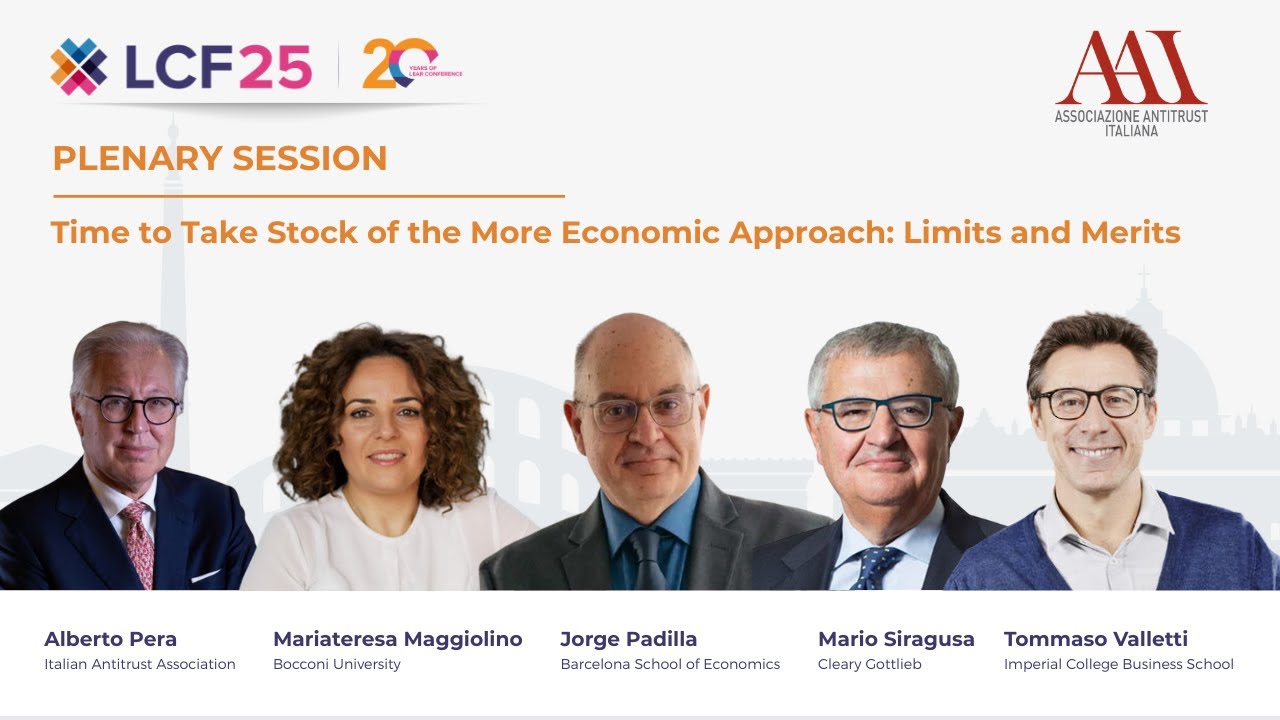
LCF5 - Time to Take Stock of the More Economic Approach: Limits and Merits
Keywords
Summary
223 words
Critical Evaluation
Value of the Information & Strength of the Argument
The video provides substantial value by offering a high-level, expert discussion on a central topic in competition policy. The arguments are well-articulated and grounded in both theoretical and practical knowledge. Padilla’s use of motivated beliefs theory to explain regulator behavior is particularly insightful, adding a novel psychological dimension to the debate. Duso’s critique, based on his experience as chief economist, provides a counterpoint that challenges the effectiveness of the MEA. The panelists do not always agree, which enriches the discussion and allows for a balanced examination of the issues. The argumentation is generally solid, though some claims, such as the macroeconomic effects of antitrust enforcement, are acknowledged as contested. The discussion is more qualitative than quantitative, but this is appropriate for a policy debate.
Scientific Rigor, Source Quality, Title Accuracy
The panelists demonstrate high scientific rigor, referencing key cases (e.g., Cervvicale, Michelin, British Airways) and economic theories (e.g., contestable markets). The sources are not explicitly cited with URLs, but the discussion is consistent with established literature in the field. The title accurately reflects the content, which is a critical assessment of the MEA. The video does not include a promotional segment. The panelists’ credentials lend credibility to the discussion, and they openly acknowledge uncertainties and controversies, enhancing the overall reliability.
219 words
Title / Content Match
The title accurately reflects the content, which is a critical assessment of the More Economic Approach in antitrust enforcement.
Quality & Reliability
8/10
The video features a panel of distinguished experts in competition law and economics, including former chief economist of DG Comp, providing a balanced and nuanced discussion. The arguments are well-structured and grounded in theoretical and practical knowledge, though the format is a debate rather than a peer-reviewed study.
Key Moments
Markers derived by PSI from the transcript: the creator did not define chapters.
- Introduction by Alberto, setting the stage for the debate on the More Economic Approach.
- Jorge Padilla begins his presentation, tracing the origins of the MEA in merger control and Article 102.
- Padilla discusses the criticism of under-enforcement and the concept of motivated beliefs.
- Padilla concludes with the idea of 'hopeful pessimism' and the need for open-mindedness.
- Tomaso Duso begins his critique, arguing that the MEA has not delivered expected results.
- Duso discusses the influence of discredited theories like contestable markets on policy.
- Duso emphasizes the need for a pragmatic approach and warns against 'epistemic arbitrage'.
- Panel discussion on the proposed new guidelines on Article 102 and the role of structural presumptions.
- Concluding remarks and questions from the audience.
Cited Sources
- Guidance on the Commission's enforcement priorities in applying Article 82 EC to abusive exclusionary conduct by dominant undertakings — Referenced as the key document of the More Economic Approach for Article 102.
- Case C-413/14 P Intel v Commission — Mentioned as a recent case where the Court of Justice adopted a more economic approach.
- The Theory of Contestable Markets — Cited by Duso as an example of a discredited theory still influencing policy.
Concurring Sources
- The More Economic Approach to EU Antitrust Law — General reference to the evolution of EU competition law.
Dissenting Sources
Contribution & Novelties
The video offers a timely and nuanced assessment of the More Economic Approach, bringing together diverse expert perspectives. Padilla’s application of motivated beliefs theory to antitrust enforcement is a novel contribution, suggesting that regulators’ pessimism may be rational and even welfare-enhancing. Duso’s critique provides a counterpoint, highlighting the practical failures and the influence of outdated economic theories. The discussion on the proposed new Article 102 guidelines offers insights into the future direction of EU competition policy.
Pour aller plus loin :
- Motivated beliefs and economic policy — Relevant to Padilla’s argument about regulators’ beliefs.
- Contestable markets theory — Discussed by Duso as an example of a discredited theory.
- Consumer welfare standard in antitrust — Central to the debate on the More Economic Approach.
123 words
Radar Profile
The radar profile shows high scores in information quality and reliability, reflecting the expertise of the panelists and the depth of the discussion. The technical level is moderate, making it accessible to a broad audience while still offering depth for specialists. The overall balance suggests a well-rounded and credible presentation.
💬 No comments were provided for analysis.