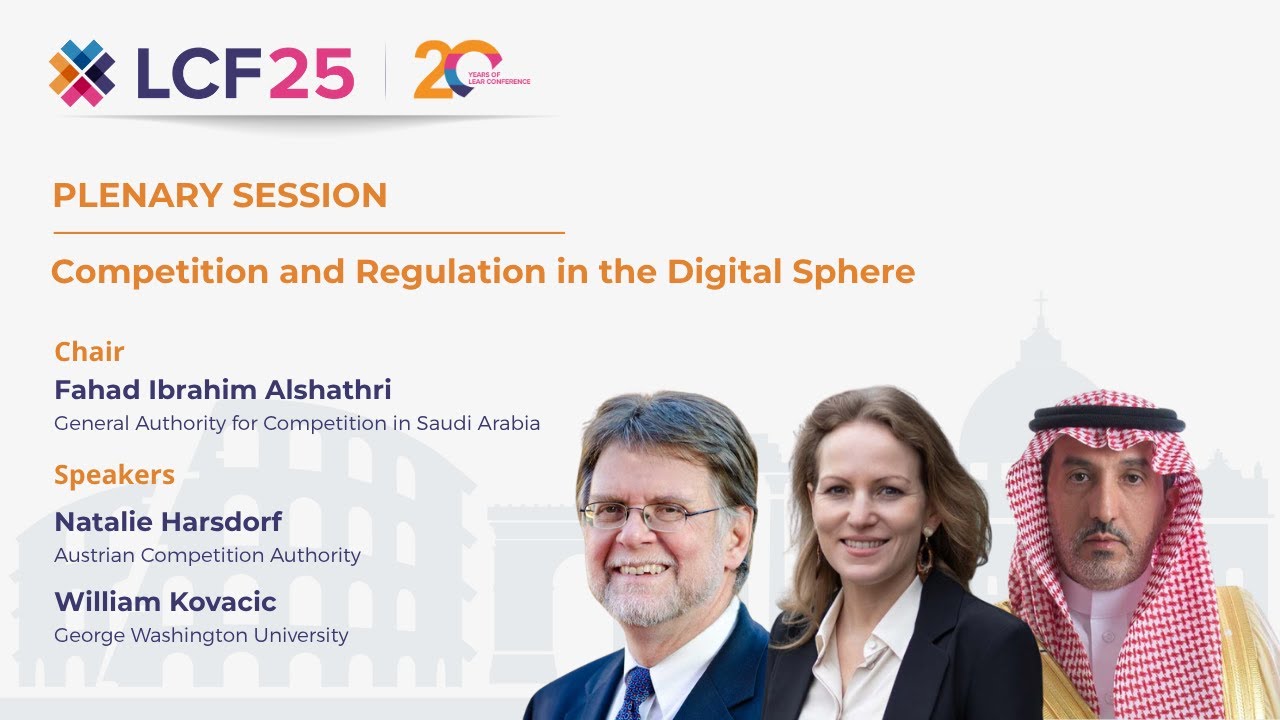
LCF25 - Competition and Regulation in the Digital Sphere - by Natalie Harsdorf and William Kovacic
Keywords
Summary
198 words
Critical Evaluation
Value of the Information & Strength of the Argument
The discussion provides valuable insights into the ongoing debate between traditional competition law and ex-ante regulation in digital markets. Harsdorf and Kovacic offer complementary perspectives: Harsdorf details the practical challenges and recent enforcement actions in the EU, while Kovacic provides a broader institutional and global view. Their arguments are well-reasoned and grounded in extensive experience, though they are primarily opinion-based rather than data-driven. The value lies in the nuanced understanding of the trade-offs between speed and flexibility, and the emphasis on the need for authorities to build technical expertise.
Scientific Rigor, Source Quality, Title Accuracy
The discussion is rigorous in its reliance on the speakers’ professional experience and knowledge of recent cases (e.g., Google ad tech, Apple, Meta). However, no formal sources are cited, and the arguments are based on expert opinion. The title accurately reflects the content, which is a focused debate on competition and regulation in the digital sphere. The speakers’ credentials lend credibility, but the lack of citations limits the verifiability of specific claims.
176 words
Title / Content Match
The title accurately reflects the content, which focuses on competition and regulation in the digital sphere.
Quality & Reliability
8/10
The discussion features two highly experienced competition law experts, providing authoritative insights into current regulatory debates. The content is well-structured and grounded in practical experience, though it lacks formal citations and is based on expert opinion rather than empirical research.
Key Moments
Markers derived by PSI from the transcript: the creator did not define chapters.
- Introduction and framing of the debate on competition law vs. regulation.
- Natalie Harsdorf discusses challenges in merger control and recent cases.
- Harsdorf explains the role of the DMA and its compliance mechanisms.
- Kovacic discusses global perspectives and resource constraints of smaller authorities.
- Kovacic advises on building knowledge and regional collaboration.
- Discussion on merger control and issues authorities should focus on.
Contribution & Novelties
The discussion offers a unique comparative perspective on the effectiveness of ex-ante regulation versus traditional competition law, drawing on the experiences of the EU and the US. It highlights the importance of knowledge-building and resource allocation for competition authorities, and the need for regional cooperation. The speakers provide practical insights into the challenges of enforcing competition law in digital markets, including the need to consider non-price dimensions.
Pour aller plus loin :
- Digital Markets Act (DMA) — Overview of the EU regulation.
- Competition law — General background on competition law.
- Federal Trade Commission — Official site of the US FTC, relevant to Kovacic’s experience.
104 words
Radar Profile
The radar profile shows high scores across all dimensions, indicating a well-rounded and informative discussion. The strengths lie in the quantity and quality of information, as well as the technical depth, while the slight lower score in reliability reflects the lack of formal citations.