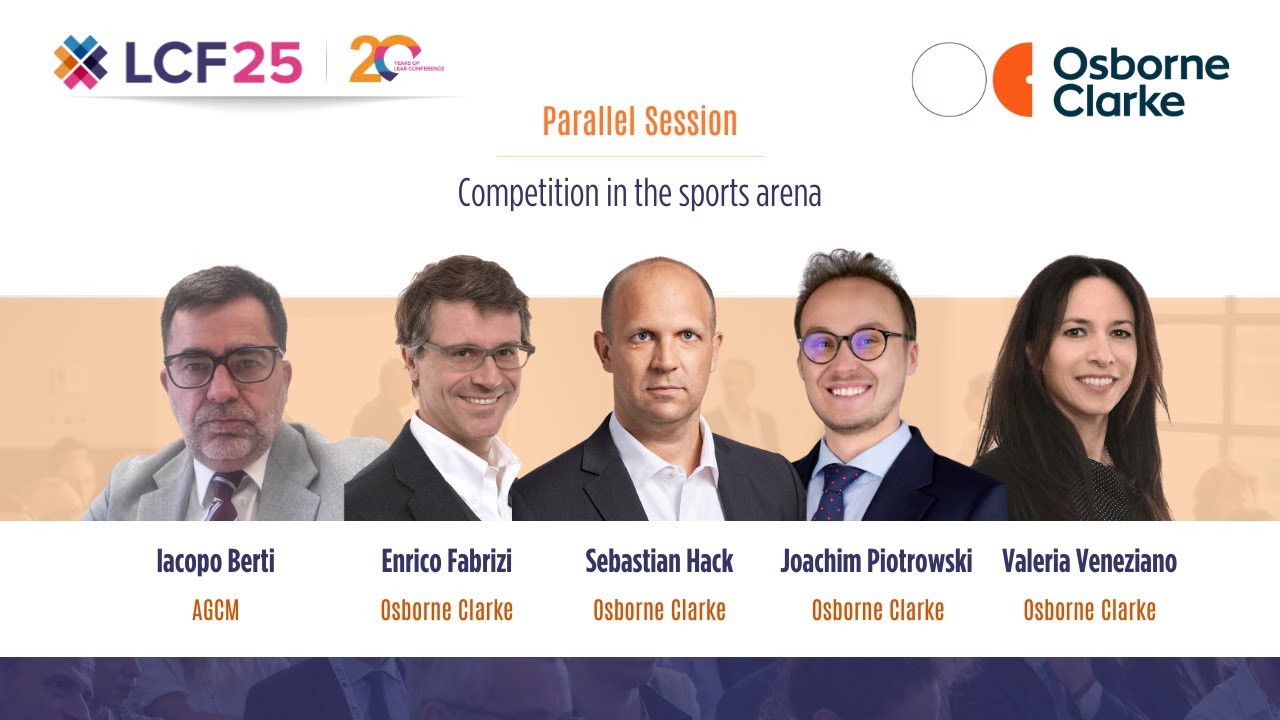
LCF25 - Competition in the sports arena
Keywords
Summary
140 words
Critical Evaluation
Value of the Information & Strength of the Argument
The panel provides valuable insights into the practical application of competition law in sports, drawing on recent case law and enforcement actions. The argumentation is solid, grounded in legal principles and specific cases, though it sometimes lacks depth in economic analysis. The discussion is balanced, presenting both enforcer and practitioner perspectives, and highlights the tension between sport’s unique characteristics and competition rules.
Scientific Rigor, Source Quality, Title Accuracy
The discussion references key CJEU cases (Bosman, Meca-Medina, Super League, ISU) and Advocate General opinions, demonstrating familiarity with relevant jurisprudence. However, specific sources are not cited in detail, and the video description provides no additional references. The title accurately reflects the content, and the panel’s expertise lends credibility. No public comments are available for analysis.
132 words
Title / Content Match
The title accurately reflects the content, which focuses on competition law in the sports sector.
Quality & Reliability
7/10
The panel features experienced competition law practitioners and an enforcer from the Italian Competition Authority, providing credible insights. However, the discussion is largely descriptive and lacks detailed citations or data sources, and the video has very low engagement metrics.
Key Moments
Markers derived by PSI from the transcript: the creator did not define chapters.
- Introduction by Enrico, setting the stage for the panel on competition law in sports.
- Yakopo discusses the economic significance of the sports industry and the application of Articles 101 and 102.
- Yakopo details Italian cases involving sports federations' restrictive practices.
- Sebastian discusses German cases, including the '50+1' rule and IOC restrictions.
- Panel discussion on the future of competition law in sports and the role of national authorities.
Cited Sources
- Case C-333/21 (Super League) — Referenced as a landmark CJEU judgment on sports governance and competition law.
- Case C-124/21 P (ISU) — Referenced as a case on abuse of dominance by a sports federation.
- Case C-680/13 (Meca-Medina) — Referenced as a case on anti-doping rules and competition law.
- Case C-415/93 (Bosman) — Referenced as a foundational case on player mobility and Article 45.
Concurring Sources
- European Commission - Competition policy in the sports sector — Provides official information on how EU competition rules apply to sports.
Contribution & Novelties
The panel offers a comparative perspective on how competition law is applied to sports in Italy and Germany, highlighting recent enforcement actions and regulatory developments. It underscores the growing economic importance of sports and the need for antitrust scrutiny. The discussion provides practical insights for practitioners and suggests that national competition authorities are increasingly active in this area.
Pour aller plus loin :
- EU competition law and sport — Official European Commission page on competition policy in the sports sector.
- Article 165 TFEU — Treaty provision recognizing the specificity of sport.
- The specificity of sport in EU law — European Parliament briefing on the specificity of sport in EU law.
110 words
Radar Profile
The radar profile shows high scores in information quantity and quality, reflecting the panel's substantive content and expertise. The technical level is also high, indicating a specialized audience. The overall reliability is strong, though the lack of detailed citations and low engagement metrics slightly reduce the score.