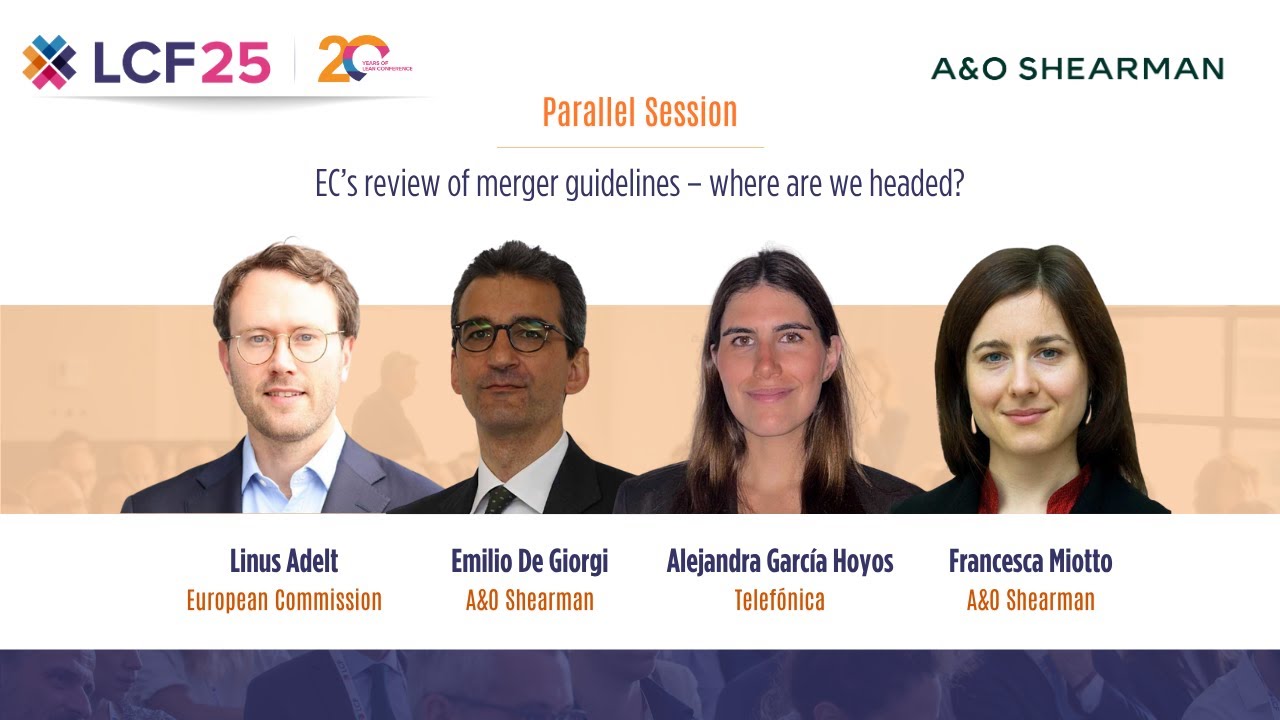
LCF25 - EC’s review of merger guidelines – where are we headed?
Keywords
Summary
205 words
Critical Evaluation
Value of the Information & Strength of the Argument
The video offers valuable insights into the ongoing debate on EU merger guidelines revision. The panelists present well-articulated arguments from different perspectives: the Commission’s balancing act, the telecom industry’s push for dynamic efficiency, and the legal/economic considerations. The discussion is substantive, addressing complex issues like innovation measurement and out-of-market effects. However, the arguments are largely based on the panelists’ professional opinions and experiences rather than empirical evidence, which limits the strength of the argumentation. The telecom perspective is particularly detailed, proposing concrete changes to the analytical framework, but it is not critically examined by other panelists.
Scientific Rigor, Source Quality, Title Accuracy
The video demonstrates a high level of scientific rigor in the sense that it features experts with deep knowledge of the subject. However, it lacks explicit citations to specific studies or reports, aside from references to the Draghi report and the Commission’s consultation documents. The title accurately reflects the content, and the discussion stays on topic. The absence of formal sources is a limitation, but the panelists’ expertise lends credibility. The video does not include any public comments, so no analysis of audience reception is possible.
197 words
Title / Content Match
The title accurately reflects the content, which focuses on the European Commission's review of merger guidelines and the direction it may take.
Quality & Reliability
7/10
The video features a panel of experts from the European Commission, private practice, and the telecom industry, providing a balanced discussion on the revision of EU merger guidelines. The content is well-structured and grounded in current policy debates, but it lacks formal citations and relies on the panelists' expertise rather than verifiable sources.
Key Moments
Markers derived by PSI from the transcript: the creator did not define chapters.
- Introduction by moderator Francesca, setting the context of the EC's consultation on merger guidelines.
- Lenos Adult discusses the trade-off between scale and market power, arguing that there is no fundamental conflict.
- Alejandra Garcia presents Telefonica's perspective, criticizing the Commission's static analysis and advocating for dynamic efficiency.
- Discussion on how innovation can be better integrated into merger review, including the Commission's commissioned study.
- Lenos addresses concerns about killer acquisitions and the need to support startups' exit strategies.
- Alejandra discusses the role of remedies, citing the UK's Vodafone-Three merger as an example.
- Panelists answer questions from the audience, touching on sector-specific approaches and the future of merger control.
Cited Sources
- European Commission consultation on merger guidelines — Referenced as the ongoing consultation that the panel discusses.
- Draghi report on European competitiveness — Mentioned as a key driver for the revision, particularly regarding telecoms fragmentation.
Concurring Sources
- Draghi report on European competitiveness — The report's recommendations on telecoms and scale align with the panel's discussion.
Dissenting Sources
- Academic studies on merger effects — The panel acknowledges that academic literature is mixed on the effects of mergers on innovation, with some studies suggesting negative impacts.
Contribution & Novelties
The video provides a timely and balanced overview of the ongoing revision of EU merger guidelines, highlighting the tension between scale and market power, and the need to incorporate dynamic efficiency and innovation into merger analysis. It offers insights from the Commission, private practice, and industry, making it a valuable resource for understanding the current debate.
Pour aller plus loin :
- EU merger control — Official EU page on merger control, providing background on the legal framework.
- Dynamic efficiency in competition policy — Overview of the concept and its relevance to merger analysis.
- Killer acquisitions — Explanation of the term and its implications for innovation.
105 words
Radar Profile
The radar profile shows high scores in quantity and quality of information, reflecting the depth of the discussion. The technical level is moderate, making it accessible to a broad audience. The overall reliability is good, but the lack of formal citations slightly reduces the score.