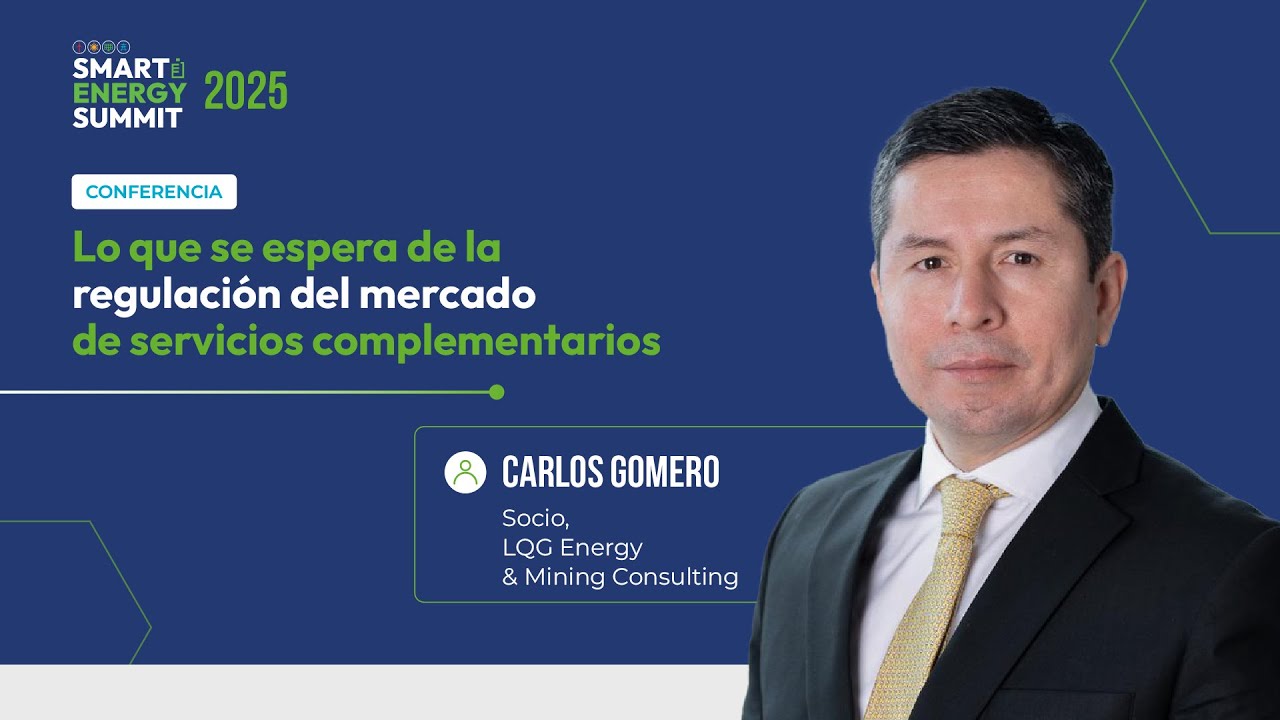
Lo que se espera de la regulación del mercado de servicios complementarios - Carlos Gomero
Keywords
Summary
161 words
Critical Evaluation
Value of the Information & Strength of the Argument
The presentation offers valuable insights into the regulatory evolution of ancillary services in Peru, drawing on the speaker’s professional expertise. The argumentation is coherent and well-structured, tracing the historical development from fragmented rules to the recent law. Gomero effectively highlights the shortcomings of the current system, such as misaligned incentives for Black Start and the lack of a true market. He argues convincingly for a market-based approach, emphasizing the importance of competition and technological neutrality. However, the analysis is largely qualitative and lacks quantitative data or case studies to strengthen the claims. The discussion of the causality principle and its potential impact on renewables is thought-provoking but could benefit from more concrete examples.
Scientific Rigor, Source Quality, Title Accuracy
The speaker demonstrates a strong understanding of the regulatory landscape, referencing specific laws (Law 32249, Law 28832) and technical procedures (PR-9, PR-20, PR-21, PR-22). However, no external sources are cited, and the presentation relies solely on the speaker’s interpretation. The title accurately reflects the content, which focuses on expectations for the regulation. The content is consistent with the title, though it could have delved deeper into specific regulatory proposals. No comments were provided, so public reception cannot be assessed.
207 words
Title / Content Match
The title accurately reflects the content, which focuses on expectations for the regulation of the ancillary services market in Peru.
Quality & Reliability
7/10
The speaker is a partner at LQG Energy and Mining Consulting, providing expert analysis based on regulatory experience. The content is well-structured and references specific laws and technical procedures, but lacks citations to external sources and is primarily opinion.
Key Moments
Markers derived by PSI from the transcript: the creator did not define chapters.
- Introduction and context of the presentation
- Overview of current regulatory framework for ancillary services
- Discussion of primary and secondary frequency regulation
- Analysis of Black Start and cold reserve services
- Introduction of Law 32249 and its implications
- Expectations for the new regulation: organic and systematic approach
- Market design considerations: pricing and allocation mechanisms
- Application of causality principle and impact on renewables
- Final reflections on the role of demand and conclusion
Cited Sources
- Law 32249 — Mentioned as the recent law introducing the ancillary services market
- Law 28832 — Mentioned as the law that elevated ancillary services to legal status
- Technical Procedure PR-9 — Referenced for Black Start operation
- Technical Procedure PR-20 — Referenced for synthetic inertia discussion
- Technical Procedure PR-21 — Referenced for primary frequency regulation
- Technical Procedure PR-22 — Referenced for secondary frequency regulation
Contribution & Novelties
The presentation provides a clear and expert perspective on the regulatory evolution of ancillary services in Peru, highlighting the shift from a fragmented system to a market-based approach. It offers practical insights into the challenges and expectations for the upcoming regulation, particularly regarding the causality principle and its impact on renewable energy projects.
Pour aller plus loin :
- Ancillary services in electricity markets — Provides a general overview of ancillary services and their role in power systems.
- Law 32249 (Peru) — Official text of the law mentioned in the video.
- COES (Peru’s system operator) — Official website of the Peruvian system operator, relevant for understanding the operational context.
108 words
Radar Profile
The radar profile shows a balanced performance across all dimensions, with slightly higher scores in information quantity and reliability, reflecting the speaker's expertise and structured presentation. The lower score in technical level suggests the content is accessible to a general audience, while still providing valuable insights.