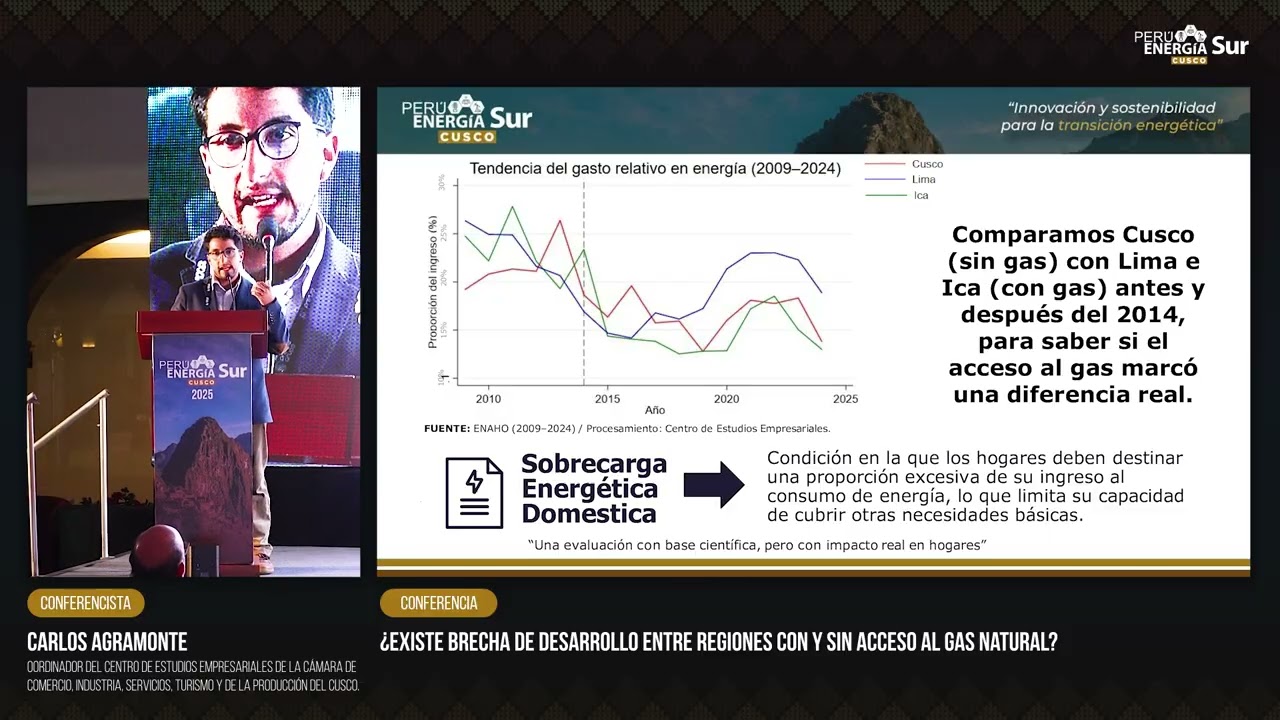
¿Existe brecha de desarrollo entre regiones con y sin acceso al gas natural? │ Perú Energía Cusco
Keywords
Summary
241 words
Critical Evaluation
Value of the Information & Strength of the Argument
The presentation provides valuable insights into the potential economic benefits of natural gas access in a specific region, using a simulation based on official data. The argumentation is coherent, linking energy poverty to broader development outcomes. However, the analysis relies heavily on a single simulation and does not thoroughly address potential counterarguments or alternative energy solutions. The speaker’s affiliation with a business chamber may introduce a pro-gas bias, and the lack of detailed methodological transparency limits the strength of the claims.
Scientific Rigor, Source Quality, Title Accuracy
The speaker cites official sources such as ENAHO (National Household Survey) and Osinergmin (regulatory body), which adds credibility. However, the presentation does not provide specific references or links to the underlying study, making it difficult to verify the data and methodology. The title accurately reflects the content, focusing on regional development gaps related to natural gas access. No comments were provided for analysis.
159 words
Title / Content Match
The title accurately reflects the content, which compares development gaps between regions with and without natural gas access, focusing on Cusco.
Quality & Reliability
5/10
The presentation is based on a study by the Business Studies Center, using data from official sources (ENAHO, Osinergmin). However, the methodology is not fully detailed, and the speaker is an industry advocate, which may introduce bias. The analysis is largely qualitative with limited peer-reviewed evidence.
Key Moments
Markers derived by PSI from the transcript: the creator did not define chapters.
- Introduction and context: presentation of the study on natural gas and poverty in Cusco.
- Peru's household gas connection rate (18%) and comparison with Bolivia.
- Cusco's economic indicators: GDP per capita, growth rate, and urban/rural population split.
- Definition of energy poverty based on Osinergmin criteria (10% threshold).
- Comparison of energy expenditure across Cusco, Lima, and Ica, highlighting the role of income levels.
- Simulation of Cusco with natural gas access using difference-in-differences methodology.
- Trends in energy poverty from 2009 to 2024, showing Cusco's stagnation compared to Lima.
- Economic multiplier effects: increased disposable income, consumption, and job creation.
- Conclusions: gas reduces energy poverty, improves income, and Cusco has potential to lead gas expansion.
Cited Sources
- ENAHO (Encuesta Nacional de Hogares) — Mentioned as the source for household income and expenditure data used in the analysis.
- Osinergmin — Cited for the criteria defining energy poverty (10% of income spent on energy).
Concurring Sources
- World Bank - Peru — The World Bank provides data and analysis on poverty and energy access in Peru, which may support the claims about regional disparities.
Dissenting Sources
- IEA - Energy Poverty — The IEA's definition of energy poverty focuses on lack of access to modern energy services, which may differ from the expenditure-based approach used in the video, potentially leading to different conclusions.
Contribution & Novelties
The presentation offers a region-specific analysis of the potential impact of natural gas on poverty and economic development in Cusco, using a simulation based on official data. It highlights the multidimensional nature of energy poverty, considering not only cost but also quality and continuity of energy. The study contributes to the debate on energy policy in Peru, advocating for gas expansion as a tool for regional development.
Pour aller plus loin :
- Energy poverty — Provides a general overview of energy poverty definitions and measurement.
- Difference in differences — Explains the econometric method used in the simulation.
- Natural gas in Peru — Offers context on the natural gas sector in Peru, including infrastructure and policy.
115 words
Radar Profile
The radar profile shows moderate scores across all dimensions, with slightly higher scores in information quantity and technical level, but lower in reliability. This suggests a presentation that provides useful data and a clear argument, but lacks rigorous sourcing and methodological transparency.