¿Cuáles son los avances en la masificación del gas natural en Cusco? - Perú Energía Cusco 2025
Keywords
Summary
207 words
Critical Evaluation
Value of the Information & Strength of the Argument
The video provides valuable insights into a real-world case of natural gas adoption in a high-altitude region, offering concrete data on conversion numbers and economic benefits. The argumentation is based on practical experience and specific examples, such as the growth from 620 to 4,000 conversions and the reduction in fuel costs for taxi drivers. However, the presentation is largely anecdotal and promotional, lacking detailed technical analysis or independent data. The speaker’s role as a company representative introduces potential bias, and the claims about environmental benefits and cost savings are not substantiated with quantitative evidence. The argument that altitude is not a barrier is supported by the existence of operating vehicles, but technical specifics are not provided.
Scientific Rigor, Source Quality, Title Accuracy
The video is a conference presentation, not a peer-reviewed study. The speaker cites the Camisea Consortium and Fondo FISE as partners, but no external sources or references are provided. The title accurately reflects the content, which focuses on advances in natural gas massification in Cusco. The presentation is coherent and well-structured, but the lack of citations and reliance on personal experience limit its scientific rigor. No comments were provided for analysis.
202 words
Title / Content Match
The title accurately reflects the content, which focuses on advances in natural gas massification in Cusco.
Quality & Reliability
7/10
The video presents a practitioner's account of a natural gas vehicle conversion program in Cusco, Peru. It includes specific data (620 conversions in 2021, 4000 by 2024) and references to technical feasibility at altitude, but lacks independent verification and detailed technical evidence. The speaker is an industry insider, which lends practical credibility but also potential bias.
Key Moments
Markers derived by PSI from the transcript: the creator did not define chapters.
- Introduction and thanks to Perú Energía; speaker introduces Eva Energy and its partners.
- Background on Eva Energy: alliance between Limagas Natural and Spanish company HAM, with experience in natural gas.
- Focus on Cusco as an example of massification; four actors involved: Camisea Consortium, Primax, and local entrepreneur Wilber Loza.
- Discussion of initial skepticism about NGV at altitude; technical evidence shows it works up to 4,000 meters.
- Growth from 620 conversions in 2021 to 4,000 vehicles in 2024; benefits for families and taxi drivers.
- Social benefits: reduced fuel costs, additional income, and lower pollution; 98% of converted vehicles are used for work.
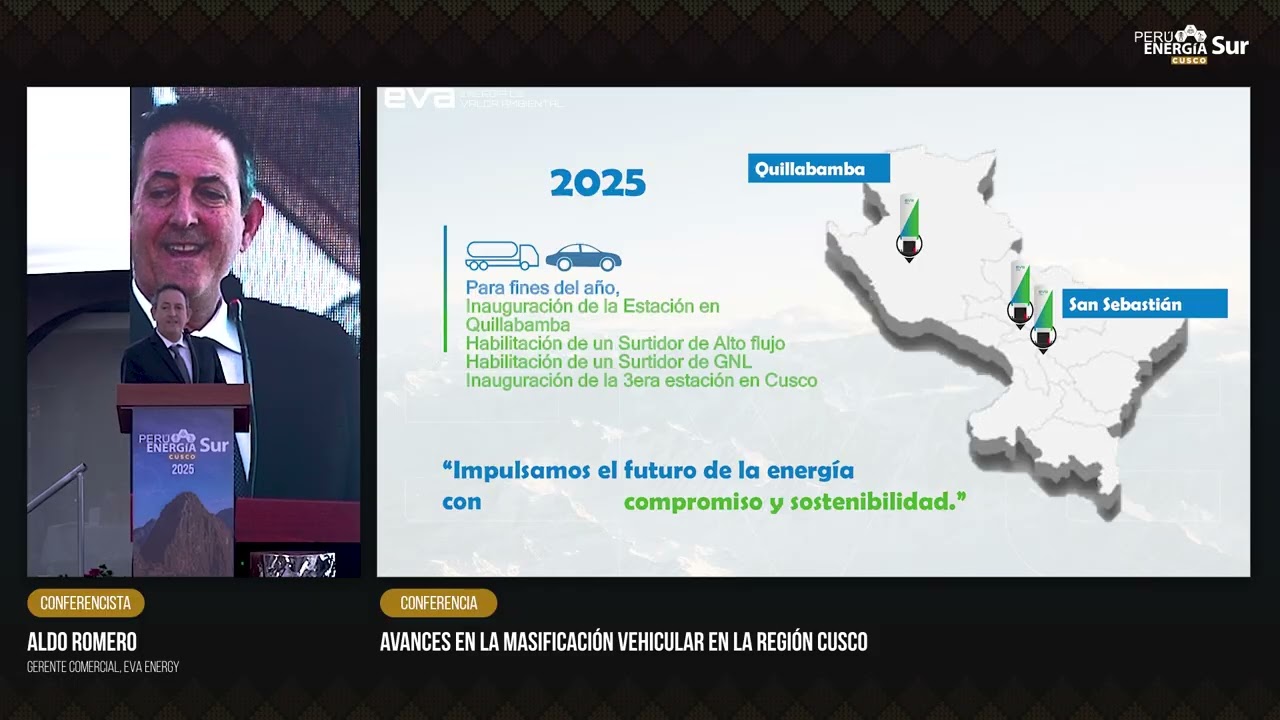
- Future projects: new station in Quillabamba, high-flow dispensers in San Sebastián for public transport conversion.
- Third NGV station by year-end; new free conversion program with Camisea and Fondo FISE for 100-200 families.
- GNL corridor from Lima to Arequipa with stations in Mala, Nazca, and La Joya; trucks with 1000-2000 km autonomy.
- Plans for mining corridor to Espinar and 16 stations by 2025; emphasis on private investment and replicability.
Contribution & Novelties
The video provides a case study of natural gas vehicle adoption in a high-altitude Andean city, demonstrating that technical barriers can be overcome with proper conversion and equipment. It highlights a successful public-private partnership model and quantifies the growth in conversions. The presentation offers practical insights for replicating similar initiatives in other regions.
Pour aller plus loin :
- Natural gas vehicle — Overview of NGV technology and benefits.
- Compressed natural gas — Details on CNG as a fuel.
- Liquefied natural gas — Information on LNG and its applications.
- Camisea Gas Project — Background on the Peruvian natural gas project.
99 words
Radar Profile
The radar profile shows moderate scores across all dimensions, with slightly higher quality of information and lower technical level. This indicates a balanced but not deeply technical presentation, suitable for a general audience interested in energy projects.