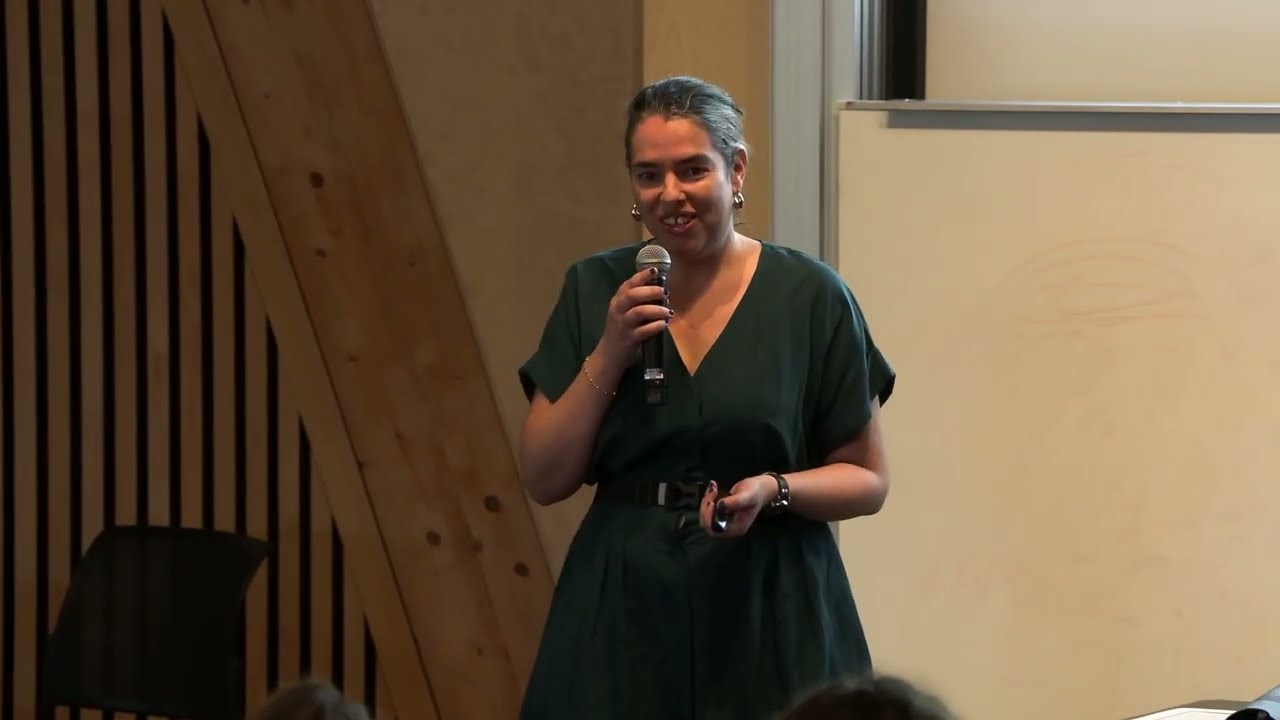
Denise Cadete - 15th Frith Prize Lecture (2026)
Keywords
Summary
181 words
Critical Evaluation
Value of the Information & Strength of the Argument
The lecture provides valuable insights into body perception, a relatively understudied area. The speaker presents a coherent narrative, building from established illusions (rubber hand, mirror box) to her own novel paradigms. The argumentation is solid: she systematically tests alternative explanations (e.g., invisibility, finger-specificity) and acknowledges limitations. The use of multiple experiments and converging evidence strengthens the claims. The discussion of clinical and evolutionary implications adds depth. However, some conclusions are based on single studies and would benefit from replication.
Scientific Rigor, Source Quality, Title Accuracy
The lecture demonstrates scientific rigor through detailed methodology and appropriate referencing. The speaker cites key studies (e.g., Nagel, Ramachandran, Botvinick & Cohen) and recent work (e.g., Tamar Makin’s group). The title accurately reflects the content. The presentation is well-structured, with clear hypotheses and results. The speaker is careful not to overstate findings, acknowledging uncertainties. The inclusion of control conditions and statistical analyses (e.g., perceived location) enhances credibility.
161 words
Title / Content Match
The title accurately reflects the content: a prize lecture by Denise Cadete presenting her research on body perception.
Quality & Reliability
8/10
The lecture presents original research from the speaker's PhD, with references to established studies (e.g., rubber hand illusion, mirror box) and recent findings. The methodology is described in detail, and the results are presented with appropriate caution. However, as a single lecture, it lacks peer review and independent replication.
Key Moments
Markers derived by PSI from the transcript: the creator did not define chapters.
- Introduction: What is it like to have a body? Nagel's bat analogy, octopus example.
- Body map in the brain, phantom limb persistence.
- Rubber hand illusion and its use in studying body perception.
- Six-finger illusion: method and initial findings.
- Testing shape and posture flexibility of the extra finger.
- Application to anorexia: posture constraint.
- Action affordances: changes in perceived hand size.
- Extra arm illusion and self-other boundary.
- Evolutionary and clinical perspectives: six-finger individuals, robotic extra finger.
- Perceived hand weight: psychophysical staircase, underestimation, fatigue effect.
Cited Sources
- Nagel, T. (1974). What is it like to be a bat? — Philosophical basis for the subjective experience of having a body.
- Botvinick, M., & Cohen, J. (1998). Rubber hands 'feel' touch that eyes see. — Classic rubber hand illusion study.
- Ramachandran, V. S., & Rogers-Ramachandran, D. (1996). Synaesthesia in phantom limbs induced with mirrors. — Mirror box illusion for phantom limb pain.
- Guterstam, A., et al. (2013). The invisible hand illusion. — Invisible hand illusion study.
- Makin, T. R., et al. (2013). Phantom limb pain and the brain. — Persistence of limb representation after amputation.
- Kieliba, P., et al. (2021). Robotic sixth finger and cortical changes. — Study on robotic extra finger and motor control.
Concurring Sources
- Botvinick, M., & Cohen, J. (1998). Rubber hands 'feel' touch that eyes see. — Supports the role of synchronous visual-tactile stimulation in body ownership.
- Guterstam, A., et al. (2013). The invisible hand illusion. — Shows that invisibility alone does not explain flexibility; posture constraints remain.
- Makin, T. R., et al. (2013). Phantom limb pain and the brain. — Supports persistence of body representation after limb loss.
Dissenting Sources
- Kieliba, P., et al. (2021). Robotic sixth finger and cortical changes. — Suggests that using a robotic extra finger may reduce motor control, contrasting with the idea of enhanced abilities.
Contribution & Novelties
The lecture presents novel findings on the flexibility of supernumerary body part representation, showing that the brain can embody extra fingers and arms in various orientations, shapes, and even from another person. It also introduces a new method to measure perceived body weight, revealing systematic underestimation. These contributions advance our understanding of body representation and have implications for prosthetics and rehabilitation.
Pour aller plus loin :
- Rubber hand illusion — Foundational illusion for studying body ownership.
- Phantom limb — Phenomenon of persistent limb representation after amputation.
- Somatosensory cortex — Brain area processing touch and body position.
- Mirror box — Therapy for phantom limb pain.
- Body schema — Concept of body representation in neuroscience.
113 words
Radar Profile
The radar profile shows high scores in information quantity, quality, and reliability, with a slightly lower technical level, indicating a well-supported and accessible presentation of complex neuroscience research.
💬 No comments were provided for analysis.