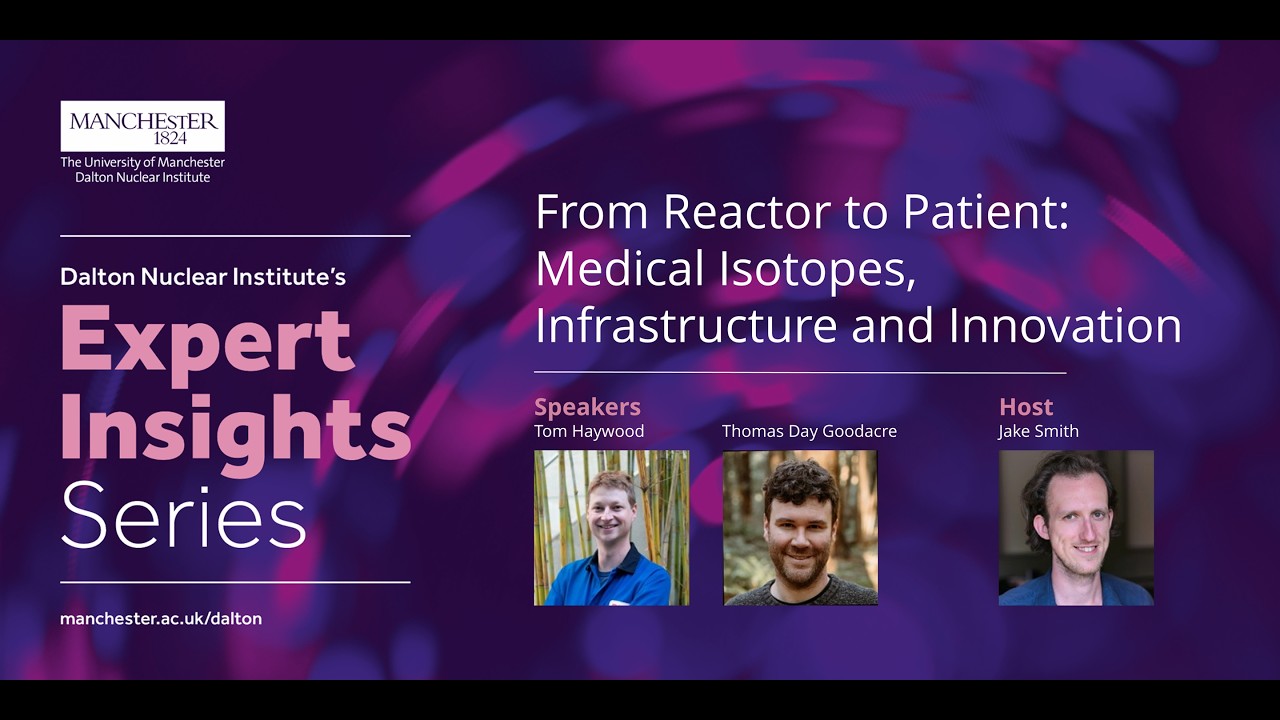
From Reactor to Patient: Medical Isotopes, Infrastructure and Innovation
Keywords
Summary
159 words
Critical Evaluation
Value of the Information & Strength of the Argument
The discussion provides valuable insights into the medical isotope landscape, particularly the UK’s supply chain vulnerabilities and the potential of new technologies like compact fusion neutron sources. The argumentation is solid, grounded in the speakers’ extensive experience in nuclear physics and industry. They effectively explain complex concepts such as theranostics and the differences between reactor and accelerator production, making a compelling case for diversifying production methods. However, the conversation is somewhat high-level and lacks quantitative data or specific examples of clinical outcomes, which would strengthen the argumentation.
96 words
Title / Content Match
The title accurately reflects the content, covering the journey of medical isotopes from production to patient use, including infrastructure and innovation.
Quality & Reliability
7/10
The discussion is led by experts in nuclear physics and medical isotope production, providing accurate technical information. However, it is a conversational panel without formal citations or peer-reviewed references, limiting verifiability.
Key Moments
Markers derived by PSI from the transcript: the creator did not define chapters.
- Introduction of speakers and their backgrounds.
- Discussion on why radioisotopes are used in medicine, covering diagnostics and therapy.
- Explanation of why many different isotopes are needed, focusing on half-life and decay energy.
- Thomas discusses his background at CERN and TRIUMF and the use of ISOL techniques.
- Tom Haywood introduces Astral Systems and their compact fusion neutron sources for isotope production.
- Comparison of reactor and accelerator production, including the UK's reliance on imports.
- Discussion on theranostics and the use of isotope pairs for diagnosis and therapy.
- Explanation of ISOL and SPECT acronyms, and the role of facilities like ISOLDE and MEDICIS.
- Further discussion on terbium isotopes and their potential in theranostics.
- Q&A session begins, addressing audience questions.
Cited Sources
- ISOLDE facility at CERN — Mentioned as a facility for producing exotic nuclei for fundamental physics and medical isotope research.
- TRIUMF — Mentioned as a national particle accelerator center in Canada where Thomas worked.
- MEDICIS facility at CERN — Mentioned as a facility next to ISOLDE dedicated to medical isotope production.
Concurring Sources
- IAEA on Medical Isotopes — The IAEA provides authoritative information on medical isotope production and supply, aligning with the discussion's emphasis on global challenges.
- NHS England on Nuclear Medicine — The NHS relies on medical isotopes for diagnostics and therapy, supporting the discussion's relevance to healthcare.
Dissenting Sources
- Potential concerns about fusion neutron sources — The discussion presents fusion neutron sources as a promising alternative, but some experts may question their scalability and cost-effectiveness compared to established methods.
Contribution & Novelties
The session provides a unique perspective on the UK’s medical isotope supply chain, highlighting the potential of compact fusion neutron sources as a disruptive technology. It bridges fundamental nuclear physics and clinical applications, offering insights into theranostics and the importance of production route diversity. The discussion underscores the need for innovation to address aging infrastructure and supply chain resilience.
Pour aller plus loin :
- Theranostics — Overview of theranostics combining therapy and diagnostics.
- Inertial electrostatic confinement — Background on the fusion technology used by Astral Systems.
- Technetium-99m generator — Explanation of the most common medical isotope and its production.
- ISOL technique — Details on isotope separation online, a key method for producing exotic isotopes.
114 words
Radar Profile
The radar profile shows high scores in information quality and technical level, reflecting the expert panel's depth. The lower score in information quantity suggests the discussion could have provided more data or examples. Overall, the profile indicates a technically rich but somewhat concise session.
💬 No comments were provided for analysis.