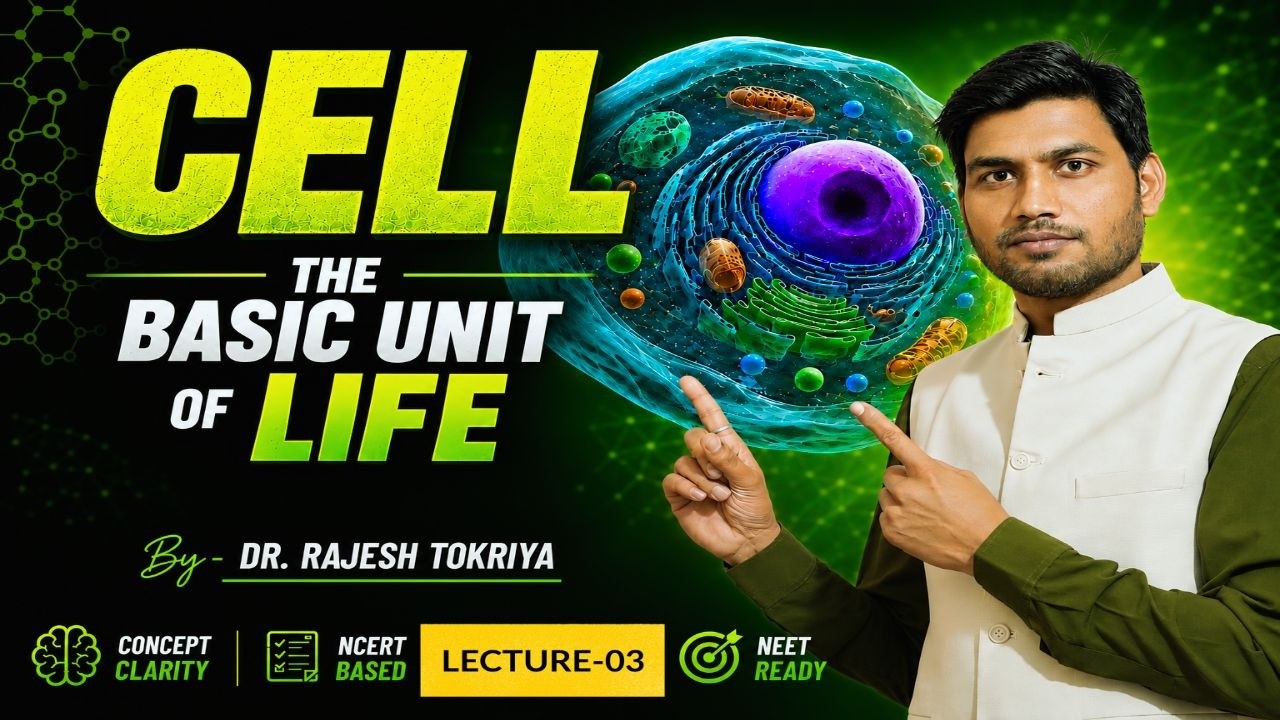
L-3: Types of Cell (Prokaryotic & Eukaryotic Cell)
Keywords
Summary
180 words
Critical Evaluation
Value of the Information & Strength of the Argument
The video provides a clear and accessible introduction to cell types, using analogies to make the concepts relatable. The argumentation is straightforward, relying on established biological facts. However, the depth is limited; it does not delve into molecular details or evolutionary significance. The value lies in its pedagogical approach for beginners, but it lacks critical analysis or novel insights.
Scientific Rigor, Source Quality, Title Accuracy
The scientific rigor is moderate; the information is accurate but presented without citations or references. The title accurately reflects the content. The video does not cite any external sources, and the description mentions NCERT-based concepts, but no specific references are provided. The absence of sources reduces the overall reliability for advanced learners.
126 words
Title / Content Match
The title accurately reflects the content, which focuses on the types of cells.
Quality & Reliability
6/10
The content is accurate but basic, relying on standard textbook knowledge. The presentation is clear but lacks depth and critical analysis. No sources are cited, and the video is a lecture-style tutorial.
Key Moments
Markers derived by PSI from the transcript: the creator did not define chapters.
- Introduction and recap of cell theory
- Explanation of the term 'prokaryotic' and 'eukaryotic'
- Analogy with old mobile phones to describe prokaryotic cells
- Detailed structure of prokaryotic cells: cell wall, plasma membrane, cytoplasm, DNA
- Absence of membrane-bound organelles in prokaryotes; presence of 70S ribosomes
- Examples of prokaryotes: bacteria, cyanobacteria, archaebacteria
- Introduction to eukaryotic cells and smartphone analogy
- Structure of eukaryotic cells: nucleus, organelles, and nuclear membrane
- Comparison between prokaryotic and eukaryotic cells
- Summary and conclusion
Contribution & Novelties
The video offers a beginner-friendly explanation of cell types, using relatable analogies to aid understanding. It is particularly useful for students preparing for competitive exams like NEET, as it aligns with NCERT curriculum. However, it does not introduce new scientific information.
Pour aller plus loin :
- Cell (biology) — Overview of cell structure and function.
- Prokaryote — Detailed information on prokaryotic cells.
- Eukaryote — Detailed information on eukaryotic cells.
- Endosymbiotic theory — Explains the origin of eukaryotic organelles.
78 words
Radar Profile
The radar profile shows moderate scores across all dimensions, with a slightly higher score in information quantity and quality, and lower in technical level. This indicates a balanced but basic educational content, suitable for beginners but not for advanced learners.