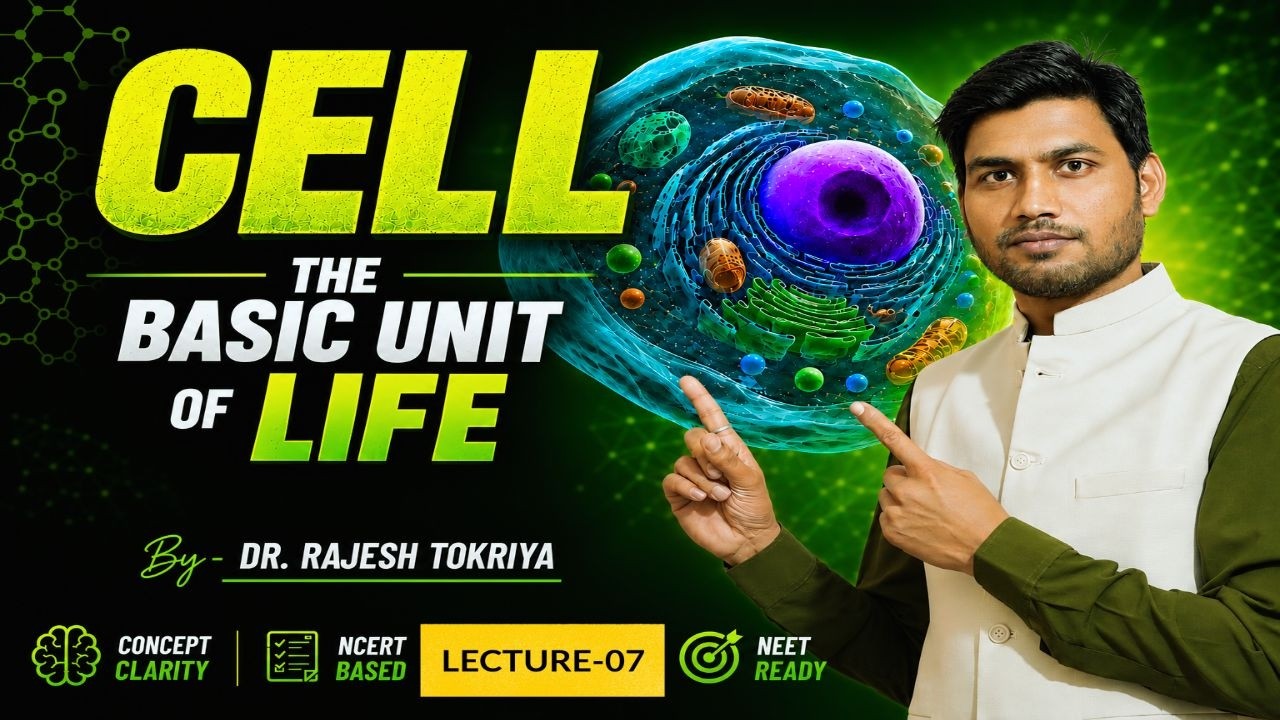
L-7 (Part-2) Ultrastructure of the Prokaryotic Cell (Bacteria)
Keywords
Summary
169 words
Critical Evaluation
Value of the Information & Strength of the Argument
The lecture provides a clear and structured explanation of prokaryotic cell components, particularly focusing on the cytoplasm, ribosomes, and plasmids. The instructor uses diagrams and analogies to simplify complex concepts, such as comparing polyribosomes to multiple people on a bike. The argumentation is logical and builds on previous knowledge, but it lacks critical analysis or comparison with eukaryotic cells. The value lies in its educational clarity for beginners, though it does not offer new insights for advanced students.
Scientific Rigor, Source Quality, Title Accuracy
The scientific rigor is moderate; the content is accurate but basic, based on standard textbooks like NCERT. No external sources are cited, and the instructor relies on established knowledge. The title accurately reflects the content, which is a detailed tutorial on prokaryotic cell ultrastructure. The lecture is well-structured, but the lack of citations and the repetitive nature reduce its scientific depth.
154 words
Title / Content Match
The title accurately reflects the content, which focuses on the ultrastructure of prokaryotic cells, specifically bacteria.
Quality & Reliability
7/10
The lecture is based on standard biology textbooks (NCERT) and covers fundamental concepts accurately. The instructor explains structures and functions clearly, but the content is basic and lacks depth for advanced learners. No external sources are cited, and the presentation is purely didactic.
Key Moments
Markers derived by PSI from the transcript: the creator did not define chapters.
- Introduction and recap of previous lecture on cell envelope.
- Definition of protoplasm as living material of the cell.
- Explanation of cytoplasm: colorless, jelly-like, contains organelles.
- Discussion on nucleoid and absence of nuclear membrane.
- Introduction to ribosomes: 70S type in prokaryotes, composed of 50S and 30S subunits.
- Explanation of polyribosomes (polysomes) and their role in protein synthesis.
- Discussion on plasmids: extrachromosomal DNA, functions.
- Inclusion bodies as storage granules.
- Summary and emphasis on note-taking.
Contribution & Novelties
The lecture provides a foundational understanding of prokaryotic cell ultrastructure, focusing on cytoplasm, ribosomes, and plasmids. It is particularly useful for students preparing for competitive exams like NEET. The explanation of polyribosomes and the distinction between 70S and 80S ribosomes are key takeaways.
Pour aller plus loin :
- Prokaryotic cell — Overview of prokaryotic cell structure.
- Ribosome — Detailed article on ribosome structure and function.
- Plasmid — Comprehensive information on plasmids and their roles.
74 words
Radar Profile
The radar profile shows moderate scores across all dimensions, indicating a balanced but basic educational content. The highest score is in quality of information, reflecting accurate but elementary explanations. The low technical level suggests the lecture is aimed at beginners.