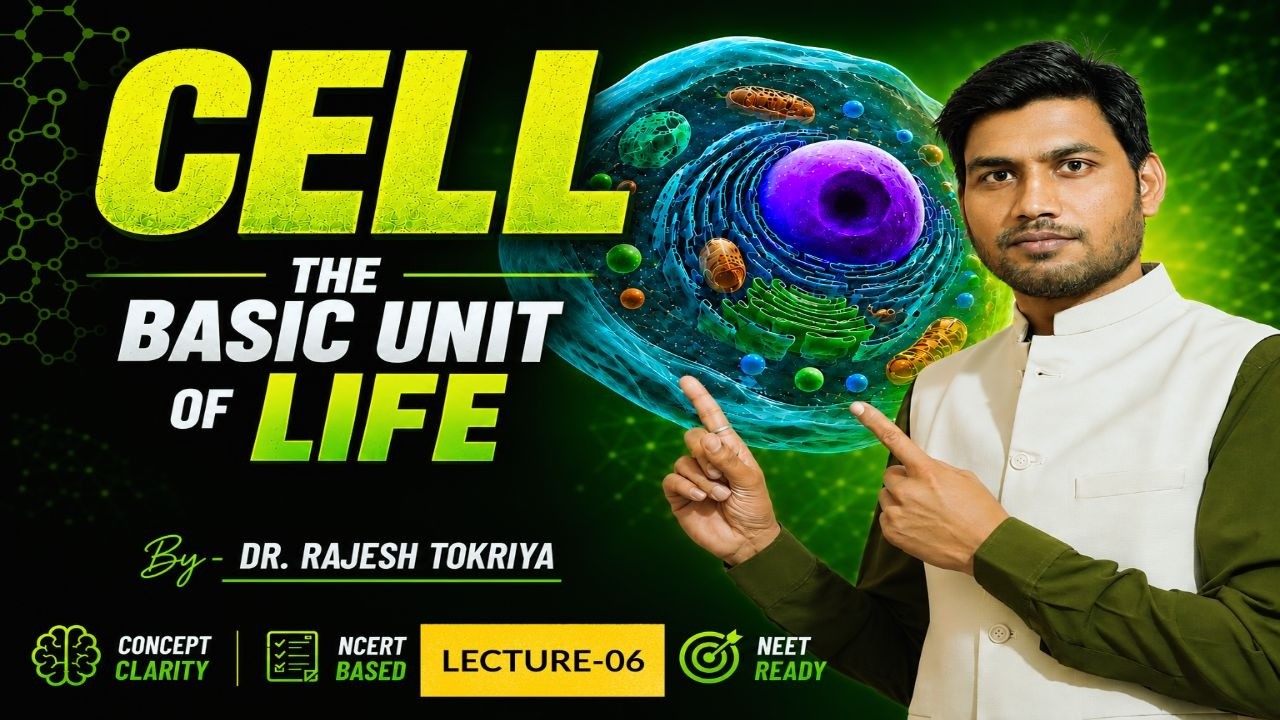
L-6 (Part-1) Ultrastructure of the Prokaryotic Cell (Bacteria)
Keywords
Summary
160 words
Critical Evaluation
Value of the Information & Strength of the Argument
The lecture provides valuable information for students learning about prokaryotic cell structure, with clear explanations and practical examples. The argumentation is solid, as it builds on previous knowledge and logically progresses from the outer layers to the inner components. The instructor uses analogies (e.g., Lactobacillus in yogurt) to illustrate concepts, making the content accessible. However, the presentation is one-sided, with no discussion of alternative viewpoints or recent research, which limits its depth.
Scientific Rigor, Source Quality, Title Accuracy
The scientific rigor is moderate: the content aligns with standard biology textbooks, but no specific sources are cited within the video. The description mentions NCERT-based concepts, which is a reliable reference for Indian board exams. The title accurately reflects the content, and the lecture stays on topic. No comments were provided for analysis, so public reception cannot be assessed.
146 words
Title / Content Match
The title accurately reflects the content, which focuses on the ultrastructure of prokaryotic cells, specifically bacteria.
Quality & Reliability
7/10
The lecture provides accurate and detailed information on prokaryotic cell ultrastructure, consistent with standard biology textbooks. However, it lacks citations to primary sources and is presented in a tutorial style with some informal language.
Key Moments
Markers derived by PSI from the transcript: the creator did not define chapters.
- Introduction and welcome, recap of previous lecture on cell structure.
- Definition of ultrastructure and its significance in studying cells.
- Overview of cell envelope components: glycocalyx, cell wall, plasma membrane.
- Detailed discussion on glycocalyx: slime layer vs capsule, composition and functions.
- Explanation of capsule's role in virulence and pathogenicity, with examples.
- Introduction to cell wall: location, composition, and functions.
- Discussion on peptidoglycan structure and its importance in bacteria.
- Mention of Mycoplasma as an exception lacking cell wall, and summary.
Contribution & Novelties
The lecture offers a clear and structured explanation of prokaryotic cell ultrastructure, particularly the cell envelope, which is fundamental for understanding bacterial biology. It connects theoretical concepts with practical examples, such as the pathogenicity of encapsulated bacteria. The ‘Pour aller plus loin’ section suggests further exploration of related topics.
Pour aller plus loin :
- Peptidoglycan — Detailed article on the structure and function of peptidoglycan.
- Glycocalyx — Overview of the glycocalyx in various cell types.
- Mycoplasma — Information on Mycoplasma, the bacterium lacking a cell wall.
86 words
Radar Profile
The radar profile shows balanced scores across all dimensions, with slightly higher scores in information quantity and technical level, indicating a comprehensive yet accessible lecture. The lower score in information quality suggests room for more in-depth scientific rigor.