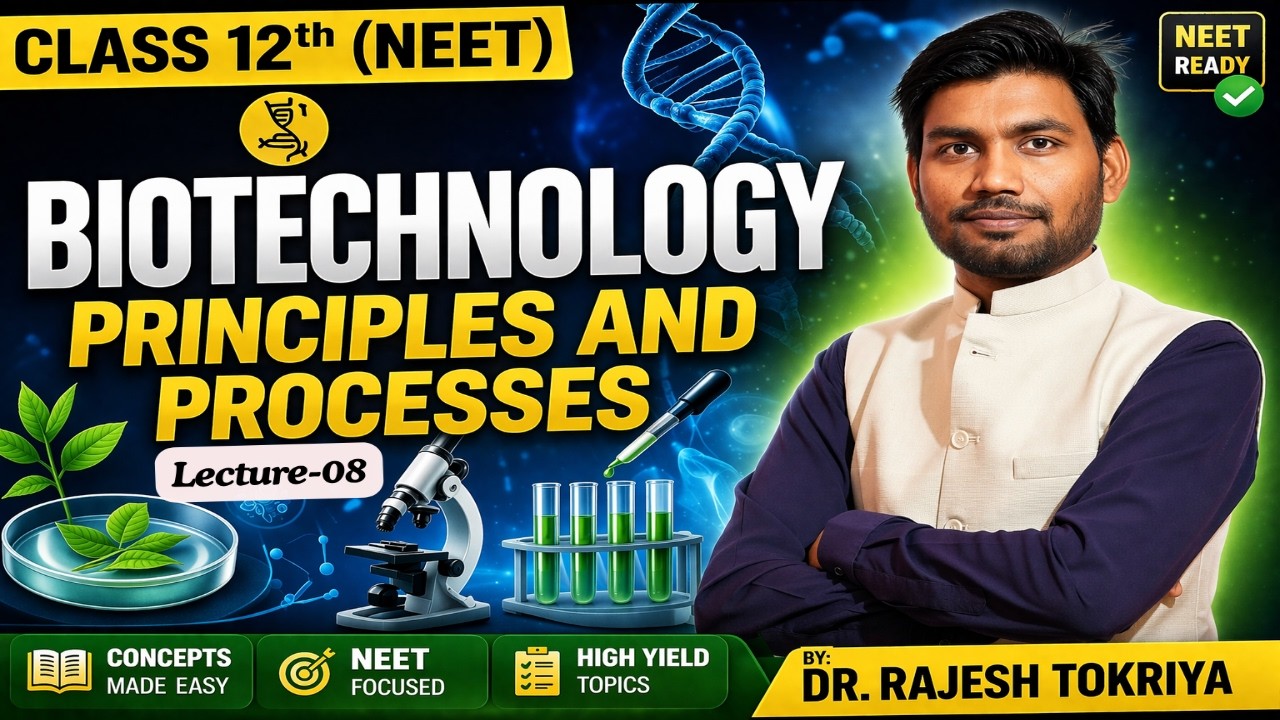
Lec -8: Tools of rDNA Technology - 4: Cloning Vector (Plasmid) & Features | By Dr. Rajesh Tokriya
Keywords
Summary
216 words
Critical Evaluation
Value of the Information & Strength of the Argument
The lecture provides a solid foundational explanation of cloning vectors, using clear analogies and step-by-step reasoning to build understanding. The value lies in its pedagogical approach, making complex concepts accessible to students. The argumentation is logical, progressing from the need for a vector to its features and functions. However, the lecture lacks depth in discussing alternative vectors (e.g., bacteriophages, cosmids) and does not address potential limitations or variations in plasmid design. The instructor’s explanations are consistent with established molecular biology principles, but the absence of citations to primary literature or experimental evidence limits the scientific rigor.
Scientific Rigor, Source Quality, Title Accuracy
The scientific rigor is moderate; the content is accurate but presented without referencing specific studies or sources. The lecture relies on standard textbook knowledge (NCERT) and does not engage with primary research. The title accurately describes the content, focusing on cloning vectors and their features. The description mentions the chapter ‘Biotechnology: Principles and Processes’ and lists topics covered, which aligns with the video. No external sources are cited in the description or during the lecture, so the quality of sources is limited to the instructor’s expertise. The video’s educational nature is clear, and the content is well-structured for its target audience.
212 words
Title / Content Match
The title accurately reflects the content, which focuses on cloning vectors (plasmids) and their features as tools of rDNA technology.
Quality & Reliability
7/10
The lecture provides a clear and accurate explanation of cloning vectors, plasmids, and their features (origin of replication, selectable markers, restriction sites) based on standard molecular biology concepts. The content aligns with NCERT curriculum and is presented in a structured, educational manner. However, the video lacks citations to primary sources and is primarily pedagogical, with no experimental data or peer-reviewed references.
Key Moments
Markers derived by PSI from the transcript: the creator did not define chapters.
- Introduction to the lecture and recap of previous tools (restriction enzymes, DNA ligase, alkaline phosphatase).
- Explanation of cloning vector concept using courier boy analogy.
- Diagrammatic representation of plasmid isolation from E. coli and insertion of gene of interest.
- Definition of cloning vector as a DNA molecule that carries a gene of interest into a host cell.
- Introduction to three features of cloning vectors: origin of replication, selectable marker, and restriction site.
- Detailed explanation of origin of replication (Ori) as an AT-rich sequence where replication starts.
- Discussion on how Ori controls copy number of the vector.
- Explanation of selectable markers as antibiotic resistance genes (e.g., ampicillin, tetracycline).
- Illustration of plasmids with and without selectable markers and their implications.
- Explanation of cloning/restriction sites as specific sequences for restriction enzyme cutting.
Cited Sources
- Instagram profile of Biology By Dr. Rajesh — Mentioned in the video description as a follow-up resource for students.
Concurring Sources
- NCERT Biology Textbook for Class 12 — The lecture aligns with the NCERT curriculum, which covers biotechnology principles and processes.
Contribution & Novelties
The lecture provides a clear, student-friendly explanation of cloning vectors, emphasizing the three essential features (Ori, selectable marker, restriction site) with practical analogies. It reinforces the importance of these features in recombinant DNA technology, particularly for exam preparation. The lecture does not introduce novel scientific concepts but serves as an effective educational tool.
Pour aller plus loin :
- Plasmid — Overview of plasmids, their structure, and roles in molecular biology.
- Origin of replication — Detailed explanation of replication origins and their significance.
- Selectable marker — Discussion of selectable markers in genetic engineering.
- Restriction enzyme — Information on restriction enzymes and their recognition sites.
103 words
Radar Profile
The radar profile shows high scores in quantity of information and technical level, indicating a comprehensive and moderately technical lecture. Quality and reliability are slightly lower due to lack of citations, but the content is accurate. The overall balance suggests a solid educational resource for students.
💬 No comments were provided for analysis.