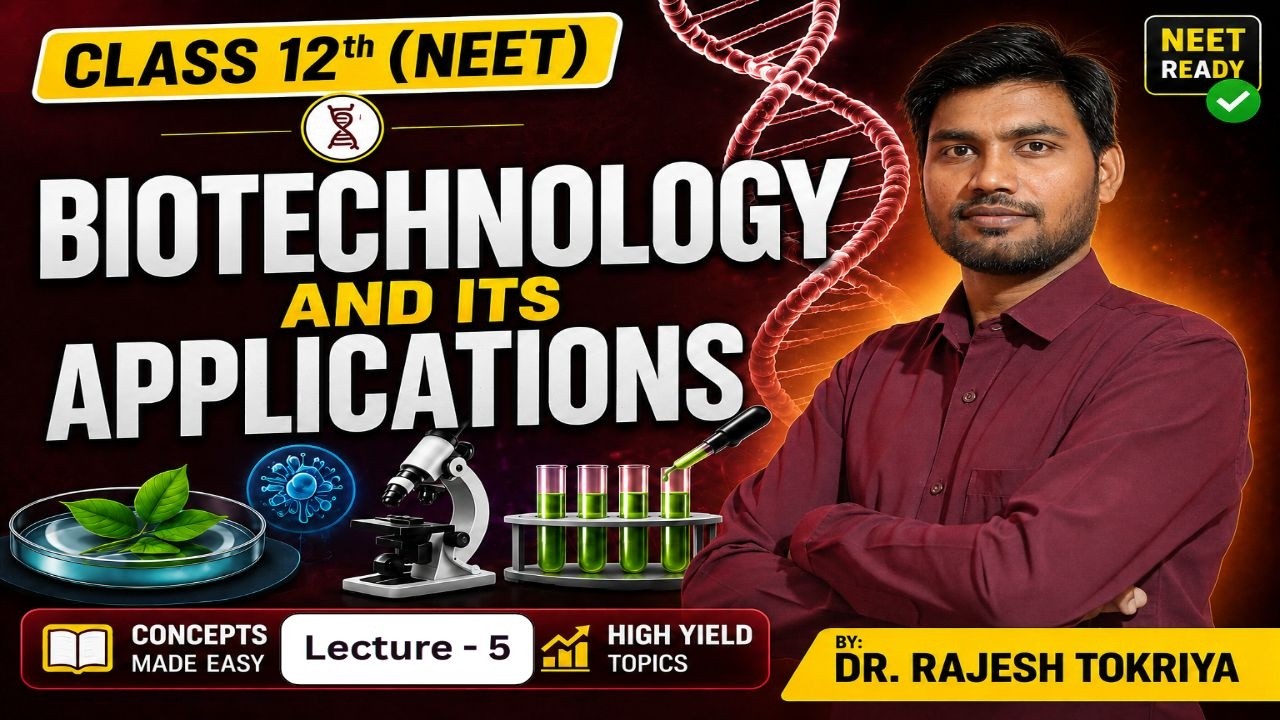
Lec -5: Insulin Production Through rDNA Technology | Class 12 Biology | By Dr. Rajesh Tokriya
Keywords
Summary
185 words
Critical Evaluation
Value of the Information & Strength of the Argument
The lecture provides a solid foundational understanding of insulin production, breaking down complex biological processes into digestible steps. The argumentation is logical, starting from the physiological role of insulin, moving to disease states, and then to the biotechnological solution. The explanation of why bacterial-produced insulin is initially inactive (proinsulin) and the need for post-translational modification is particularly valuable. However, the lecture lacks depth in discussing alternative methods or recent advances, and the argumentation is primarily descriptive rather than critical. The value lies in its clarity for exam preparation, but it does not offer novel insights beyond standard textbook content.
Scientific Rigor, Source Quality, Title Accuracy
The scientific content is accurate and aligns with NCERT curriculum, but no external sources are cited. The lecture relies on established knowledge in molecular biology, and the instructor does not reference specific studies or papers. The title accurately reflects the content, focusing on insulin production via rDNA technology. The presentation is methodical, but the lack of citations reduces its scientific rigor. The description mentions Instagram as a follow-up, but no scholarly references are provided. Overall, the lecture is reliable for educational purposes but not for advanced research.
201 words
Title / Content Match
The title accurately reflects the content, focusing on insulin production via rDNA technology as part of a Class 12 Biology lecture.
Quality & Reliability
7/10
The lecture provides a clear and accurate explanation of insulin production using recombinant DNA technology, based on standard NCERT biology content. The scientific concepts are correct, but the presentation is pedagogical and lacks citations to primary sources. The information is reliable for educational purposes, though not exhaustive.
Key Moments
Markers derived by PSI from the transcript: the creator did not define chapters.
- Introduction and overview of biotechnology applications in healthcare.
- Explanation of normal insulin function and glucose transport.
- Discussion of Type 1 and Type 2 diabetes mechanisms.
- Historical use of animal insulin and its drawbacks.
- Introduction to recombinant DNA technology for insulin production.
- Use of pBR322 plasmid and transformation into E. coli.
- Explanation of proinsulin and the need for post-translational modification.
- Processing of proinsulin to active insulin by removing C-peptide.
- Summary and exam-oriented points.
Cited Sources
- Instagram - Biology By Dr. Rajesh — Mentioned in the video description as a follow-up for students.
Concurring Sources
- NCERT Biology Textbook — Standard textbook content aligns with the lecture's explanations.
Contribution & Novelties
The lecture offers a clear, step-by-step explanation of insulin production using rDNA technology, emphasizing the difference between proinsulin and active insulin, which is often glossed over in textbooks. It provides a strong foundation for students preparing for competitive exams. However, it does not introduce new scientific concepts beyond standard curriculum.
Pour aller plus loin :
- Recombinant DNA technology — Overview of the technique used.
- Insulin — Detailed information on insulin structure and function.
- Diabetes mellitus — Comprehensive resource on diabetes types and treatments.
83 words
Radar Profile
The radar profile shows high scores in quality of information and reliability, with moderate scores in quantity and technical level. This indicates a lecture that is accurate and clear but not highly detailed or advanced, suitable for introductory learning.
💬 No comments were provided for analysis.