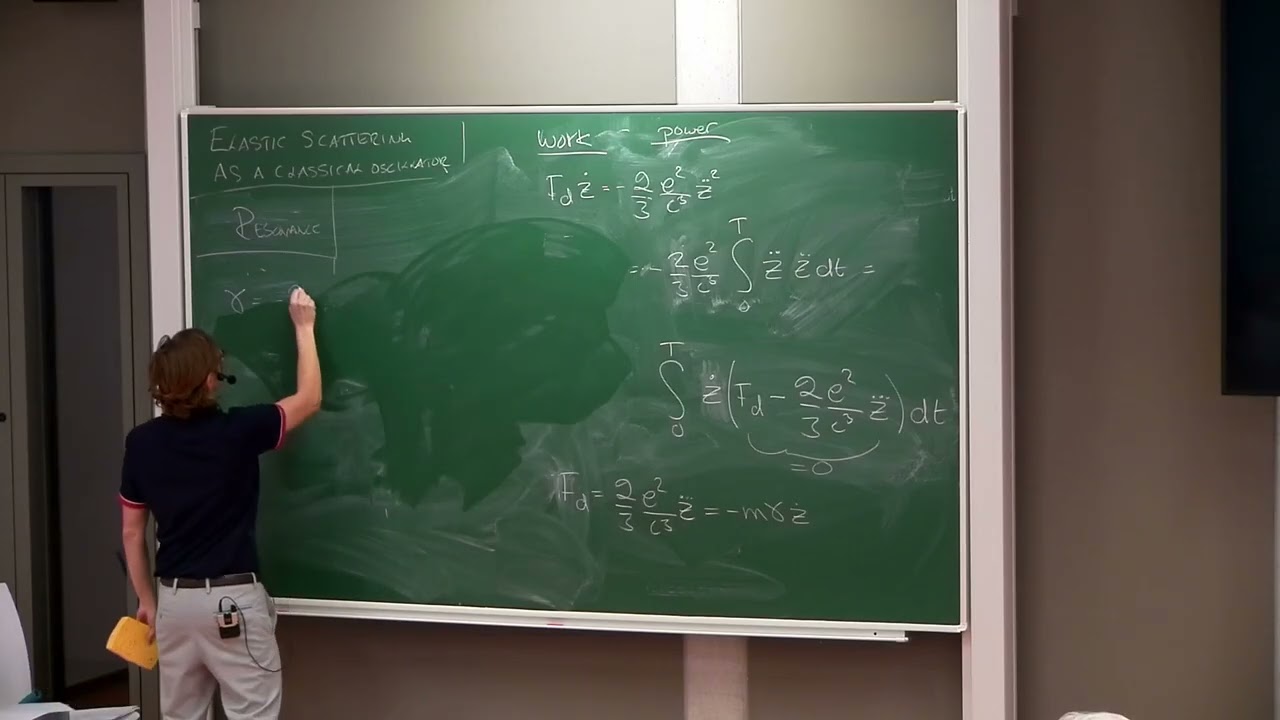
Radiation Processes in Astronomy: L9b - Spectral line scattering (classic), Lorentz profile, Q-value
Keywords
Summary
199 words
Critical Evaluation
Value of the Information & Strength of the Argument
The lecture provides a clear and rigorous derivation of the classical treatment of spectral line scattering, building from fundamental principles. The argumentation is logical and step-by-step, with the professor explicitly showing how the damping coefficient is derived from energy loss and how it leads to the Lorentz profile. The introduction of the Q-value is well-motivated and effectively illustrates the extreme sharpness of atomic resonances. The connection to astrophysical applications, such as line-driven winds, demonstrates the practical importance of the concepts. The lecture also honestly points out the limitations of the classical model, paving the way for quantum mechanical corrections. Overall, the information is valuable for understanding the physical basis of spectral line formation and its role in astrophysical phenomena.
Scientific Rigor, Source Quality, Title Accuracy
The lecture is scientifically rigorous, based on well-established classical physics. The professor derives equations from first principles and clearly states approximations. However, no external sources are cited within the lecture, and the description only provides links to the course playlist and the professor’s research group, not to specific references. The title accurately reflects the content, which is a detailed treatment of spectral line scattering, the Lorentz profile, and the Q-value. The lecture is part of a structured course, indicating a pedagogical context. The lack of citations is typical for a lecture, but it limits the ability to verify specific claims. The algebraic steps are sometimes skipped, but the professor encourages students to verify them, maintaining transparency.
250 words
Title / Content Match
The title accurately describes the content: spectral line scattering, Lorentz profile, and Q-value are all covered in detail.
Quality & Reliability
8/10
The lecture is a formal academic presentation by a professor, based on established physics (classical oscillator model, Lorentz profile). The derivation is rigorous and transparent, with clear steps and acknowledgment of approximations. The content aligns with standard astrophysics textbooks. However, it is a single lecture without external citations or peer review, and some algebraic steps are skipped.
Key Moments
Markers derived by PSI from the transcript: the creator did not define chapters.
- Introduction and recap of Thomson and Rayleigh scattering, and their astrophysical applications.
- Derivation of the classical damping coefficient from the Larmor formula and energy loss.
- Derivation of the cross-section near resonance and introduction of the Lorentz profile function.
- Normalization of the Lorentz profile and definition of the frequency-integrated cross-section.
- Calculation of the full width at half maximum (FWHM) of the Lorentz profile.
- Discussion of the constant classical width in wavelength space and its small value.
- Introduction of the Q-value and comparison with mechanical and electrical oscillators.
- Application to line-driven winds and the enhancement of radiation force.
- Limitations of the classical model and introduction of oscillator strengths.
- Derivation of the lifetime of the excited state and comparison with quantum mechanical results.
Cited Sources
- Course playlist: Radiation Processes in Astronomy — The lecture is part of this course playlist, providing context for the series.
- Research group page (Equation Home) — The lecturer's research group page, relevant to the application of line-driven winds.
Concurring Sources
- Rybicki & Lightman, Radiative Processes in Astrophysics — Standard textbook covering similar derivations of spectral line scattering and the Lorentz profile.
Contribution & Novelties
This lecture provides a clear and detailed classical derivation of spectral line scattering, emphasizing the Lorentz profile and the Q-value. It bridges the gap between fundamental physics and astrophysical applications, such as line-driven winds. The lecture’s pedagogical approach, with explicit derivations and practical examples, enhances understanding. It also highlights the limitations of the classical model, motivating the need for quantum mechanical treatments.
Pour aller plus loin :
- Lorentzian function — The mathematical form of the Lorentz profile and its properties.
- Oscillator strength — Quantum mechanical correction factor for line strengths.
- Line-driven winds — Overview of stellar winds, including line-driven mechanisms.
100 words
Radar Profile
The radar profile shows high scores in information quantity, quality, and technical level, with a slightly lower but still high reliability score. This indicates a dense, well-structured, and technically advanced lecture, though the lack of external citations slightly reduces the reliability score.
💬 No comments were provided for analysis.