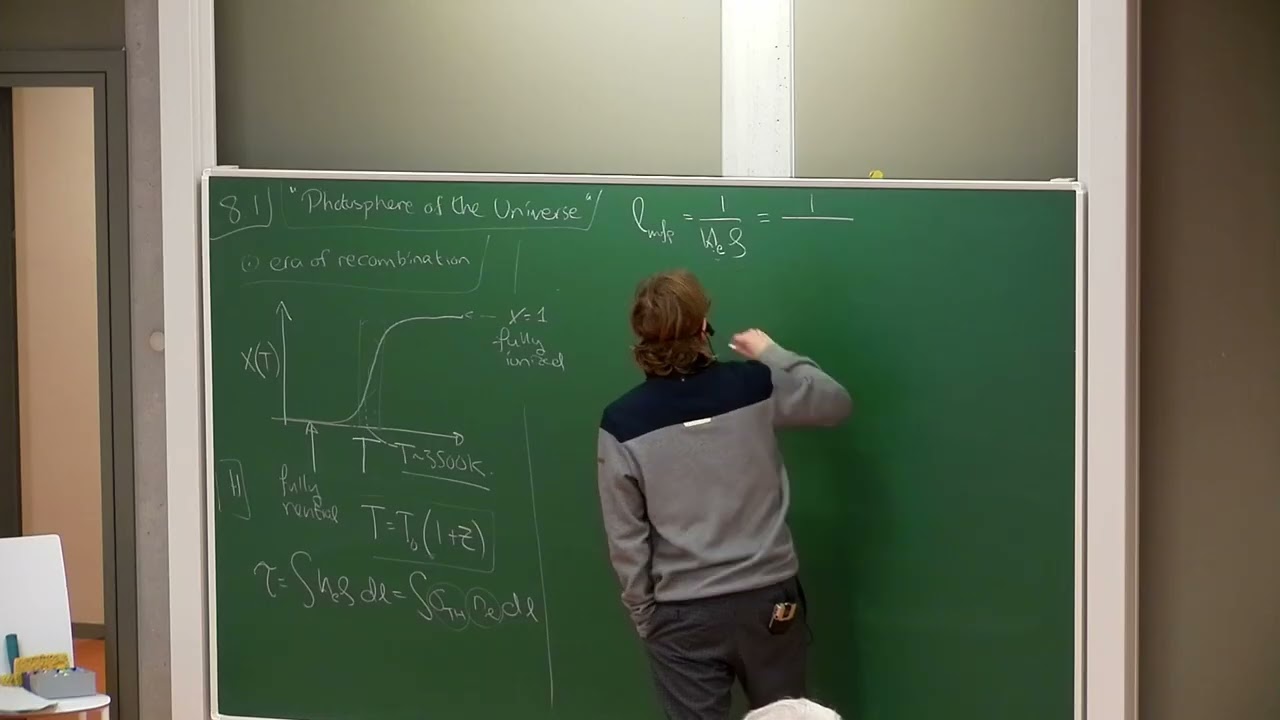
Radiative Processes in Astronomy: L14a - Cosmic Background Radiation II, Photosphere of our Universe
Keywords
Summary
182 words
Critical Evaluation
Value of the Information & Strength of the Argument
The lecture provides a rigorous quantitative derivation of the conditions for photon decoupling in the early universe. It builds on previous lectures and exercises, using the Saha equation and the concept of optical depth. The argumentation is logical and step-by-step, with clear explanations of the physical concepts. The lecturer also provides a plausibility check by approximating the optical depth in the era before recombination, confirming that it is much greater than unity. The value of the information is high for students of astrophysics, as it connects theoretical concepts to observable phenomena.
Scientific Rigor, Source Quality, Title Accuracy
The lecture is scientifically rigorous, with derivations based on established physics. The lecturer does not cite specific sources during the lecture, but the content is consistent with standard cosmology textbooks. The description provides links to the course playlist and the lecturer’s research group, but no direct references to the specific topics. The title accurately reflects the content, and the lecture is well-structured. The lecturer acknowledges potential errors and encourages feedback, which adds to the authenticity but also indicates a lack of editing.
188 words
Title / Content Match
The title accurately reflects the content: the lecture focuses on the cosmic background radiation and the calculation of the photosphere of the universe.
Quality & Reliability
8/10
The lecture is part of a university course, delivered by a professor, and presents derivations and quantitative calculations. The content is consistent with established cosmology. However, it is a live recording with potential minor errors, and the lecturer encourages feedback. The sources are institutional but not directly cited for the specific claims.
Key Moments
Markers derived by PSI from the transcript: the creator did not define chapters.
- Introduction and review of recombination era
- Definition of mean free path and its dependence on ionization fraction
- Introduction of horizon distance and comparison with mean free path
- Derivation of optical depth integral and conversion to redshift
- Numerical integration and result: optical depth reaches unity at z~1100-1300
- Plausibility analysis using constant ionization approximation
- Conclusion: surface of last scattering and analogy with stellar photosphere
Cited Sources
- Course Playlist — All lectures for the course
- Research Group Page — Lecturer's research group
Concurring Sources
- Cosmic microwave background — General reference for CMB and decoupling
- Recombination (cosmology) — Detailed description of recombination epoch
Contribution & Novelties
The lecture provides a clear and detailed derivation of the epoch of photon decoupling, emphasizing the role of optical depth and mean free path. It offers a pedagogical approach that connects the theoretical framework to the observable cosmic background radiation. The lecturer also highlights the fundamental limit of observability, comparing it to the photosphere of stars.
Pour aller plus loin :
- Cosmic microwave background — Overview of the CMB and its significance.
- Recombination (cosmology) — Detailed explanation of the recombination epoch.
- Saha ionization equation — The equation used to calculate ionization fraction.
92 words
Radar Profile
The radar profile shows high scores in all dimensions, indicating a well-rounded and reliable lecture. The strongest aspects are the quantity and quality of information, as well as the technical level, reflecting the advanced nature of the content.
💬 Sur les 0 commentaires analysés, aucune tendance n'est disponible.