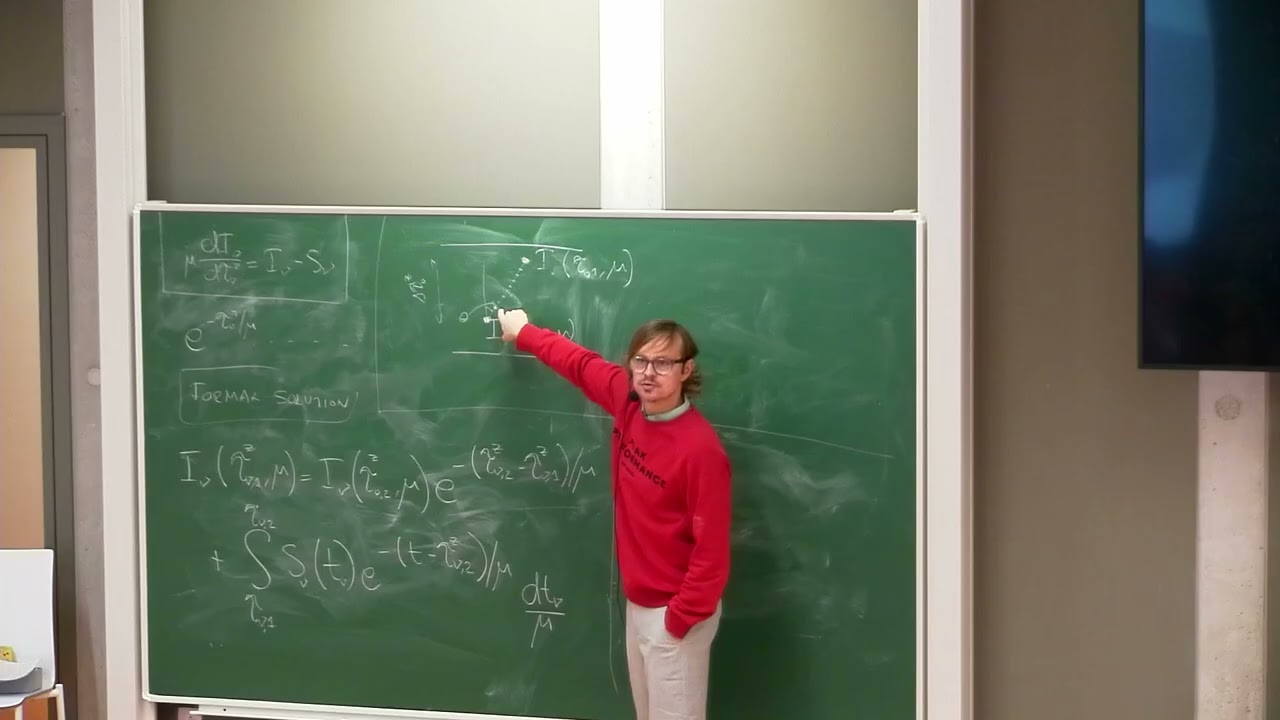
Radiation Processes in Astronomy: L5b - semi-infinite atmosphere, Eddington-Barbier, limb darkening
Keywords
Summary
167 words
Critical Evaluation
Value of the Information & Strength of the Argument
The lecture provides a clear and rigorous derivation of the formal solution to the radiative transfer equation for a semi-infinite atmosphere. The argumentation is solid, building on previous lectures and using mathematical steps that are explained. The physical interpretation of the Eddington-Barbier approximation is well-illustrated with the concept of seeing to optical depth unity. The explanation of limb darkening is intuitive and connects the mathematical result to observable phenomena. The discussion of the flux and the optical depth 2/3 is also well-motivated. The lecture is valuable for students learning radiative transfer, as it bridges theory and observation.
Scientific Rigor, Source Quality, Title Accuracy
The lecture is scientifically rigorous, with derivations that follow standard astrophysics textbooks. The professor does not cite specific sources, but the content is consistent with established knowledge. The title accurately reflects the content. The video is part of a university course, indicating a high level of academic rigor. No external sources are provided in the description, but the lecture itself is a primary educational source.
177 words
Title / Content Match
The title accurately describes the content: the lecture covers the semi-infinite atmosphere solution, the Eddington-Barbier approximation, and limb darkening.
Quality & Reliability
8/10
Lecture by a professor at KU Leuven, part of a structured course. The content is mathematically rigorous and consistent with standard astrophysics textbooks. The derivation is clear and the physical interpretations are accurate. The video is a formal educational resource, not peer-reviewed, but the source is authoritative.
Key Moments
Markers derived by PSI from the transcript: the creator did not define chapters.
- Introduction and recap of the plane-parallel radiative transfer equation.
- Derivation of the formal solution for the emergent intensity.
- Interpretation of the formal solution: exponential attenuation and source integral.
- Introduction of the semi-infinite atmosphere and emergent intensity equation.
- Example with constant source function, recovering the homogeneous slab result.
- Assumption of linear source function and derivation of the Eddington-Barbier approximation.
- Explanation of limb darkening using the Eddington-Barbier approximation.
- Application to exoplanet transits and the importance of limb darkening.
- Discussion of limb brightening in cases like the solar corona.
- Derivation of the emergent flux and the optical depth 2/3 result.
Contribution & Novelties
The lecture provides a clear pedagogical derivation of the Eddington-Barbier approximation and its application to limb darkening. It emphasizes the physical interpretation of optical depth unity and 2/3, which is crucial for understanding stellar atmospheres. The lecture is part of a structured course, offering a step-by-step approach that is valuable for students.
Pour aller plus loin :
- Radiative transfer — General overview of radiative transfer.
- Limb darkening — Detailed explanation of limb darkening.
- Eddington approximation — Related approximation in radiative transfer.
81 words
Radar Profile
The radar profile shows high scores across all dimensions, indicating a well-rounded and reliable educational resource. The lecture is technically detailed, scientifically accurate, and provides clear explanations, making it suitable for advanced students.