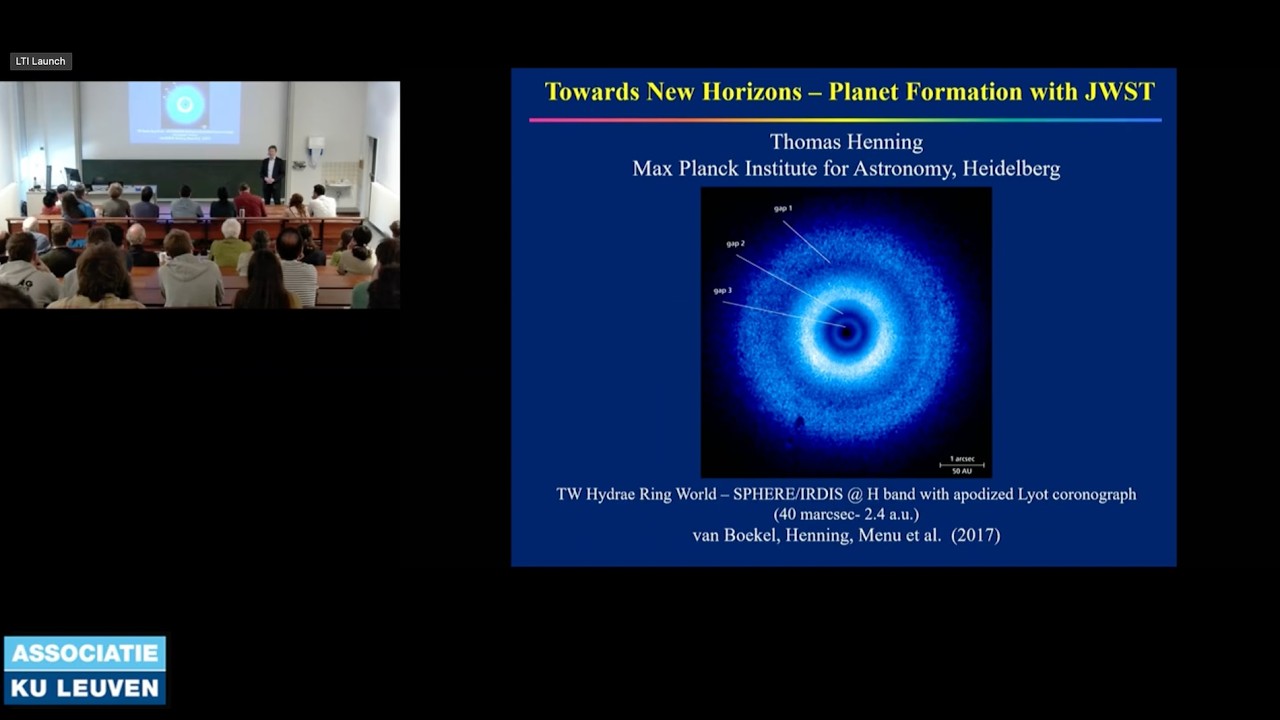
IvS Seminar: Thomas Henning (26/02/2026)
Keywords
Summary
165 words
Critical Evaluation
Value of the Information & Strength of the Argument
The talk provides a comprehensive overview of recent JWST results on planet formation, with a strong emphasis on infrared spectroscopy of protoplanetary disks. Henning presents a clear narrative of the current theoretical framework, from dust growth to pebble accretion, and supports it with observational evidence. He effectively argues that JWST’s spectral capabilities allow us to probe the inner disk regions where rocky planets form, despite the lack of spatial resolution. The argumentation is solid, based on peer-reviewed results and collaborative efforts. He also highlights surprising findings, such as the high CO2/H2O ratio and the dominance of hydrocarbons in low-mass disks, which challenge existing models. The talk is well-structured and provides valuable insights into the ongoing research.
Scientific Rigor, Source Quality, Title Accuracy
The talk demonstrates high scientific rigor, with references to specific programs (MINDS, GTO) and collaborations. Henning mentions several key papers and results, but does not provide explicit citations in the talk. The title accurately reflects the content, focusing on planet formation with JWST. The speaker is a renowned expert, and the content is consistent with current literature. However, as a seminar, it is a personal synthesis rather than a systematic review, and some results may be preliminary. The adequacy between title and content is excellent.
216 words
Title / Content Match
The title accurately reflects the content: the talk focuses on planet formation with JWST, presenting recent results and future prospects.
Quality & Reliability
8/10
The talk is given by a leading expert in planet formation and JWST science, with a strong track record. The content is based on recent JWST observations and established theoretical models. However, as a seminar, it presents a personal perspective and some results may be preliminary or not yet fully peer-reviewed.
Key Moments
Markers derived by PSI from the transcript: the creator did not define chapters.
- Introduction and overview of JWST's capabilities and extended lifetime.
- Discussion of the current planet formation paradigm, including streaming instability and pebble accretion.
- Presentation of JWST MIRI spectra of protoplanetary disks, highlighting molecular detections.
- Discovery of hydrocarbon-dominated spectra in low-mass disks.
- Analysis of PDS 70, including the detection of water in the inner disk despite a deep gap.
- Discussion of the variability of inner disks and the role of gaps in pebble transport.
Cited Sources
- MINDS program — MIRI mid-INfrared Disk Survey, a GTO program observing ~60 protoplanetary disks with JWST.
- PDS 70 observations — JWST observations of the PDS 70 system, revealing water in the inner disk and a potential third planet.
- TW Hydra observations — JWST spectrum of TW Hydra, showing depletion of oxygen and carbon and detection of molecular ions.
Concurring Sources
- JWST Early Release Science results — General JWST results on exoplanets and disks that align with the talk's findings.
- ALMA observations of protoplanetary disks — Complementary observations that support the structure and composition of disks.
Dissenting Sources
- Some theoretical models of disk gaps — The talk challenges the assumption that gaps always block pebble transport, citing observations that show water in inner disks despite gaps.
Contribution & Novelties
The talk presents recent JWST results that significantly advance our understanding of planet formation. Key novel findings include the detection of molecular ions in disks, the discovery of hydrocarbon-dominated inner disks around low-mass stars, and the observation of water in the inner disk of PDS 70 despite a deep gap. These results challenge existing models of pebble transport and disk chemistry. The talk also emphasizes the dynamic nature of inner disks, as revealed by VLTI and JWST.
Pour aller plus loin :
- JWST website — Official JWST site with mission details and science results.
- Pebble accretion theory — Overview of the pebble accretion model for planet formation.
- Streaming instability — Explanation of the mechanism for planetesimal formation.
- MINDS program — The MINDS survey website with publications and results.
128 words
Radar Profile
The radar profile shows high scores across all dimensions, indicating a well-balanced and informative seminar. The talk excels in providing up-to-date, high-quality information with a strong technical level, though it is not a formal review or original study.