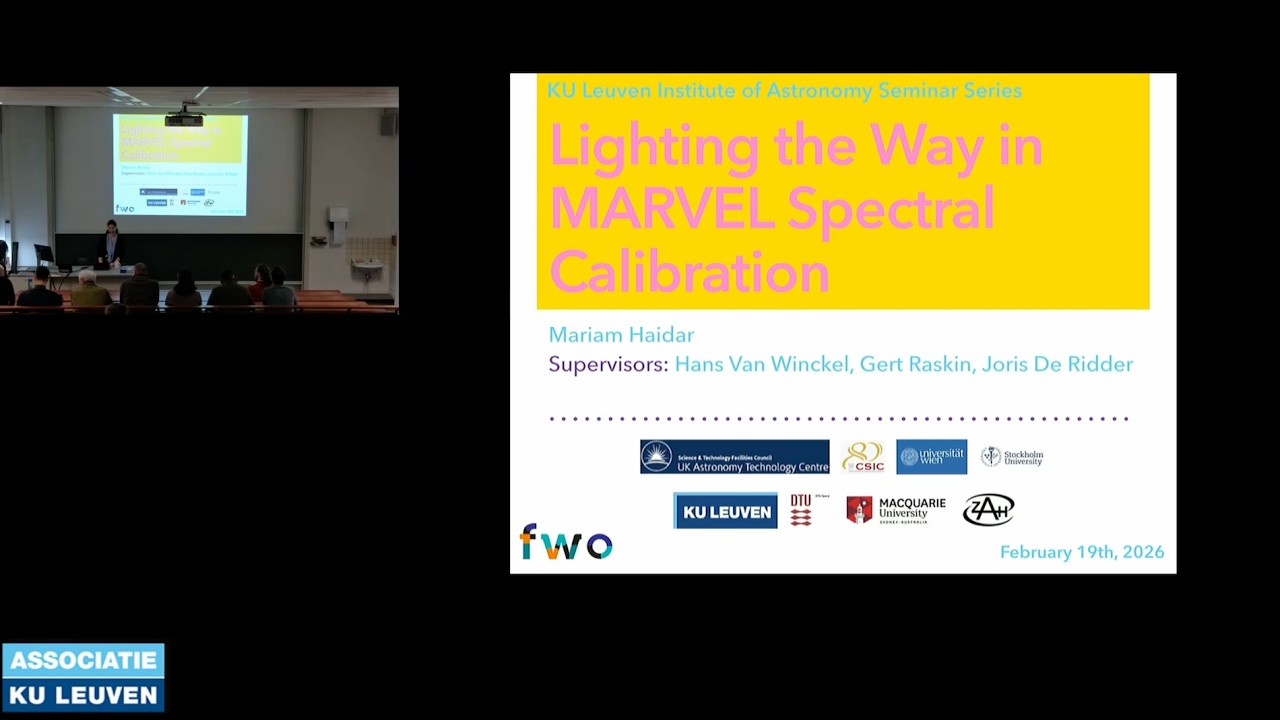
IvS Seminar: Mariam Haidar (19/02/2026)
Keywords
Summary
105 words
Critical Evaluation
Value of the Information & Strength of the Argument
The talk provides valuable insights into the practical challenges of building a high-precision radial velocity instrument. The argumentation is logical, progressing from scientific motivation to technical implementation. The speaker clearly explains why 1 m/s precision is difficult, citing specific examples like temperature sensitivity and modal noise. The discussion of calibration sources is detailed, and the ongoing work on uranium-neon line lists is presented with a clear methodology. The talk is informative for those interested in astronomical instrumentation, though it assumes some background knowledge.
Scientific Rigor, Source Quality, Title Accuracy
The presentation is scientifically rigorous, with references to known instruments (HARPS, NEID) and standard calibration techniques. The speaker mentions literature on fiber scrambling and line contamination, but specific citations are not provided in the talk. The title accurately reflects the content, focusing on MARVEL’s spectral calibration. The talk is a seminar presentation, so it is not peer-reviewed, but it is based on ongoing research and established knowledge in the field.
168 words
Title / Content Match
The title accurately reflects the content: a seminar by Mariam Haidar on MARVEL's spectral calibration.
Quality & Reliability
8/10
Presentation by a PhD researcher at a recognized institute, detailing ongoing calibration work for the MARVEL facility. Technical depth is high, but as a seminar talk it is not peer-reviewed and some claims (e.g., temperature sensitivity) are stated without specific references.
Key Moments
Markers derived by PSI from the transcript: the creator did not define chapters.
- Introduction and outline of the talk
- Context: exoplanet characterization and the need for radial velocity follow-up
- Overview of the MARVEL facility: four telescopes feeding one spectrograph
- Explanation of 1 m/s precision and its challenges
- Calibration unit design: sources and fiber switchers
- Temperature stability and modal noise mitigation
- Discussion of thorium-argon and uranium-neon lamps
- Ongoing work: developing a uranium-neon line list
- Methodology for line identification and vetting
- Conclusion and future plans for MARVEL
Cited Sources
- MARVEL website — Mentioned as the facility under construction
- NEID spectrograph — Used for calibration data for uranium-neon line list
Concurring Sources
- HARPS spectrograph — Mentioned as a similar high-precision RV instrument
Contribution & Novelties
The talk presents the calibration strategy for MARVEL, a new facility, and highlights the ongoing development of a uranium-neon line list for the visible range, which is a novel contribution. The speaker emphasizes the challenges of multi-telescope calibration and the importance of stability.
Pour aller plus loin :
- Radial velocity method — Background on the technique.
- Fabry–Pérot interferometer — Principle behind the etalon used.
- Modal noise in optical fibers — Explanation of the noise source and mitigation.
77 words
Radar Profile
The radar profile shows high scores in quantity and quality of information, with a strong technical level. The overall reliability is slightly lower due to the nature of a seminar talk without peer review, but the speaker's expertise and the detailed technical content support a high rating.
💬 No comments were provided for analysis.