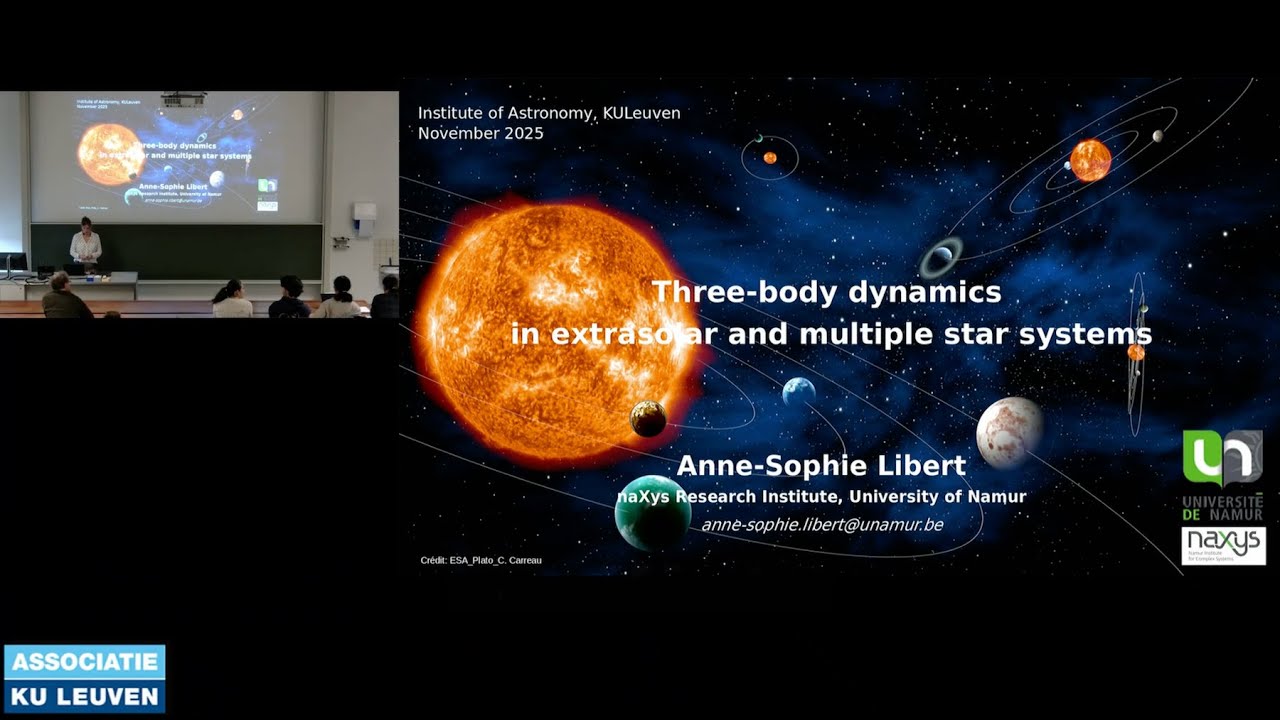
IvS Seminar: Anne-Sophie Libert (06/11/2025)
Keywords
Summary
192 words
Critical Evaluation
Value of the Information & Strength of the Argument
The talk provides a comprehensive overview of the dynamical mechanisms governing extrasolar and multiple star systems, with a strong emphasis on the interconnection between dynamics, observations, and formation scenarios. The argumentation is solid, grounded in mathematical derivations and supported by comparisons with numerical simulations. The speaker effectively demonstrates how analytical frameworks can interpret and predict the behavior of complex systems, and she presents several concrete examples from her research, such as the application to the Andromeda system and the GL 876 system. The value of the information is high for an audience with a background in celestial mechanics or exoplanet dynamics, as it offers both fundamental insights and recent research findings.
Scientific Rigor, Source Quality, Title Accuracy
The talk is scientifically rigorous, with clear mathematical foundations and references to established works such as those by von Zeipel, Lidov, and Kozai. The speaker cites her own research and that of others, though specific citations are not listed in the description. The title accurately reflects the content, which is focused on three-body dynamics in extrasolar and multiple star systems. The presentation is well-structured, moving from basic concepts to specific applications, and the speaker acknowledges the limitations and open questions in the field.
209 words
Title / Content Match
The title accurately reflects the content, which focuses on three-body dynamics in extrasolar and multiple star systems.
Quality & Reliability
8/10
The talk is based on peer-reviewed research, presents mathematical derivations and comparisons with numerical simulations, and is delivered by a professor in celestial mechanics. The content is rigorous and well-structured, though it is a seminar presentation and not a full publication.
Key Moments
Markers derived by PSI from the transcript: the creator did not define chapters.
- Introduction to the talk and motivation: growing number of exoplanet systems and stellar multiplicity.
- Fundamentals of the N-body problem: non-integrability for more than two bodies, Hamiltonian formalism, and perturbation theory.
- Introduction to mean-motion resonances and secular resonances, including the von Zeipel-Lidov-Kozai effect.
- Explanation of the von Zeipel-Lidov-Kozai resonance: conditions, Kozai constant, and eccentricity-inclination cycles.
- Application of ZLK to two-planet systems: stability criteria and the role of general relativity for close-in planets.
- ZLK in protoplanetary discs and binary star systems: effects of disc dispersal and stellar companions.
- ZLK in triple star systems: high eccentricity oscillations, tidal circularization, and ZLK migration.
- Mean-motion resonances: families of periodic orbits, resonant capture during migration, and resonant chains.
- Observational constraints: proximity of systems to resonances, resonant offsets, and the role of additional dissipation.
- Applications to real systems: K2-21, GL 876, and the impact of stellar multiplicity on planet stability.
Cited Sources
- von Zeipel-Lidov-Kozai effect — The speaker discusses the von Zeipel-Lidov-Kozai resonance, a secular resonance in three-body systems.
- Mean-motion resonance — The speaker explains mean-motion resonances and their role in exoplanet systems.
- Three-body problem — The talk is centered on the three-body problem in celestial mechanics.
Concurring Sources
- Kozai mechanism — The speaker's description of the ZLK resonance aligns with the standard explanation.
- Orbital resonance — The talk's discussion of mean-motion resonances is consistent with established knowledge.
Contribution & Novelties
The talk presents recent research on the von Zeipel-Lidov-Kozai resonance and mean-motion resonances in extrasolar and multiple star systems. It highlights the interconnectedness of dynamics, observations, and formation, and shows how analytical frameworks can be used to constrain orbital parameters and understand system stability. The speaker’s work demonstrates that ZLK can operate at different scales, from exoplanets to protoplanetary discs to triple stars, and that mean-motion resonances are a natural outcome of migration, with observed offsets explained by additional dissipation.
Pour aller plus loin :
- Kozai mechanism — Provides a detailed explanation of the von Zeipel-Lidov-Kozai effect.
- Orbital resonance — Overview of mean-motion resonances and their applications.
- Exoplanet migration — Discusses the migration of planets in protoplanetary discs, relevant to resonant capture.
122 words
Radar Profile
The radar profile shows high scores in information quantity, quality, and technical level, indicating a dense and rigorous presentation. The global reliability is also high, reflecting the speaker's expertise and the scientific basis of the content.