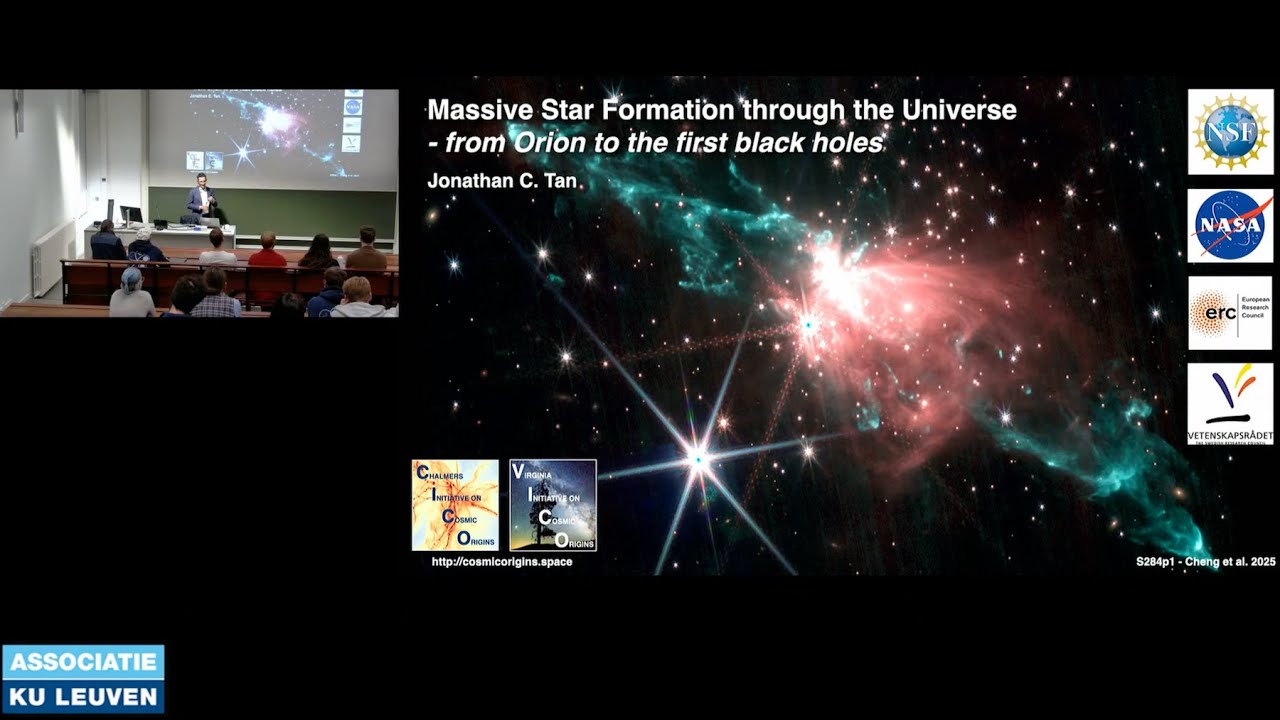
IvS Seminar: Jonathan Tan (25/09/2025)
Keywords
Summary
126 words
Critical Evaluation
Value of the Information & Strength of the Argument
The seminar provides valuable insights into the current state of massive star formation research, presenting a coherent theoretical framework supported by observational data and simulations. The argumentation is solid, with clear logical progression from theoretical models to observational tests. Tan effectively integrates multiple lines of evidence, including ALMA observations, SOFIA data, and numerical simulations, to support his claims. The discussion of the turbulent core model and its predictions is particularly strong, offering a testable framework for understanding massive star formation. The seminar also highlights open questions and debates, such as the core accretion versus competitive accretion paradigms, providing a balanced perspective.
Scientific Rigor, Source Quality, Title Accuracy
The seminar demonstrates high scientific rigor, with references to established theories and recent observations. Tan cites specific works, such as the Kennicutt-Schmidt relation and the Krumholz-McKee theory, and discusses their implications. The quality of sources is high, drawing from peer-reviewed literature and major observational programs. The title accurately reflects the content, covering both local and early universe massive star formation. The seminar is well-structured and the arguments are logically presented, though it represents a personal research perspective rather than a comprehensive review.
198 words
Title / Content Match
The title accurately reflects the content, covering massive star formation from local regions like Orion to the early universe and the potential link to supermassive black holes.
Quality & Reliability
8/10
The seminar is presented by a recognized expert in massive star formation, with a coherent theoretical framework supported by observational data and simulations. The content is rigorous and well-structured, though it represents a personal research perspective rather than a comprehensive review.
Key Moments
Markers derived by PSI from the transcript: the creator did not define chapters.
- Introduction and welcome by Andrew, introducing Jonathan Tan.
- Tan begins his talk, outlining the importance of massive stars and the seminar structure.
- Discussion of open questions in massive star formation, including initial conditions and accretion mechanisms.
- Presentation of the turbulent core model and its extension to include non-thermal pressure.
- Introduction of shear-driven cloud collisions as a mechanism for star formation regulation.
- Comparison of model predictions with ALMA data from the PHANGS survey.
- Discussion of infrared dark clouds and their role in massive star formation.
- Overview of the turbulent core model's predictions for accretion rates and protostellar evolution.
- Presentation of SOFIA observations and the SOMA program for testing model predictions.
- Discussion of the link between massive star formation and the first black holes, including dark matter annihilation.
Cited Sources
- Kennicutt-Schmidt relation — Referenced as foundational for extragalactic star formation studies.
- Krumholz and McKee (2008) — Theory on the formation of high-mass stars via thermal pressure.
- ALMA PHANGS survey — Used to test predictions of shear-driven cloud collisions.
- SOFIA telescope — Used for observations of massive star-forming regions.
Concurring Sources
- Krumholz and McKee (2008) — Supports the idea that high accretion rates are needed for massive star formation.
- ALMA PHANGS survey — Data consistent with the shear-driven cloud collision model.
Dissenting Sources
- Competitive accretion model — Alternative theory to core accretion, which Tan argues against based on magnetic field effects.
Contribution & Novelties
The seminar presents a comprehensive overview of massive star formation, integrating theoretical models with recent observational data. The discussion of shear-driven cloud collisions as a regulator of star formation efficiency is a novel contribution, supported by ALMA data. The potential link between the first massive stars and supermassive black holes, possibly influenced by dark matter annihilation, offers a new perspective on early universe astrophysics.
Pour aller plus loin :
- Turbulent core model — Provides background on the standard model of star formation.
- Kennicutt-Schmidt relation — Relevant to the discussion of star formation rates.
- Supermassive black hole formation — Context for the early universe black hole seeds.
106 words
Radar Profile
The radar profile shows high scores in quantity and quality of information, with a strong technical level. The reliability is also high, reflecting the expert presentation and use of observational data. The overall profile indicates a well-rounded, informative seminar.
💬 No comments were provided for analysis.