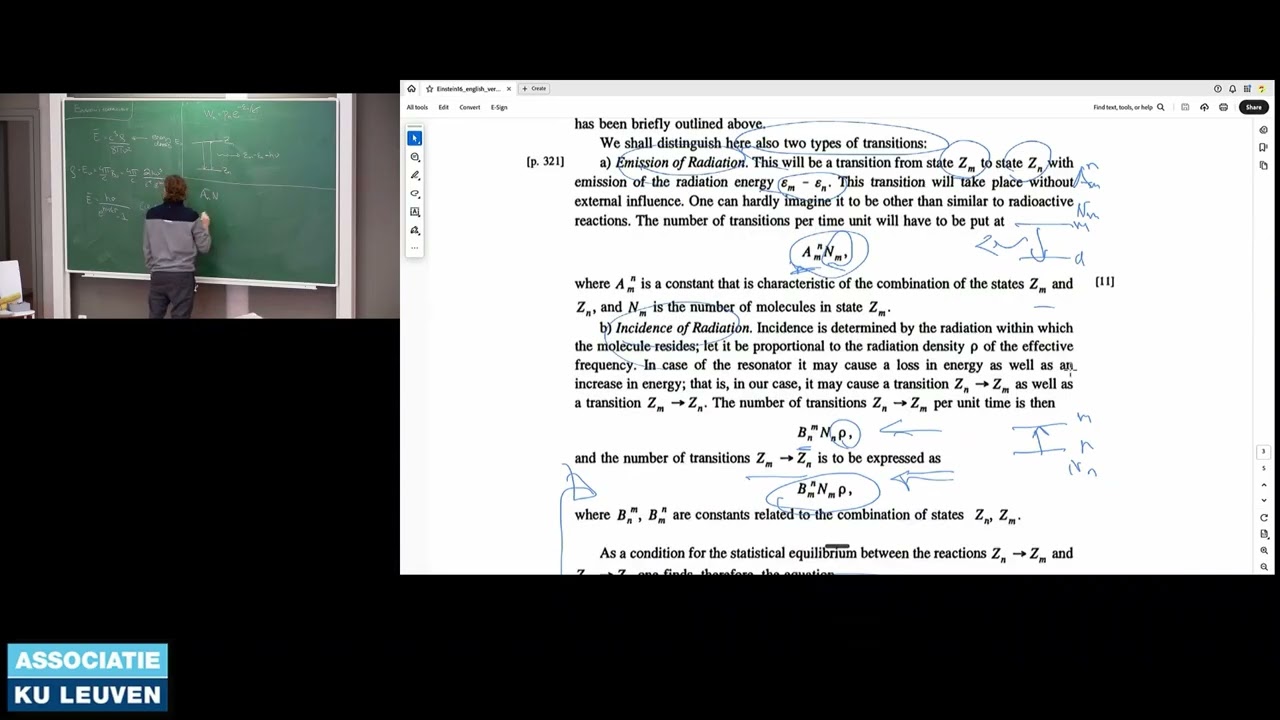
Radiative Processes in Astronomy: L14b - Einsteins atomic coefficients via his original paper
Keywords
Summary
174 words
Critical Evaluation
Value of the Information & Strength of the Argument
The lecture provides a thorough and valuable analysis of Einstein’s original derivation, offering deep insights into the physical reasoning behind the coefficients. The argumentation is solid, as it carefully follows Einstein’s logic and demonstrates how the hypothesis of stimulated emission is necessary to achieve consistency with Planck’s law. The lecturer also effectively connects the theoretical concepts to practical applications in astrophysics, such as masers and lasers, and to the formalism of radiative transfer. The step-by-step derivation is clear, though some minor errors on the board are acknowledged, which does not significantly detract from the overall value.
Scientific Rigor, Source Quality, Title Accuracy
The lecture is based on Einstein’s original 1917 paper, which is a primary source of high scientific rigor. The lecturer also references Planck’s quantum theory and Bohr’s atomic model, providing a solid historical and theoretical context. The sources are appropriate and well-integrated. The title accurately reflects the content, as the lecture indeed focuses on Einstein’s atomic coefficients via his original paper. The lecture is part of a university course, and the lecturer’s expertise is evident. However, as a live lecture, it lacks the polish of a peer-reviewed publication, but the scientific content is reliable.
205 words
Title / Content Match
The title accurately describes the content: the lecture focuses on Einstein's atomic coefficients as derived in his original paper.
Quality & Reliability
8/10
The lecture is based on Einstein's original 1917 paper and provides a rigorous derivation of the Einstein coefficients, connecting them to radiative transfer. The lecturer is a professor at KU Leuven, and the content is accurate and well-structured. However, it is a live lecture with minor errors and no peer review.
Key Moments
Markers derived by PSI from the transcript: the creator did not define chapters.
- Introduction to Einstein's 1917 paper and its significance.
- Review of Planck's quantum theory and the mean energy of a resonator.
- Derivation of the Einstein coefficients and the balance equation.
- Use of Boltzmann distribution and Planck's law to derive relations between coefficients.
- Identification of terms and conclusion that stimulated emission is necessary.
- Connection of Einstein coefficients to radiative transfer quantities.
- Expression for line extinction and emission coefficients.
- Discussion of stimulated emission dominance and laser action.
- Relative importance of stimulated vs spontaneous emission in different regimes.
- Conclusion and exercise on LTE source function.
Cited Sources
- Einstein Papers Project (Caltech) — Mentioned as the source of the translated version of Einstein's paper.
- Course Playlist — All lectures of the course are available in this playlist.
Concurring Sources
- Einstein's original paper (1917) — The lecture is based on this paper, which is a primary source.
- Planck's law — Referenced as the foundation for the derivation.
Contribution & Novelties
The lecture provides a unique pedagogical approach by directly analyzing Einstein’s original paper, offering students a historical perspective on the derivation of the Einstein coefficients. It bridges the gap between fundamental quantum concepts and practical radiative transfer applications, emphasizing the universality of the coefficient relations. The lecturer’s live format adds authenticity and allows for spontaneous clarification of complex points.
Pour aller plus loin :
- Einstein coefficients - Wikipedia — Provides a comprehensive overview of the coefficients and their applications.
- Stimulated emission - Wikipedia — Explains the concept of stimulated emission and its role in lasers.
- Radiative transfer - Wikipedia — Covers the fundamentals of radiative transfer, relevant to the lecture’s latter part.
112 words
Radar Profile
The radar profile shows high scores in quality of information, technical level, and reliability, indicating a rigorous and detailed lecture. The quantity of information is also high, but the overall score is slightly lower due to the lecture format and minor errors. The profile suggests a content that is highly informative and technically sound, suitable for advanced students.