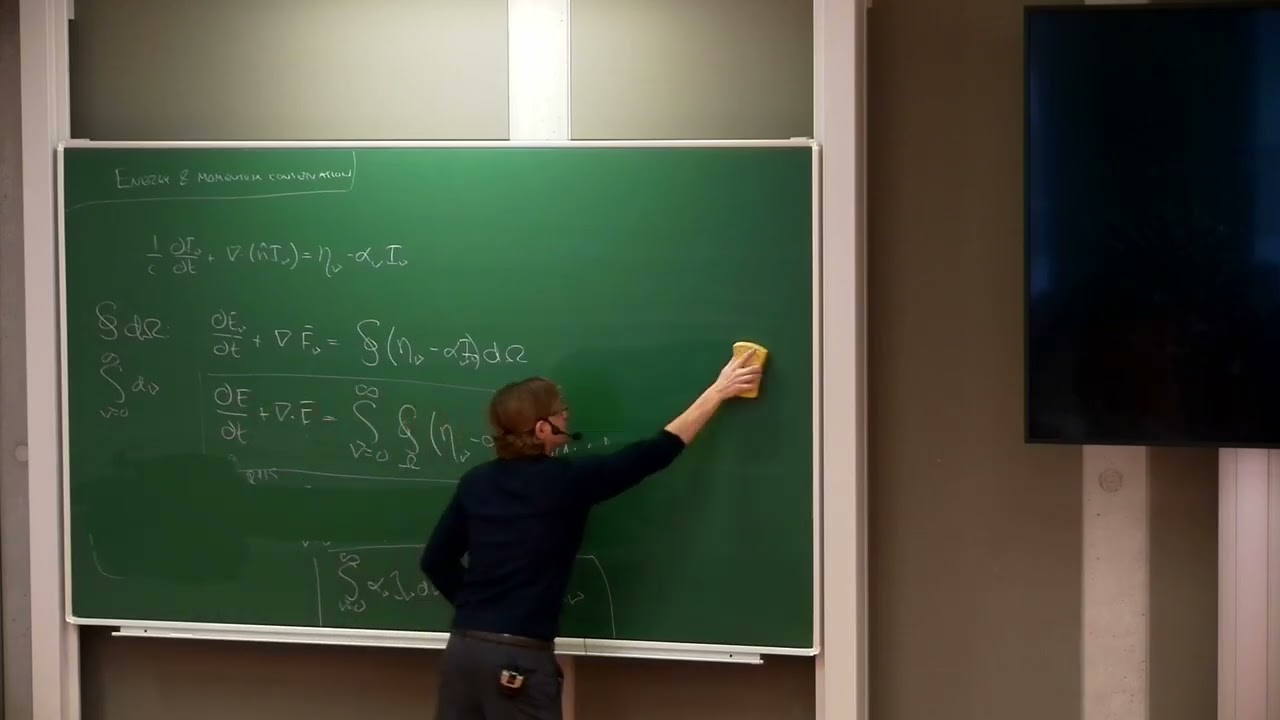
Radiation Processes in Astronomy: L7 - Radiative equilibrium, heating and cooling, force, wave eqn
Keywords
Summary
156 words
Critical Evaluation
Value of the Information & Strength of the Argument
The lecture provides a solid derivation of the energy and momentum conservation equations from the radiative transfer equation, with clear physical interpretations. The argumentation is coherent, building on previous lectures and connecting to real astrophysical phenomena. The instructor demonstrates the utility of these equations through examples like radiative equilibrium in stellar atmospheres and optically thin cooling in galaxy formation, highlighting their importance. The derivation of the radiation force and its role in the Eddington limit is particularly valuable, as it ties together fundamental physics with observable consequences. The lecture also includes a unit analysis to verify the correctness of the radiation acceleration expression, showing attention to detail. Overall, the content is well-structured and provides a strong foundation for understanding radiation processes in astrophysics.
Scientific Rigor, Source Quality, Title Accuracy
The lecture is scientifically rigorous, with derivations based on standard radiative transfer theory. The instructor references the course book and lecture notes, and the content aligns with established astrophysics literature. The title accurately reflects the content, covering radiative equilibrium, heating and cooling, radiation force, and the wave equation. The lecture is part of a structured course, and the instructor encourages feedback and corrections, indicating a commitment to accuracy. No external sources are cited beyond the course materials, but the derivations are self-contained and consistent with known physics. The adéquation between title and content is excellent.
233 words
Title / Content Match
The title accurately describes the content: the lecture covers radiative equilibrium, heating and cooling, radiation force, and the wave equation in the context of radiation processes in astronomy.
Quality & Reliability
8/10
The lecture is delivered by a professor in astrophysics, presenting derivations and physical concepts with mathematical rigor. The content is consistent with standard astrophysics textbooks and the instructor demonstrates unit checks and acknowledges errors, indicating a careful approach. However, as a live lecture, it may contain minor unedited slips, but overall it is reliable for educational purposes.
Key Moments
Markers derived by PSI from the transcript: the creator did not define chapters.
- Introduction and overview of the lecture topics.
- Derivation of the energy equation for the radiation field.
- Definition of radiative equilibrium and its physical meaning.
- Application to temperature structure in stars and accretion discs.
- Discussion of optically thin radiative cooling in galaxy formation and solar corona.
- Derivation of flux constancy and connection to Eddington-Barbier approximation.
- Derivation of the momentum equation and radiation force.
- Unit analysis of radiation acceleration and discussion of Eddington limit.
- Vacuum limit and derivation of wave equations for the radiation field.
- Summary and connection to upcoming topics.
Cited Sources
- Research projects - Equation folder — Mentioned as a link to the lecturer's research group's projects.
- Radiation Processes in Astronomy - Playlist — Link to the full course playlist.
Concurring Sources
- Radiative Processes in Astrophysics — Standard reference for radiative transfer and related concepts.
- Eddington luminosity — Concept discussed in the lecture regarding radiation force and stellar mass limits.
Contribution & Novelties
This lecture provides a clear and rigorous derivation of the energy and momentum conservation equations for the radiation field, emphasizing their physical interpretation and applications. It bridges theoretical derivations with practical astrophysical examples, such as radiative equilibrium in stellar atmospheres and optically thin cooling in galaxy formation. The lecture also highlights the importance of radiation force in extreme environments like accretion discs and massive stars, setting the stage for the Eddington limit. The pedagogical approach, with iterative methods for temperature structure and unit checks, adds educational value.
Pour aller plus loin :
- Radiative transfer — Provides background on the fundamental equation and its applications.
- Eddington luminosity — Directly related to the radiation force and stellar mass limits.
- Limb darkening — Phenomenon explained using the Eddington-Barbier approximation.
- Solar corona — Context for optically thin radiative cooling.
135 words
Radar Profile
The radar profile shows high scores in quantity and quality of information, with a moderate technical level, indicating a lecture that is dense but accessible to students with some background. The reliability is high, reflecting the instructor's expertise and careful derivations.
💬 No comments were provided for analysis.