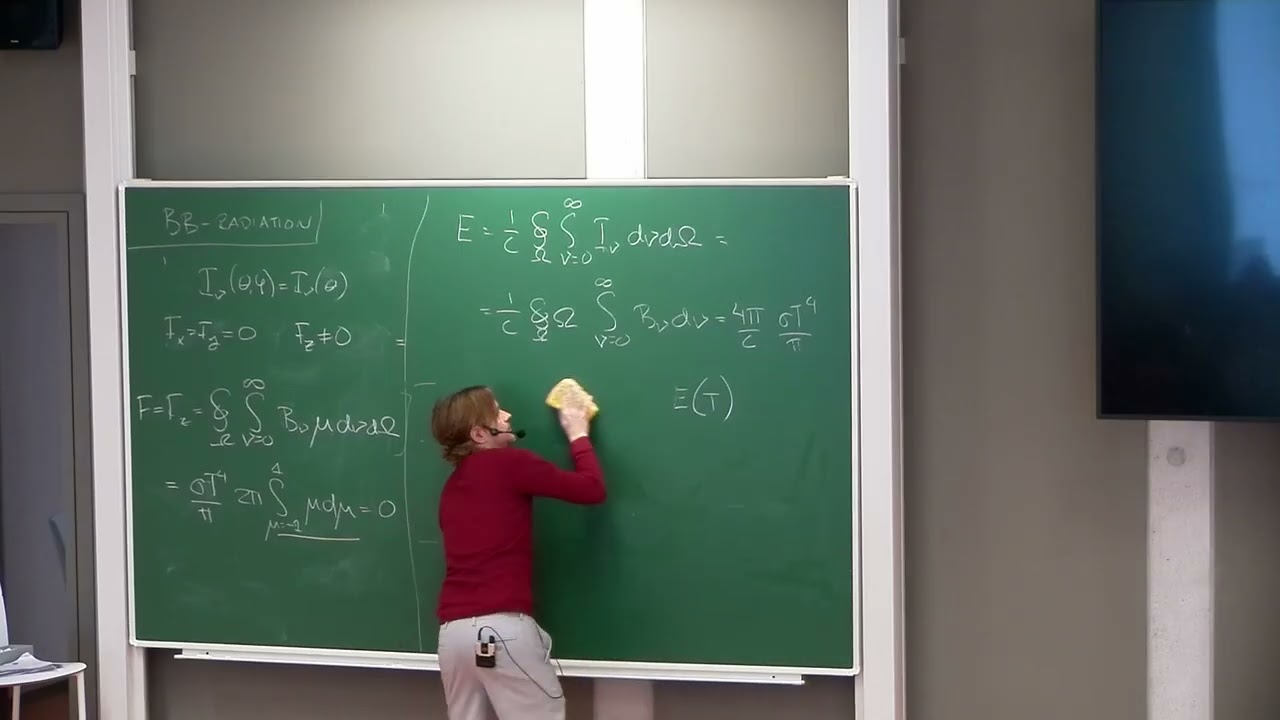
Radiation Processes in Astronomy: L4a - Blackbody Radiation II (including definition Teff)
Keywords
Summary
139 words
Critical Evaluation
Value of the Information & Strength of the Argument
The lecture provides a clear and rigorous derivation of key blackbody radiation properties, emphasizing the distinction between isotropic and surface emission. The argumentation is logical and builds on previous lectures, with mathematical steps shown in detail. The use of examples (stars, accretion disks) illustrates the practical relevance of the concepts. The instructor also highlights common pitfalls, such as the zero flux from an isotropic field, which aids understanding.
Scientific Rigor, Source Quality, Title Accuracy
The scientific rigor is high, as the content is standard astrophysics and the derivations are accurate. The lecture does not cite external sources, but it is part of a university course, and the material is well-established. The title accurately reflects the content, focusing on blackbody radiation and the definition of effective temperature. No comments were provided for analysis.
141 words
Title / Content Match
The title accurately reflects the content: the lecture covers blackbody radiation properties, integrated quantities, and the definition of effective temperature.
Quality & Reliability
8/10
Lecture by a professor at KU Leuven, part of a formal course. Content is mathematically rigorous and based on established physics. No citations to external sources, but the material is standard and accurate.
Key Moments
Markers derived by PSI from the transcript: the creator did not define chapters.
- Introduction and recap of previous lecture on blackbody radiation.
- Derivation of the integrated Planck function and Stefan-Boltzmann law.
- Connection to energy density and the radiation constant.
- Discussion of the Rayleigh-Jeans limit and ultraviolet catastrophe.
- Derivation of flux from blackbody radiation, showing it is zero for isotropic field.
- Derivation of radiation pressure and its relation to energy density.
- Introduction to effective temperature and its definition from surface flux.
- Application to stars: effective temperature and optical depth of 2/3.
- Application to accretion disks and luminosity expressions.
- Preview of optical depth and the photosphere of the universe.
Cited Sources
- Equation folder - KU Leuven — Link to the lecturer's research group page, mentioned in the description.
- Radiation Processes in Astronomy playlist — Playlist containing all lectures of the course.
Concurring Sources
- Rybicki & Lightman, Radiative Processes in Astrophysics — Standard textbook covering blackbody radiation and radiative transfer.
Contribution & Novelties
The lecture provides a clear pedagogical explanation of blackbody radiation integrated properties and the definition of effective temperature, emphasizing the distinction between isotropic and surface emission. It bridges theoretical derivations with practical astrophysical applications.
Pour aller plus loin :
- Stefan-Boltzmann law — Fundamental law derived in the lecture.
- Effective temperature — Definition and application in stellar astrophysics.
- Optical depth — Key concept introduced at the end, relevant to radiative transfer.
70 words
Radar Profile
The radar profile shows high scores across all dimensions, indicating a well-balanced and reliable educational resource. The lecture is technically deep, information-dense, and scientifically accurate, making it suitable for advanced students.