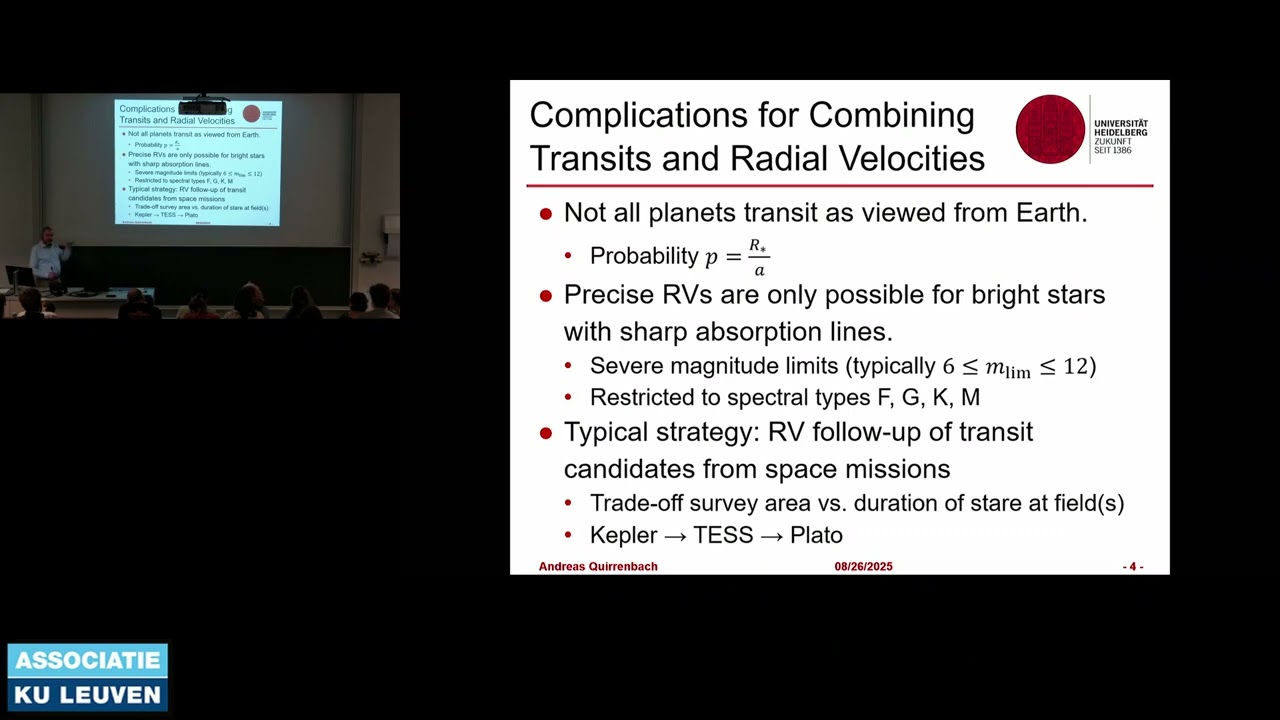
IvS Seminar: Andreas Quirrenbach (26/08/2025)
Keywords
Summary
245 words
Critical Evaluation
Value of the Information & Strength of the Argument
The seminar provides valuable insights into the practical aspects of exoplanet detection around M dwarfs, combining theoretical principles with hands-on experience from the CARMENES project. The argumentation is solid, grounded in well-established physics and observational techniques. The speaker clearly explains the trade-offs between different detection methods and the challenges of achieving high precision. He also presents unexpected results, such as the better performance of the visible spectrograph, which adds credibility. The discussion of stellar activity as a source of false signals is particularly informative. The talk is not merely a literature review but offers original perspectives from a leading practitioner.
Scientific Rigor, Source Quality, Title Accuracy
The seminar is scientifically rigorous, with clear explanations of the underlying physics and instrumentation. The speaker references established methods and missions (Kepler, TESS, PLATO) and presents results from his own project (CARMENES). However, specific sources are not cited in the talk, and the description provides no links. The title accurately reflects the content. The speaker’s expertise and the technical detail lend credibility, but the lack of explicit citations limits the ability to verify specific claims. The talk is an expert opinion based on extensive experience, rather than a formal literature review.
206 words
Title / Content Match
The title accurately reflects the content: a seminar by Andreas Quirrenbach on terrestrial planets orbiting low-mass stars, including instrumental aspects.
Quality & Reliability
8/10
The speaker is a recognized expert in exoplanet detection and instrumentation, with a long career in the field. The seminar presents a coherent overview of methods and results, grounded in established scientific principles. However, it is a seminar talk, not a peer-reviewed publication, and some claims are based on personal experience and ongoing research.
Key Moments
Markers derived by PSI from the transcript: the creator did not define chapters.
- Introduction by host, brief bio of Andreas Quirrenbach.
- Overview of radial velocity method and its observable (planet mass).
- Overview of transit photometry and its observable (planet radius).
- Discussion of combining methods for density and surface gravity.
- Advantages of M dwarfs: deeper transits and larger RV signals.
- Habitable zones of M dwarfs: short periods and ground-based feasibility.
- Challenges: UV flux and atmospheric erosion.
- Introduction to CARMENES instrument and its design.
- Explanation of echelle spectrograph and image slicer.
- Results: visible vs. near-infrared performance and Teegarden's Star planets.
Contribution & Novelties
The seminar provides an insider’s perspective on the CARMENES project, including design choices, unexpected performance findings, and the discovery of Earth-mass planets around Teegarden’s Star. It highlights the practical challenges of achieving high-precision radial velocities and the importance of wide wavelength coverage for mitigating stellar activity. The talk contributes to the ongoing discussion on the habitability of M dwarf planets by emphasizing the need for detailed characterization.
Pour aller plus loin :
- CARMENES instrument page — Official project website with details on the instrument and survey.
- Teegarden’s Star on Wikipedia — Overview of the star and its planetary system.
- Exoplanet habitability on Wikipedia — Discussion of the potential habitability of planets around red dwarfs.
114 words
Radar Profile
The radar profile shows high scores in information quantity, quality, and technical level, with a slightly lower but still high score in global reliability. This indicates a technically dense and informative seminar from an expert, with minor caveats regarding source citation.