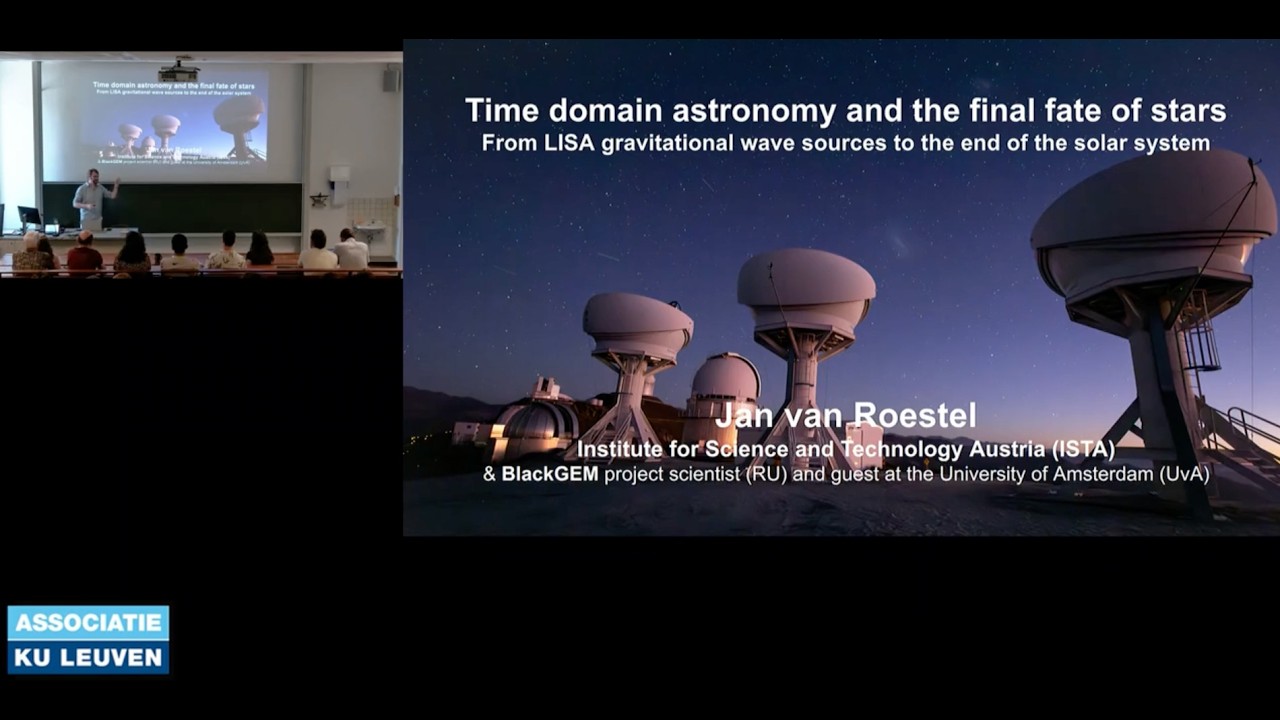
IvS Seminar: Jan van Roestel (28/5/2026)
Keywords
Summary
155 words
Critical Evaluation
Value of the Information & Strength of the Argument
The seminar provides valuable insights into the current state of time-domain astronomy and the BlackGEM project, offering technical details and early results. The argumentation is solid, based on the speaker’s direct involvement in the project and his research on white dwarfs. He effectively connects the capabilities of BlackGEM to specific scientific questions, such as the detection of kilonovae and the study of white dwarf binaries. The presentation is well-structured, moving from instrumentation to science cases, and includes concrete examples and data. However, as a seminar, it does not provide in-depth analysis or peer-reviewed conclusions, but rather an overview of ongoing work.
Scientific Rigor, Source Quality, Title Accuracy
The speaker is a recognized expert, and the content is consistent with established knowledge in the field. He references specific projects and results, such as the BlackGEM telescope, LIGO/Virgo, and the Zwicky Transient Facility, but does not cite specific publications in the talk. The title accurately reflects the content, which is a combination of time-domain astronomy and the fate of stars, with a focus on white dwarfs. The seminar is aimed at an academic audience, and the technical level is appropriate. No comments were provided for analysis.
203 words
Title / Content Match
The title accurately reflects the content, focusing on time-domain astronomy and the fate of stars, with a specific emphasis on white dwarfs and the solar system's future.
Quality & Reliability
8/10
The seminar is delivered by an expert researcher (project scientist for BlackGEM) and presents technical details and results from ongoing projects. The content is consistent with current knowledge in time-domain astronomy and white dwarf research, though it is a seminar rather than a peer-reviewed publication.
Key Moments
Markers derived by PSI from the transcript: the creator did not define chapters.
- Introduction to the seminar and speaker's background.
- Overview of optical time-domain astronomy and BlackGEM array.
- Technical details of BlackGEM telescopes and filters.
- Data processing and databases for BlackGEM.
- Main science driver: kilonova follow-up and gravitational wave alerts.
- Example of supernova detection and progenitor constraints.
- Introduction to white dwarf binaries and their formation.
- White dwarf binaries as LISA sources and exoplanet searches.
- Future surveys and conclusion.
Cited Sources
- BlackGEM website — Mentioned as the project's official site for information and data access.
- LIGO/Virgo/KAGRA — Referenced as the gravitational wave detectors that trigger BlackGEM observations.
Concurring Sources
- BlackGEM website — Official project page confirming the telescope's capabilities and goals.
- LIGO/Virgo/KAGRA — Gravitational wave observatories that provide alerts for kilonova searches.
Contribution & Novelties
The seminar provides an update on the BlackGEM project and its early results, particularly in the context of time-domain astronomy and white dwarf research. It highlights the unique capabilities of BlackGEM, such as its rapid response and multicolor observations, and discusses the potential for discovering exoplanets around white dwarfs, which could inform the fate of the solar system.
Pour aller plus loin :
- White dwarf — Background on white dwarfs, the most common stellar remnants.
- LISA (Laser Interferometer Space Antenna) — Space-based gravitational wave observatory expected to detect double white dwarf binaries.
- Kilonova — The optical counterpart to neutron star mergers, a key target for BlackGEM.
106 words
Radar Profile
The radar profile shows high scores in information quantity, quality, and reliability, with a slightly lower technical level, indicating a well-balanced seminar that is accessible yet informative.