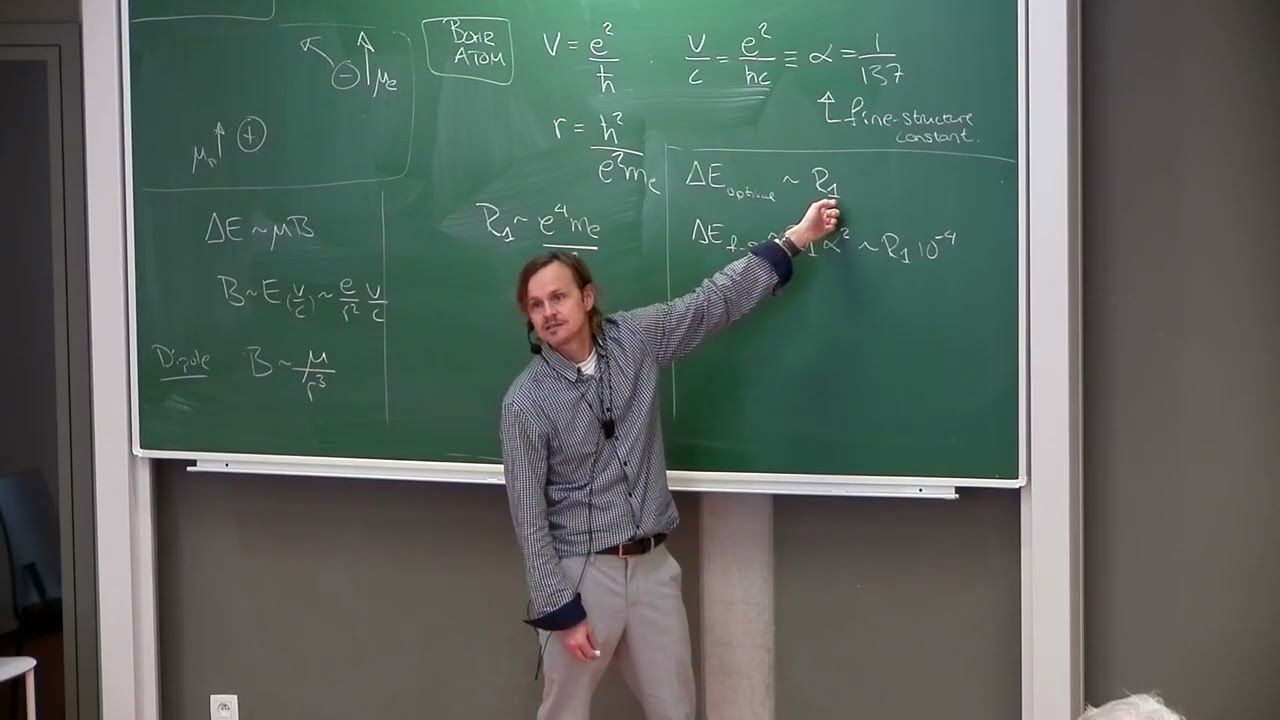
Radiative Processes in Astronomy: L12b - Estimate life times of optical and 21cm (hyperfine str) H
Keywords
Summary
163 words
Critical Evaluation
Value of the Information & Strength of the Argument
The lecture provides valuable insights into the physical reasoning behind atomic transition lifetimes and their astronomical significance. The argumentation is solid, based on well-established physics principles (Larmor formula, Bohr model, fine structure constant). The lecturer clearly explains the scaling arguments and acknowledges the approximations involved, which strengthens the credibility. The application to dark matter is well-motivated and connects the theoretical estimates to a major astronomical observation.
Scientific Rigor, Source Quality, Title Accuracy
The scientific rigor is high for a lecture: the derivations are transparent, and the lecturer explicitly states the limitations of the order-of-magnitude approach. The sources are not explicitly cited within the lecture, but the content is standard physics. The title accurately reflects the content. The description provides links to the course playlist and research group, which are relevant for further study.
142 words
Title / Content Match
The title accurately describes the content: the lecture focuses on estimating lifetimes of optical and 21cm hydrogen transitions, with a brief application to dark matter.
Quality & Reliability
8/10
The lecture is a formal academic presentation by a professor, using semi-classical derivations and order-of-magnitude estimates. The content is consistent with established physics, and the lecturer explicitly notes the approximate nature of the calculations. The video is unedited, which adds authenticity but also includes minor imprecisions in speech.
Key Moments
Markers derived by PSI from the transcript: the creator did not define chapters.
- Introduction to the lecture and the goal: estimating lifetimes of optical and 21cm hydrogen transitions.
- Semi-classical derivation of the scaling for hyperfine splitting energy, introducing the fine structure constant.
- Derivation of the scaling for the 21cm line energy, showing it is ~1e-7 times optical energies.
- Estimation of the Lyman-alpha lifetime using the Larmor formula, obtaining ~2e-9 seconds.
- Scaling to the 21cm line lifetime, obtaining ~6 million years, and comparison to the actual value.
- Discussion of the importance of the 21cm line for astronomy, including mapping neutral hydrogen and the early universe.
- Application to galaxy rotation curves: how 21cm observations reveal flat rotation curves, indicating dark matter.
- Conclusion summarizing the key points and the significance of the 21cm line for dark matter evidence.
Cited Sources
- Course Playlist: Radiation Processes in Astronomy — Link to the full course playlist for further lectures.
- Research Group Page — Link to the lecturer's research group page for more information.
Concurring Sources
- Wikipedia: Hydrogen line — Confirms the 21cm line's role in astronomy and its lifetime.
- Wikipedia: Galaxy rotation curve — Confirms the use of 21cm observations to infer dark matter.
Contribution & Novelties
The lecture provides a clear pedagogical derivation of the lifetimes of hydrogen transitions, particularly the 21cm line, using simple scaling arguments. It bridges theoretical physics and observational astronomy, showing how the long lifetime of the 21cm line makes it a powerful tool for studying the universe. The application to dark matter is a classic example, but the lecture’s contribution lies in the intuitive explanation of why the line is so weak yet so important.
Pour aller plus loin :
- Fine structure — Background on fine structure splitting.
- Hyperfine structure — Detailed explanation of hyperfine splitting.
- 21 cm line — Overview of the 21cm line and its astronomical uses.
- Galaxy rotation curve — Explanation of rotation curves and dark matter evidence.
120 words
Radar Profile
The radar profile shows high scores across all dimensions, indicating a well-rounded and reliable educational content. The slightly lower score in 'quantite_information' reflects the lecture's focused scope, but the quality and technical depth are strong.