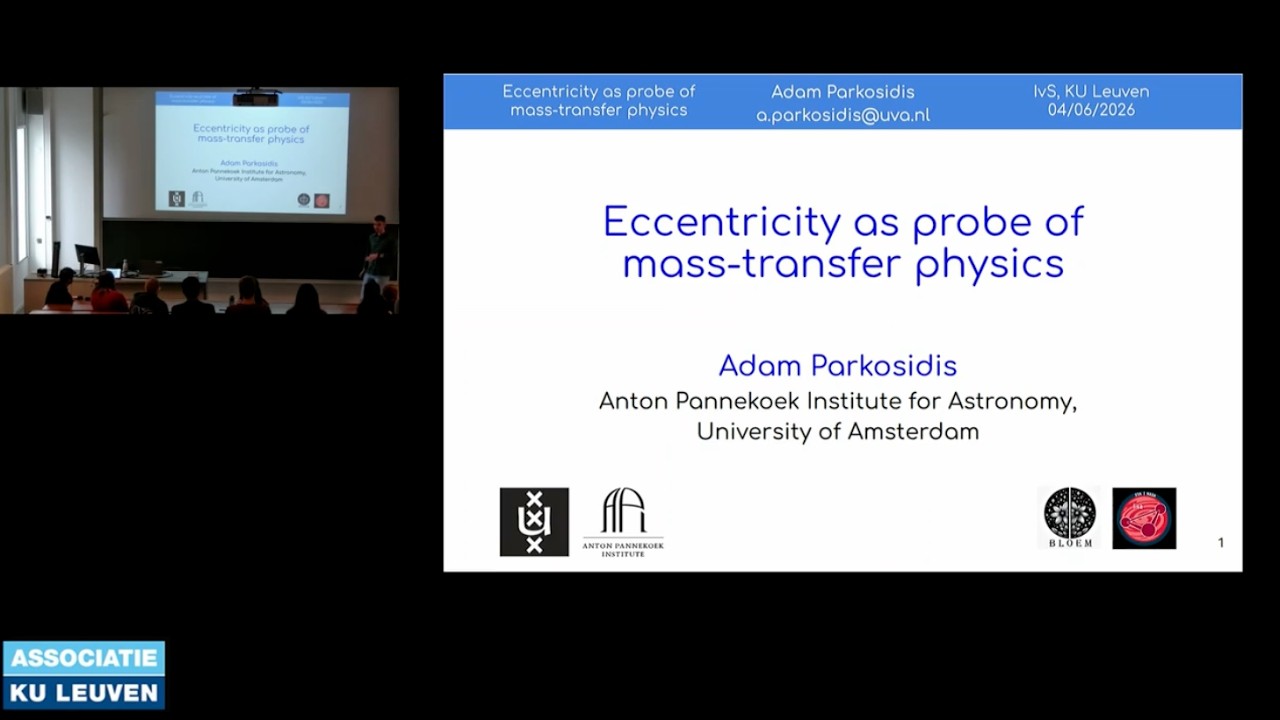
Eccentricity as probe of mass-transfer physics
Keywords
Summary
178 words
Critical Evaluation
Value of the Information & Strength of the Argument
The presentation provides a comprehensive overview of the eccentricity problem and evaluates existing mechanisms critically, highlighting their shortcomings. The introduction of the GeMT model is a valuable contribution, offering a new framework that can be tested against observations. The argumentation is logical and well-supported by examples and comparisons with observational data. The speaker effectively demonstrates the importance of considering eccentric orbits in binary evolution, which has implications for gravitational wave predictions and other astrophysical phenomena.
Scientific Rigor, Source Quality, Title Accuracy
The talk is scientifically rigorous, with clear definitions and references to relevant literature. The speaker cites specific mechanisms and studies, and the model is compared to observational data from surveys like Gaia. The title accurately reflects the content, focusing on eccentricity as a probe of mass-transfer physics. The presentation is well-structured and the reasoning is transparent, though as a seminar, it may not include all details of the model’s derivation.
160 words
Title / Content Match
The title accurately reflects the content, focusing on using eccentricity as a diagnostic for mass-transfer physics.
Quality & Reliability
8/10
Presentation of a new semi-analytic model (GeMT) with comparisons to observations, based on established binary evolution theory. The speaker is a PhD candidate presenting his own research, which is typical for a seminar. The content is technically sound and well-structured, but as a seminar, it may not have undergone full peer review.
Key Moments
Markers derived by PSI from the transcript: the creator did not define chapters.
- Introduction: importance of binaries and their interactions.
- Observational evidence: eccentric post-mass-transfer systems and the eccentricity problem.
- Review of eccentricity-pumping mechanisms and their limitations.
- Introduction of the GeMT model and its predictions for orbital evolution.
- Comparison with observations of wide SDB binaries.
- Implications for gravitational wave sources and conclusions.
Cited Sources
- Gaia Data Release 3: Summary of the content and survey properties — Mentioned as a survey that revealed many eccentric post-interaction binaries.
- TESS: Transiting Exoplanet Survey Satellite — Mentioned as a survey that contributed to the census of binaries.
- LISA: Laser Interferometer Space Antenna — Mentioned as a future mission for gravitational wave detection.
- Zwicky Transient Facility (ZTF) — Mentioned for its high supernova discovery rate.
- LSST: Legacy Survey of Space and Time — Mentioned as a future survey that will increase supernova discoveries.
Concurring Sources
- Gaia Data Release 3: Summary of the content and survey properties — Observational evidence of many eccentric post-interaction binaries.
Dissenting Sources
- Classical binary population synthesis models — These models assume instantaneous circularization and predict circular post-mass-transfer orbits, conflicting with observations.
Contribution & Novelties
The seminar presents a novel semi-analytic model (GeMT) for the secular orbital evolution of mass-transferring binaries with eccentric orbits, addressing a long-standing discrepancy between theory and observations. The model naturally produces eccentric post-mass-transfer systems and explains the observed trend of higher eccentricities at longer orbital periods. This provides a new tool to constrain mass-transfer physics and has implications for binary population synthesis and gravitational wave predictions.
Pour aller plus loin :
- Roche lobe — Fundamental concept in binary mass transfer.
- Lidov-Kozai mechanism — A mechanism for eccentricity excitation in hierarchical triples.
- Common envelope evolution — Another important binary interaction phase.
- Subdwarf B stars — The observed population used for comparison.
110 words
Radar Profile
The radar profile shows a balanced performance across all dimensions, with slightly lower scores in 'quantite_information' and 'qualite_information' compared to 'niveau_technique' and 'fiabilite_globale'. This indicates a technically rigorous presentation with a good amount of information, though the depth of detail may be limited by the seminar format.
💬 No comments were provided for analysis.