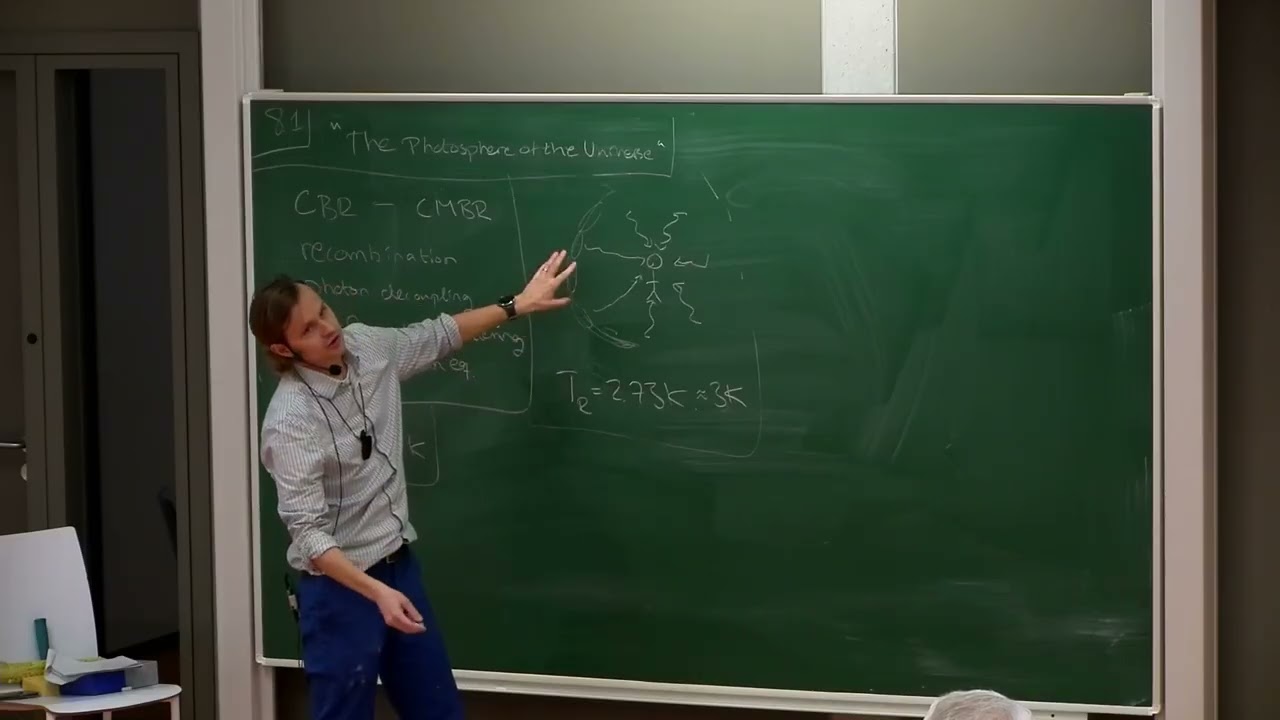
Radiative Processes in Astronomy: L13b - Cosmic Background Radiation I, Era of Recombination
Keywords
Summary
207 words
Critical Evaluation
Value of the Information & Strength of the Argument
The lecture provides a clear and rigorous derivation of the era of recombination using the Saha equation and blackbody radiation concepts. The argumentation is solid, building step-by-step from basic principles to the final result. The professor highlights the key insight that the high photon-to-baryon ratio in the universe allows ionization to occur at lower temperatures than in stellar atmospheres. He also contrasts the universe’s conditions with everyday air to illustrate the vast difference in photon-to-baryon ratios. The lecture is valuable for understanding the physics behind the CMB and the conditions of the early universe.
Scientific Rigor, Source Quality, Title Accuracy
The lecture is scientifically rigorous, based on established physics and standard derivations. The professor references the Saha equation and blackbody radiation, which are well-known. However, no external sources are cited, and the lecture relies on the course material. The title accurately reflects the content, focusing on radiative processes and the cosmic background radiation. The lecture is part of a university course, indicating a high level of academic rigor.
177 words
Title / Content Match
The title accurately reflects the content: a lecture on radiative processes applied to cosmic background radiation, focusing on the era of recombination.
Quality & Reliability
8/10
Lecture by a university professor, based on established physics (Saha equation, blackbody radiation), with clear derivations and references to course material. No citations to external sources, but the content is standard and rigorous.
Key Moments
Markers derived by PSI from the transcript: the creator did not define chapters.
- Introduction to the lecture topic: computing the photosphere of the universe, i.e., the cosmic background radiation.
- Explanation of the cosmic microwave background as a perfect blackbody at 2.73 K, discovered by Penzias and Wilson.
- Discussion of the surface of last scattering and the era of recombination.
- Introduction to the concept of optical depth and Thomson scattering as the main opacity source.
- Estimation of the photon-to-baryon ratio in the universe, finding it to be about 10^9.
- Comparison with the photon-to-baryon ratio in air in a room, showing it is about 10^-12.
- Derivation of the number of photons with energy above the ionization potential using the Wien tail.
- Calculation showing that ionization can occur at around 5,000 K due to the high photon-to-baryon ratio.
- Introduction of the Saha equation for a hydrogen-only universe.
- Derivation of the ionization fraction as a function of temperature and baryon density.
Cited Sources
- Course playlist: Radiation Processes in Astronomy — The lecture is part of this course playlist.
- Research group website — Mentioned as a link to the lecturer's research group.
Concurring Sources
- Cosmic microwave background — General reference for the CMB.
- Saha ionization equation — The equation used in the lecture.
Contribution & Novelties
The lecture provides a clear pedagogical derivation of the era of recombination using the Saha equation and blackbody radiation, emphasizing the role of the photon-to-baryon ratio. It offers a novel perspective by contrasting the universe’s conditions with everyday air and stellar atmospheres.
Pour aller plus loin :
- Cosmic microwave background — Overview of the CMB and its significance.
- Saha ionization equation — Derivation and applications.
- Recombination (cosmology) — Detailed explanation of the recombination epoch.
74 words
Radar Profile
The radar profile shows high scores across all dimensions, indicating a well-balanced and rigorous lecture. The quantity and quality of information are strong, with a high technical level and reliable content.
💬 Sur les 2 commentaires analysés, les tendances montrent une appréciation positive de la clarté et de la pédagogie du professeur.