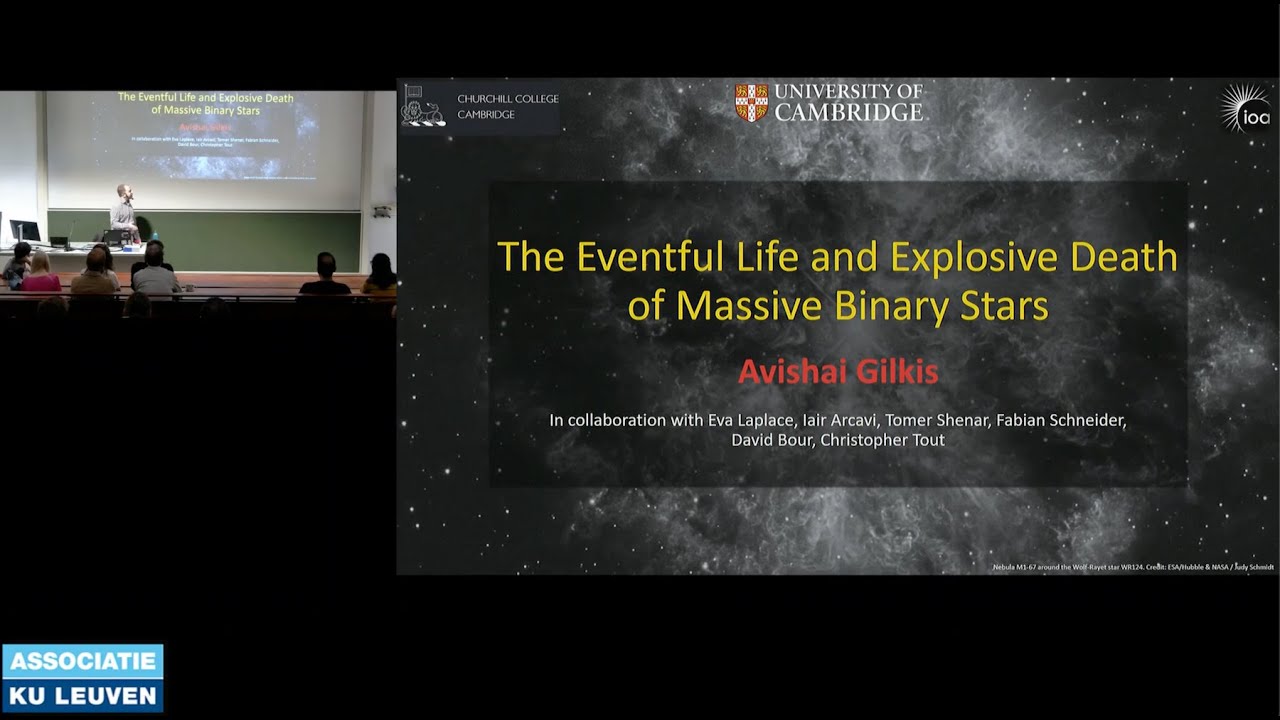
IvS Seminar: Avishai Gilkis (02/10/2025)
Keywords
Summary
223 words
Critical Evaluation
Value of the Information & Strength of the Argument
The talk provides valuable insights into the current understanding of massive binary star evolution and supernova progenitors. The speaker effectively combines theoretical models with observational data, presenting a coherent narrative that highlights the importance of binary interactions. He supports his arguments with specific examples, such as SN 1987A, SN 1993J, and the Type Ib progenitor, and uses his own simulations to illustrate the diversity of possible outcomes. The argumentation is solid, though some points are presented as ongoing research with uncertainties, which is appropriate for a seminar.
Scientific Rigor, Source Quality, Title Accuracy
The talk demonstrates scientific rigor by referencing well-established theories and recent observational results. The speaker mentions specific studies and collaborations, and the content aligns with current astrophysical literature. The title accurately reflects the content, and the presentation is well-structured. The speaker does not overstate conclusions and acknowledges uncertainties in areas like common envelope evolution and wind prescriptions. Overall, the scientific quality is high, and the title is appropriate.
170 words
Title / Content Match
The title accurately reflects the content, which focuses on the lives and explosive deaths of massive binary stars.
Quality & Reliability
8/10
The talk presents original research results from stellar evolution simulations, grounded in established astrophysical theory and supported by observational data. The speaker is an expert in the field, and the content is consistent with current scientific understanding. However, as a seminar, it may not undergo the same peer-review scrutiny as a published paper.
Key Moments
Markers derived by PSI from the transcript: the creator did not define chapters.
- Introduction to massive stars and their role as supernova progenitors.
- Discussion on the rarity of galactic supernovae and the importance of SN 1987A.
- Classification of supernovae and the role of binary interactions.
- Observational evidence for binary stripping: SN 1993J and Type Ib progenitors.
- Introduction to MESA and modeling binary evolution.
- Parameter space of stripped supernova progenitors and the role of winds.
- Case study of Omicron Sagittarii and its revised nature.
- Discussion on Wolf-Rayet stars as potential progenitors.
- Future prospects and the importance of binary evolution in supernova research.
Cited Sources
- MESA stellar evolution code — The speaker uses MESA for his simulations.
- Gaia mission — Mentioned for updated distances and potential discoveries.
Concurring Sources
- MESA stellar evolution code — The speaker uses MESA for his simulations.
- Gaia mission — Mentioned for updated distances and potential discoveries.
Contribution & Novelties
The talk presents recent results from detailed stellar evolution simulations that reveal short-lived phases where stripped stars may develop strong winds and masquerade as Wolf-Rayet stars just before exploding, providing a natural explanation for the diversity of stripped-envelope supernovae. It also highlights the importance of binary interactions in shaping stellar evolution and the need to consider them in supernova progenitor studies.
Pour aller plus loin :
- Stellar evolution — Overview of stellar life cycles.
- Binary star — Basics of binary systems.
- Supernova — General information on supernovae.
- Wolf-Rayet star — Details on Wolf-Rayet stars.
- MESA code — The stellar evolution code used.
102 words
Radar Profile
The radar profile shows high scores in information quantity, quality, and reliability, with a slightly lower technical level, indicating a well-balanced and accessible seminar for an academic audience.