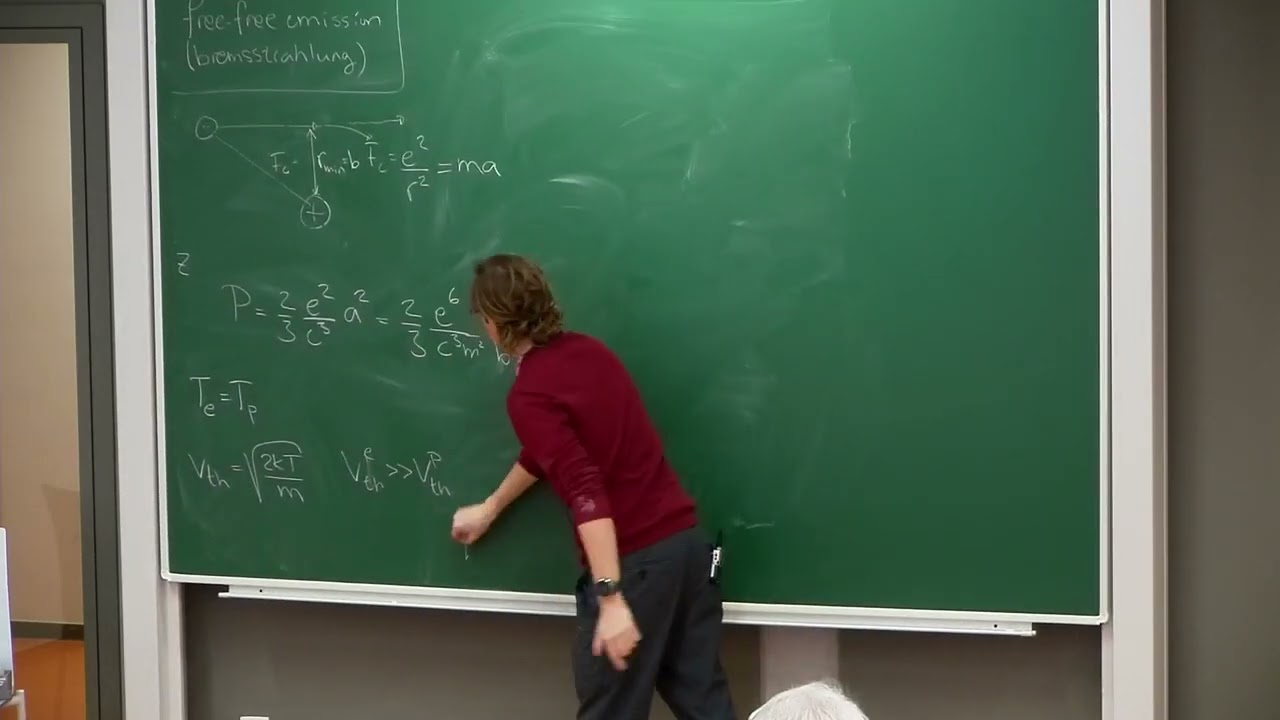
Radiative Processes in Astronomy: L16b - Thermal Bremsstrahlung
Keywords
Summary
185 words
Critical Evaluation
Value of the Information & Strength of the Argument
The lecture provides a thorough and rigorous derivation of thermal bremsstrahlung, building on previously established concepts in the course. The argumentation is logical and step-by-step, with clear explanations of approximations and their validity. The lecturer emphasizes the physical intuition behind each step, such as why the emitted power is independent of frequency in the classical limit. The application to real astrophysical objects (HII regions) demonstrates the practical value of the derived formulas. The presentation is engaging and interactive, with the lecturer encouraging questions and corrections.
Scientific Rigor, Source Quality, Title Accuracy
The scientific rigor is high: the derivation follows standard textbook treatments (e.g., Rybicki & Lightman). The lecturer explicitly notes the numerical factor discrepancy between the approximate and exact derivations, showing transparency. The sources cited are the course playlist and the lecturer’s research group page, which are appropriate for a lecture. The title accurately reflects the content. No comments were provided, so no analysis of public reception is possible.
168 words
Title / Content Match
The title accurately describes the content: a lecture on thermal bremsstrahlung, covering derivation, emission and absorption coefficients, and applications.
Quality & Reliability
9/10
Lecture by a professor at KU Leuven, part of a structured course. The derivation is rigorous, with clear assumptions and approximations. The content is consistent with standard astrophysics textbooks. The lecturer openly invites corrections, indicating a commitment to accuracy.
Key Moments
Markers derived by PSI from the transcript: the creator did not define chapters.
- Introduction to free-free processes and bremsstrahlung
- Physical picture: electron deflected by proton, emits radiation
- Derivation of emitted power per ion using Larmor formula
- Integration over impact parameter and frequency
- Averaging over Maxwellian velocity distribution
- Derivation of emission coefficient in cgs units
- Derivation of absorption coefficient via Kirchhoff's law
- Application to homogeneous cloud: emergent spectrum
- Explanation of spectral turnover and comparison to Orion Nebula
- Estimation of mass density from observed turnover frequency
Cited Sources
- Course Playlist: Radiation Processes in Astronomy — Playlist containing all lectures of the course, including this one.
- Research Group Page - KU Leuven — Link to the lecturer's research group, mentioned for further information.
Concurring Sources
- Radiative Processes in Astrophysics — Standard textbook that covers bremsstrahlung and radiative transfer, consistent with the lecture's content.
Contribution & Novelties
This lecture provides a clear and detailed derivation of thermal bremsstrahlung, bridging classical and quantum treatments. It emphasizes the physical reasoning behind the formulas and applies them to real astrophysical observations, enabling students to understand and use these concepts. The lecture is part of a comprehensive course, offering a structured learning path.
Pour aller plus loin :
- Bremsstrahlung - Wikipedia — Overview of the phenomenon, including quantum and relativistic aspects.
- Gaunt factor - Wikipedia — Explanation of the quantum correction factor mentioned in the lecture.
- H II region - Wikipedia — Context for the application to ionized nebulae.
- Radiative Processes in Astrophysics - Rybicki & Lightman — Standard textbook covering bremsstrahlung in more detail.
114 words
Radar Profile
The radar profile shows high scores across all dimensions, indicating a well-balanced and comprehensive lecture. The strong technical depth and rigorous derivation are complemented by clear explanations and practical applications, making it an excellent educational resource.